
What's inside
- Best Spotting Scope for Winter Birding Cold: Quick Comparison Table
- Why Winter Birding Cold Is Hard on a Spotting Scope
- Best Spotting Scope for Winter Birding Cold Reviewed
- Buying Guide: How to Choose the Best Spotting Scope for Winter Birding Cold
- How to Use a Spotting Scope in Winter Cold Without Fogging It
- Which Best Spotting Scope for Winter Birding Cold Should You Buy?
- Frequently Asked Questions About the Best Spotting Scope for Winter Birding Cold
As an Amazon Associate I earn from qualifying purchases. This post may contain affiliate links at no extra cost to you.
The best spotting scope for winter birding cold is the one that stays fog-free when you step from a warm car into freezing air, gathers enough light on short winter days, focuses smoothly while you are wearing gloves, and holds steady on a tripod in wind and snow. Winter birding is not the same as summer birding. The light is lower, the air is colder, the wind is stronger, and a scope that fogs, stiffens, or dims will cost you the bird you came to see.
For most winter birders, a spotting scope with a 65mm to 88mm objective lens, a magnification range of 20x to 60x, nitrogen purging for fogproofing, a waterproof housing, and long eye relief for glasses, is a good starting point. A larger objective helps in low winter light, while a 65mm scope is lighter to carry through snow. The right choice depends on how far you walk, how cold it gets where you bird, and how much you are willing to carry.
At sharpsightoptics.org, we focus on spotting scopes and optics. For this guide to the best spotting scope for winter birding cold in 2026, we compared current spotting scopes that are widely sold, designed for birding, and suitable for cold-weather use. We looked at magnification, objective size, weight, eye relief, close focus, fogproofing, and price. Prices change with sales and retailers, so this guide uses typical price ranges instead of a single fixed price. Magnification, weight, and eye relief figures are manufacturer listings, and real performance depends on your tripod, your weather, and your eyesight.
Cold-weather note: do not bring a warm scope straight into freezing air and expect it to stay clear. Let it cool gradually, keep lens caps on until it reaches outside temperature, and avoid breathing on the eyepiece. Dress for wind chill, take breaks indoors when needed, and follow local rules for access to winter birding sites.
Our Top Picks
Best Spotting Scope for Winter Birding Cold: Quick Comparison Table
The table below compares seven spotting scopes for winter birding cold, sorted by rating from high to low. Magnification is the zoom range, where given. Objective is the objective lens diameter, where given. Weight is the weight, where given. Eye relief is the eye relief, where given. Best for is a note on what the scope is best for, such as winter birding cold, where given. Price is the typical range, and rating is our editorial score based on low-light brightness, fog resistance, cold-weather handling, and value for winter birding.
| Spotting Scope for Winter Birding Cold | Magnification | Objective | Weight | Eye Relief | Best For | Typical Price Range | Our Rating |
|---|---|---|---|---|---|---|---|
| Swarovski ATS 65 HD Spotting Scope | 25-50x | 65mm | 49.6 oz | 17mm | Best overall, winter birding cold | $2,300 – $3,100 | 4.9 / 5 |
| Kowa TSN-883 Prominar Spotting Scope | 25-60x | 88mm | About 65 oz with eyepiece | 17mm | Best for Kowa, TSN-883 | $2,800 – $4,000 | 4.8 / 5 |
| Leupold SX-5 Santiam HD 27-55×80 Spotting Scope | 27-55x | 80mm | 68.7 oz | 16.6-19.2mm | Best for Leupold, SX-5 Santiam | $1,600 – $1,800 | 4.7 / 5 |
| Vortex Razor HD 22-48×65 Angled Spotting Scope | 22-48x | 65mm | 56.8 oz | 17-16.7mm | Best for Vortex, Razor HD 65 | $1,100 – $1,300 | 4.6 / 5 |
| Vortex Viper HD 20-60×85 Spotting Scope | 20-60x | 85mm | About 59 oz | About 18mm | Best for Vortex, Viper HD 85 | $800 – $1,000 | 4.5 / 5 |
| Celestron Regal M2 80ED Spotting Scope | 20-60x | 80mm | About 62 oz | About 18mm | Best for Celestron, Regal M2 80ED | $500 – $650 | 4.4 / 5 |
| Vortex Diamondback HD 20-60×85 Spotting Scope | 20-60x | 85mm | About 65 oz | About 18mm | Best budget, Diamondback HD 85 | $400 – $550 | 4.3 / 5 |

20-60x85 Spotting Scope with Full Size Tripod for Birding & Wildlife Falcon | With Phone Adapter and Cleaning Kit, 101-48 ft/1,000 yd FOV, BAK4, FMC, Waterproof & Fogproof, Fine Focus Control for Hunting
As an Amazon Associate we earn from qualifying purchases. Product prices and availability are accurate as of the date/time indicated.
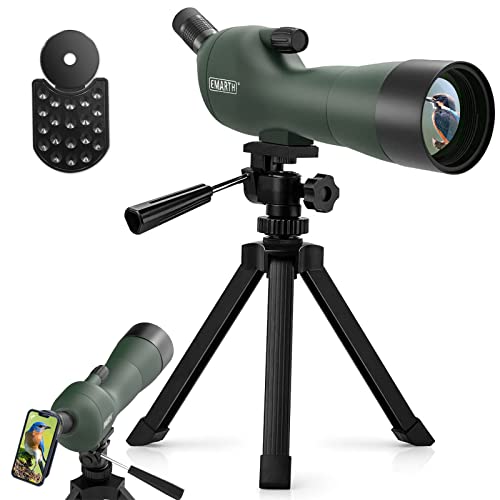
Emarth 20-60x60 Angled Spotting Scopes for Target Shooting/Hunting/Birding | 1.37lb light Spotting scope for Target Shooting w/Tripod 14" tabletop/Carry Bag, spotter scope for Hunting/Birding/Wildlife
As an Amazon Associate we earn from qualifying purchases. Product prices and availability are accurate as of the date/time indicated.

Celestron Ultima 22-66x100 Spotting Scope for Long-Range Viewing | Large Objective Lens, Long-Range Birding & Wildlife Viewing, Fully Multi-Coated, Smooth Focusing, Waterproof Construction
As an Amazon Associate we earn from qualifying purchases. Product prices and availability are accurate as of the date/time indicated.
Note: Magnification, weight, and eye relief figures are manufacturer listings. The Swarovski ATS 65 HD is listed with a 25-50x eyepiece, with a 20-60x eyepiece also available. The Kowa TSN-883 is listed with the TE-11WZ 25-60x eyepiece. Always check the scope’s magnification, objective size, and eyepiece in the manual, and confirm the current price with the retailer.
Why Winter Birding Cold Is Hard on a Spotting Scope
Winter birding cold is hard on a spotting scope for three reasons: fog, low light, and handling. Fog matters because a scope that is warm inside a car will fog when it meets cold air, and a scope that is not nitrogen purged can fog inside the lenses, where you cannot wipe it clean. A nitrogen-filled, waterproof scope resists internal fog, while a scope with good lens coatings resists external fog for longer.
Low light matters because winter days are short, the sun is low, and many winter birds are active at dawn and dusk. A larger objective, such as 80mm or 88mm, gathers more light than a 65mm objective, which helps at 20x to 30x in dim light. At 60x, the image will always be dimmer, because the same light is spread over a larger image, so winter birders often use lower magnification than they would in summer.
Handling matters because gloves make small focus knobs hard to turn, cold metal feels colder to touch, and a stiff tripod head is harder to move smoothly. A scope with a large, smooth focus ring, a rotating tripod collar, and rubber armour that stays grippy in the cold is easier to use in winter than a scope with a small, stiff focus wheel.
Best Spotting Scope for Winter Birding Cold Reviewed
1. Swarovski ATS 65 HD Spotting Scope – Best Spotting Scope for Winter Birding Cold Overall
The Swarovski ATS 65 HD Spotting Scope is our top pick because it offers a magnification of 25-50x with its 25-50x eyepiece, a 65mm objective, a weight of 49.6 ounces, a length of 14.6 inches, and eye relief of 17mm, for a typical price of $2,300 to $3,100 for the scope with an eyepiece. It is nitrogen filled, with submersion tightness to 13 feet, and a functional temperature range of -25 to +55 degrees C, or -13 to +131 degrees F, according to Swarovski.
Swarovski designs the ATS 65 HD with a focus on a lightweight, high-quality scope for birders who walk in winter. The 65mm objective is bright enough for winter daylight at 25x to 40x, the weight of 49.6 ounces is the lightest in this guide, and the cold-temperature rating is stated by the manufacturer, which is useful for winter birding. The HD glass reduces colour fringing, which helps when you are looking at a pale winter bird against snow or grey sky.
The main limitation is objective size. At 65mm, it gathers less light than an 80mm or 88mm scope at dawn, though it is easier to carry through snow. Choose the ATS 65 HD if you want the best overall scope for winter birding cold, you walk a long way in winter, and you have a budget of $2,300 to $3,100.
2. Kowa TSN-883 Prominar Spotting Scope – Best Spotting Scope for Winter Birding Cold for Kowa
The Kowa TSN-883 Prominar Spotting Scope is a scope with a magnification of 25-60x with the TE-11WZ eyepiece, an 88mm fluorite crystal objective, a body weight of 1520 grams, about 65 ounces with an eyepiece, and a close focus of 5.0 metres, or 16.4 feet, for a typical price of $2,800 to $4,000 with an eyepiece. It has dual focus, a magnesium alloy body, and a design that is made for birding and hunting.
Kowa designs the TSN-883 with a focus on a large, bright scope for low light. The 88mm fluorite objective gathers more light than a 65mm scope, which helps on short winter days, the dual focus lets you focus quickly and then fine-tune with gloves, and the 25-60x range is useful for distant winter waterfowl. The scope is a good choice for a birder who wants a Kowa scope, and who wants the brightest image in this guide.
The main limitation is weight and price. At about 65 ounces with an eyepiece and $2,800 to $4,000, it is heavier and more expensive than a Swarovski ATS 65 HD, though it offers more light. Choose the TSN-883 if you want a Kowa scope, you bird from a fixed point in winter, and you are willing to carry a heavier scope.
3. Leupold SX-5 Santiam HD 27-55×80 Spotting Scope – Best Spotting Scope for Winter Birding Cold for Leupold
The Leupold SX-5 Santiam HD 27-55×80 Spotting Scope is a scope with a magnification of 27-55x, an 80mm objective, a weight of 68.7 ounces, a length of 15 to 15.7 inches, eye relief of 16.6 to 19.2mm, a close focus of 11 feet, and a field of view of 105 to 73 feet at 1,000 yards, for a typical price of $1,600 to $1,800. It is waterproof and fogproof, with a nitrogen or argon fill, and it has an integrated Arca-Swiss compatible base.
Leupold designs the SX-5 Santiam HD with a focus on a bright, rugged scope for cold and wet field use. The 80mm objective is good for winter low light, the 27x low end is useful for scanning a winter marsh, and the long eye relief helps if you wear glasses in winter. The Arca-Swiss base makes it easy to mount on a tripod quickly, even with gloves. The scope is a good choice for a birder who wants a Leupold scope, and who wants an 80mm scope at a lower price than a Kowa or Swarovski 80mm scope.
The main limitation is weight. At 68.7 ounces, it is the heaviest scope in this guide, so it is best for car-based winter birding or a short walk, rather than a long hike through snow. Choose the SX-5 Santiam HD if you want a Leupold scope, you want an 80mm objective, and you have a budget of $1,600 to $1,800.
4. Vortex Razor HD 22-48×65 Angled Spotting Scope – Best Spotting Scope for Winter Birding Cold for Vortex Razor
The Vortex Razor HD 22-48×65 Angled Spotting Scope is a scope with a magnification of 22-48x, a 65mm objective, a weight of 56.8 ounces, a length of 14.8 inches, eye relief of 17 to 16.7mm, and a close focus of 26.2 feet, for a typical price of $1,100 to $1,300. It has HD glass, a triplet apochromatic lens system, and a design that is made for birding and hunting.
Vortex designs the Razor HD 65 with a focus on a compact, high-quality scope for birders who want good glass without the weight of an 85mm scope. The 22x low end gives a wide field of view for scanning winter flocks, the 65mm objective is bright enough for winter daylight, and the weight of 56.8 ounces is manageable in snow. The angled body is comfortable for long winter sessions, especially when you share the scope with birders of different heights. The scope is a good choice for a birder who wants a Vortex scope, and who wants a 65mm scope with premium glass.
The main limitation is magnification. At 48x maximum, it has less reach than a 20-60x scope, though 48x is often enough in winter, when heat haze is low and the air is clear. Choose the Razor HD 65 if you want a Vortex scope, you want a compact 65mm design, and you have a budget of $1,100 to $1,300.
5. Vortex Viper HD 20-60×85 Spotting Scope – Best Spotting Scope for Winter Birding Cold for Vortex Viper
The Vortex Viper HD 20-60×85 Spotting Scope is a scope with a magnification of 20-60x, an 85mm objective, a weight of about 59 ounces, and eye relief of about 18mm, for a typical price of $800 to $1,000. It has HD glass, a waterproof and fogproof housing, and a design that is made for birding and hunting.
Vortex designs the Viper HD 85 with a focus on a large-objective scope at a mid-range price for birders who want brightness in low winter light. The 85mm objective gathers more light than a 65mm scope, the 20x low end is useful for scanning, and the 60x high end helps with distant winter ducks and geese. The scope is a good choice for a birder who wants a Vortex scope with an 85mm objective, and who does not want to pay for a Razor HD.
The main limitation is optical quality at high magnification. At 60x in dim winter light, the image will be dimmer and softer than on a Razor HD or a Kowa TSN-883, so it is best used at 20x to 45x in winter. Choose the Viper HD 85 if you want a Vortex scope, you want an 85mm objective, and you have a budget of $800 to $1,000.
6. Celestron Regal M2 80ED Spotting Scope – Best Spotting Scope for Winter Birding Cold for Celestron
The Celestron Regal M2 80ED Spotting Scope is a scope with a magnification of 20-60x, an 80mm ED objective, a weight of about 62 ounces, and eye relief of about 18mm, for a typical price of $500 to $650. It has extra-low dispersion glass, a waterproof and fogproof housing, and a design that is made for birding.
Celestron designs the Regal M2 80ED with a focus on an affordable ED scope for birders who want good colour and brightness without a premium price. The 80mm ED objective helps reduce colour fringing on a bright winter bird against snow, the 20-60x range is versatile, and the price of $500 to $650 is good for an 80mm ED scope. The scope is a good choice for a birder who wants a Celestron scope, and who wants an 80mm scope on a budget.
The main limitation is build and handling in extreme cold. It is a good scope for typical winter birding, but its focus and zoom controls are less refined than on a premium scope, so test it with gloves before a long winter trip. Choose the Regal M2 80ED if you want a Celestron scope, you want an 80mm ED objective, and you have a budget of $500 to $650.
7. Vortex Diamondback HD 20-60×85 Spotting Scope – Best Budget Spotting Scope for Winter Birding Cold
The Vortex Diamondback HD 20-60×85 Spotting Scope is a scope with a magnification of 20-60x, an 85mm objective, a weight of about 65 ounces, and eye relief of about 18mm, for a typical price of $400 to $550. It has HD glass, a waterproof and fogproof housing, and a design that is made for birding and hunting on a budget.
Vortex designs the Diamondback HD 85 with a focus on a large-objective scope at the lowest price in this guide for birders who are starting winter birding. The 85mm objective is bright for its price, the 20x low end is useful for scanning, and the price of $400 to $550 makes it the most affordable way to get an 85mm scope for winter. The scope is a good choice for a birder who wants a Vortex scope, and who wants the lowest price for a large winter scope.
The main limitation is image quality at high magnification in low light. At 60x on a dull winter day, the image will be dimmer than on a Viper HD or Razor HD, so use it at 20x to 40x for the clearest winter views. Choose the Diamondback HD 85 if you want the lowest price for a winter spotting scope, you want an 85mm objective, and you have a budget of $400 to $550.
Buying Guide: How to Choose the Best Spotting Scope for Winter Birding Cold
Before you buy, think about how cold it gets where you bird, how far you walk, how much light you have, whether you wear glasses, and how much you want to spend. A scope that is perfect for a short walk from a car may not be best for a long hike through snow, and a scope that is perfect for bright winter sun may not be enough at dawn. The six points below cover the decisions that matter most for a spotting scope for winter birding cold.
1. Fogproofing: Nitrogen Purging, Waterproofing, and Your Winter Air
Fogproofing is the first decision. A spotting scope for winter birding cold should be waterproof and fogproof, with nitrogen purging, so moisture cannot get inside the lenses when the temperature changes. The Swarovski ATS 65 HD is nitrogen filled and submersion tight to 13 feet, while the Leupold SX-5 Santiam HD is waterproof and fogproof with a nitrogen or argon fill. Check the manufacturer’s waterproof and fogproof claims before you buy, and do not assume a scope is fogproof because it looks sealed.
Choose a nitrogen-purged scope if you bird in winter, you move between warm and cold air, or you bird in snow and rain. Let your scope cool gradually, keep lens caps on until it reaches outside temperature, and wipe the outside lenses with a soft, dry cloth, not your glove, which can scratch the coating.
2. Objective Size: 65mm vs 80mm vs 88mm, and Your Winter Light
Objective size is the second decision. A 65mm objective, such as on the Swarovski ATS 65 HD or Vortex Razor HD 65, is lighter and easier to carry, and it is bright enough for winter daylight at 20x to 40x. An 80mm objective, such as on the Leupold SX-5 Santiam HD or Celestron Regal M2 80ED, gathers more light, which helps at dawn and dusk. An 88mm objective, such as on the Kowa TSN-883, gathers the most light, which helps in the dimmest winter light, but it is heavier.
Choose a 65mm scope if you walk a long way in snow, you want a light scope, and you bird mainly in daylight. Choose an 80mm scope if you want a good balance of brightness and weight, and you bird at dawn or dusk. Choose an 88mm scope if you want the brightest image, you bird from a fixed point, and you do not mind extra weight.
3. Magnification: 20x vs 27x vs 60x, and Your Winter Birds
Magnification is the third decision. A low magnification of 20x to 27x gives a wide field of view, a brighter image, and a steadier view in wind, which is useful for scanning winter flocks. A high magnification of 50x to 60x gives more detail, but the image is dimmer, narrower, and more affected by wind shake, which is common in winter.
Choose a scope with a 20x or 22x low end if you scan large areas, you bird in wind, or you want a bright image. Use 40x to 50x for detail, and save 60x for calm, bright winter days. A scope with a 27-55x range, such as the Leupold SX-5 Santiam HD, is a good compromise, because it starts higher than 20x, but it does not go as high as 60x, where winter images can dim.
4. Cold-Weather Handling: Focus, Gloves, and Your Tripod
Cold-weather handling is the fourth decision. A scope for winter birding cold should have a large, smooth focus knob that you can turn with gloves, a zoom ring that does not stiffen in the cold, and a rotating tripod collar that lets you share the scope without moving the tripod. The Kowa TSN-883 has dual focus, which helps with gloves, while the Swarovski ATS 65 HD has a smooth focus that is easy to use in winter.
Choose a scope with a large focus knob if you wear thick gloves, you bird in freezing weather, or you share your scope. Use a sturdy tripod with a fluid head, keep it low in wind, and do not touch the metal tripod legs with bare hands in extreme cold. Bring spare gloves, hand warmers, and a lens cloth that stays soft in the cold.
5. Eye Relief: Glasses, Eye Relief, and Your Winter Gear
Eye relief is the fifth decision. Eye relief is the distance from the eyepiece to your eye where you can see the full image, usually 16mm to 19mm for the scopes in this guide. If you wear glasses, you need long eye relief, so you can see the full field without pressing your glasses against the eyepiece. The Leupold SX-5 Santiam HD has eye relief of 16.6 to 19.2mm, which is useful for glasses wearers in winter, when you may also wear a hat and a scarf.
Choose a scope with eye relief of at least 16mm if you wear glasses, and test it with your glasses on before you buy if you can. Use twist-up eyecups, and adjust them for glasses or for bare eyes, so you get a full, comfortable view in winter.
6. Price, Total Cost, and Choosing a Winter Spotting Scope on a Budget
Price ranges in this guide run from $400 to $4,000 for a spotting scope for winter birding cold, depending on objective size, glass quality, and brand. A budget scope at $400 to $650, such as the Vortex Diamondback HD 20-60×85 or Celestron Regal M2 80ED, is enough for most winter birders who want a large objective at a low price. A mid-price scope at $800 to $1,300, such as the Vortex Viper HD 20-60×85 or Vortex Razor HD 22-48×65, offers better glass and handling. A premium scope at $1,600 to $4,000, such as the Leupold SX-5 Santiam HD, Swarovski ATS 65 HD, or Kowa TSN-883, offers the best low-light image, fog resistance, and cold-weather handling.
Consider total cost as well as price. A scope that costs $500 and needs a $200 tripod may cost $700 in total, while a scope that costs $1,100 and needs the same tripod may cost $1,300 in total. Budget for a scope, and if you need it, a sturdy tripod, a fluid head, a stay-on case, and a lens cleaning kit, not just a scope. Do not buy the cheapest scope if it fogs in winter and you cannot see through it, and do not buy the most expensive scope if you only bird in bright winter daylight for a short time. A scope that matches your winter light, your walking distance, and your budget will help you enjoy winter birding more reliably than a scope that is cheap but fogs, or expensive but too heavy to carry through snow.
How to Use a Spotting Scope in Winter Cold Without Fogging It
Using a spotting scope in winter cold without fogging it starts with letting it cool gradually. Keep it in its case outside your coat, not inside a warm car, for a few minutes before you open it. Keep lens caps on until it reaches outside temperature, and avoid breathing on the eyepiece, because warm breath will fog a cold lens instantly.
If the outside lens fogs, wipe it gently with a soft, dry microfibre cloth, and let it clear on its own. Do not use your glove, your sleeve, or a wet cloth, because they can scratch the coating or leave moisture. If the inside lens fogs, do not open the scope. Let it warm up slowly indoors, and have it checked if it fogs repeatedly, because it may have lost its nitrogen seal.
Which Best Spotting Scope for Winter Birding Cold Should You Buy?
If you want the best spotting scope for winter birding cold, buy the Swarovski ATS 65 HD Spotting Scope. It costs $2,300 to $3,100, it offers a magnification of 25-50x, a 65mm objective, a weight of 49.6 ounces, and a functional temperature range of -25 to +55 degrees C, which is the best balance for most winter birders.
If you want a Kowa scope with an 88mm objective, buy the Kowa TSN-883 Prominar Spotting Scope. If you want a Leupold scope with an 80mm objective, buy the Leupold SX-5 Santiam HD 27-55×80 Spotting Scope. If you want a Vortex Razor scope, buy the Vortex Razor HD 22-48×65 Angled Spotting Scope. If you want a Vortex Viper scope, buy the Vortex Viper HD 20-60×85 Spotting Scope. If you want a Celestron scope, buy the Celestron Regal M2 80ED Spotting Scope. If you want the lowest price, buy the Vortex Diamondback HD 20-60×85 Spotting Scope.
All seven scopes in this guide are currently sold, designed for birding, and suitable for a birder who wants a spotting scope for winter birding cold. Pick the one that matches your winter light, how far you walk in snow, whether you wear glasses, and your budget, and always let it cool gradually and keep it fog-free.
Disclosure: sharpsightoptics.org may earn a commission from purchases made through links on this page, at no extra cost to you. Prices listed are typical ranges and can vary by retailer and sale. Magnification, weight, and eye relief figures are manufacturer claims and can vary by model and eyepiece. The Swarovski functional temperature range is -25 to +55 degrees C, as listed by Swarovski. Do not claim a scope works beyond its manufacturer functional range.
Frequently Asked Questions About the Best Spotting Scope for Winter Birding Cold
What is the best spotting scope for winter birding cold?
For most winter birders, the Swarovski ATS 65 HD Spotting Scope is best overall, because it costs $2,300 to $3,100, it offers a magnification of 25-50x, a 65mm objective, a weight of 49.6 ounces, and a functional temperature range of -25 to +55 degrees C. The Kowa TSN-883 is best if you want an 88mm objective for low light, while the Vortex Diamondback HD 20-60×85 is best if you want the lowest price.
Will a spotting scope fog up in cold weather?
Yes, a spotting scope can fog up in cold weather if it moves quickly from warm air to cold air, or if warm breath hits a cold lens. A nitrogen-purged, waterproof scope resists internal fog, while external fog can be wiped gently with a soft, dry cloth. Let your scope cool gradually, keep lens caps on until it reaches outside temperature, and avoid breathing on the eyepiece.
Is a larger objective better for winter birding?
A larger objective is better for winter birding when you need more light, such as at dawn, dusk, or on a dull winter day, because an 80mm or 88mm objective gathers more light than a 65mm objective. A 65mm objective is better when you walk a long way through snow, because it is lighter and easier to carry. Choose the objective that matches your winter light and how far you walk.
How do I keep my hands warm while using a spotting scope in winter?
Start with thin liner gloves under warm outer gloves, so you can remove the outer gloves to focus without exposing bare skin for long. Use hand warmers in your pockets, choose a scope with a large focus knob that works with gloves, and take breaks indoors when your hands get cold. Keep your tripod low in wind, and avoid touching cold metal with bare hands.
Related guides
- Best Spotting Scope for Travel Concert Viewing in 2026: 7 Spotting Scopes With Clear Optics, Compact Build, and Simple Use for Travel Concerts
- How to Avoid Thermal Resolution Mistakes Beginners in 2026: Choose the Right Thermal Resolution for Your First Thermal Monocular
- Best Spotting Scope for Lighthouse Photography Trips in 2026: ED Glass, Weatherproofing, and Digiscoping Reach for Towers That Stand a Mile Offshore
- Best Affordable Night Vision Scope in 2026: 7 Night Vision Scopes That See in the Dark, Hold Zero, and Stay Under a Beginner Budget
More from Amazon
Programs that pair well with the guide above. Offers and eligibility are set by Amazon and may change.
Free shipping on eligible items, Prime Video and more. Eligible new members can start with a free trial.
Start a Prime free trialAudiobooks and podcasts to listen to on the go. Eligible new members can start with a free trial.
Try Audible freeAd-free music streaming. Eligible new subscribers can start with a free trial.
Try Music Unlimited freeA free business account with business pricing and bulk-buying tools for work, shop or home office.
Create a business accountAs an Amazon Associate we earn from qualifying purchases.

Write Your Review
No reviews yet. Be the first to share your experience!