
What's inside
- What Makes the Best Digiscoping Adapter for Phone Photography Trips Different
- Quick Comparison: Digiscoping Adapters for Travel Compared
- The Six Trip Digiscoping Adapters Reviewed
- Buying Guide: Choosing and Using a Digiscoping Adapter on Trips
- How We Selected These Adapters for Photography Trips
- Frequently Asked Questions About Digiscoping Adapters for Trips
As an Amazon Associate I earn from qualifying purchases. This post may contain affiliate links at no extra cost to you.
The best digiscoping adapter for phone photography trips is chosen by a traveller’s logic, not a studio’s — because on a trip, the adapter lives in a daypack rather than a drawer, mates with scopes it has never met rather than the one it was fitted to at home, and must produce the photograph in the ninety seconds the bird, the whale, or the light allows. Digiscoping itself — a phone coupled to a spotting scope’s eyepiece, borrowing the scope’s magnification to photograph what no phone lens can reach — is the travelling naturalist’s great economy: the scope is already in the bag for watching, the phone is already in the pocket, and the adapter, a few ounces of alignment, turns the two into a telephoto system that travels in hand luggage and deploys on a clifftop. This guide ranks the real adapters for that parish: the custom-case system that is fastest on a known scope, the universal clamps that marry any phone to any eyepiece — the trip’s defining virtue, since borrowed and lodge scopes are the traveller’s reality — and the optics houses’ own mounts for the traveller whose scope and phone were chosen together. Alignment discipline, the travel audit, and the field routine are taught alongside, because on a trip the adapter is only ever as good as the ninety seconds around it.
State the trip’s conditions honestly, since they reorder the home rankings completely. The first is scope uncertainty: the home digiscoper fits an adapter to their own eyepiece and never thinks again, but the traveller meets the lodge’s scope, the guide’s scope, the hired scope at the hide — eyepieces of every diameter and doctrine — and the adapter that fits only home glass is dead weight in the bag. The second is time: trip sightings are unrepeatable and often brief, so deployment speed and an alignment that survives being knocked in a vehicle are worth more than the last degree of studio precision. The third is the bag: the adapter travels against the passport and the spare batteries, audited in ounces and cubic inches, and it must arrive unbent, because its whole function is geometry held to fractions of a millimetre. The fourth is the phone itself, which on a trip is also the map, the boarding pass, and the lifeline — so the adapter’s manners with cases, its respect for the phone’s buttons and lenses, and its willingness to release the phone in one motion are travel virtues, not conveniences. The table and reviews below grade every adapter against those four conditions first and its home virtues second, which is why the universal clamp that a home reviewer calls slow wears this guide’s crown for the road.
The technique’s one law governs everything that follows, and the traveller learns it before the flight: the photograph is made by alignment and stillness, in that order. Alignment — the phone’s lens centred on the eyepiece’s exit pupil, square to it, at the distance the eyepiece’s eye relief dictates — decides whether the image is a bright disc with a subject in it or a dark tunnel with a rumour. Stillness — the scope on a real tripod, the shutter fired by timer, remote, or the volume button’s cable, the wind waited out — decides whether the magnification’s promise survives to the pixel. Every adapter in this table is a machine for holding the first; the traveller’s routine, taught in the buying guide, supplies the second. Master both, and the phone-and-scope system photographs the trip’s distant parish — the nest across the estuary, the ibex on the skyline, the whale’s fluke at the channel’s far side — at a quality that justifies the whole improbable arrangement, for the price of the lightest item in the bag.
Our Top Picks
What Makes the Best Digiscoping Adapter for Phone Photography Trips Different
Universal Fit vs Custom Case: The Trip’s Defining Fork
The category divides by philosophy, and the trip chooses between them more sharply than the home ever does. The custom-case school — Phone Skope its exemplar — builds the alignment into a case moulded for your exact phone, married to an adapter ring machined for your exact eyepiece: the fastest deployment in the field, an alignment that repeats perfectly every time, and a system that fits precisely two things in the world. At home, on your own scope, it is unbeatable. On the road, meeting the lodge’s different eyepiece, it is a beautiful paperweight — unless the trip’s scope is your own, carried with you, in which case its speed is the trip’s best friend and this fork resolves itself. The universal school — the three-axis clamps of Celestron’s and Novagrade’s doctrine — adjusts to any phone and grips any eyepiece across a wide diameter parish: slower to align the first time, marked and remembered thereafter, and capable of marrying your phone to a stranger’s scope in a hide full of borrowed glass, which is the trip’s defining scene. The traveller’s rule writes itself: your own scope travels with you, buy the custom system’s speed; the world’s scopes await you, buy the universal’s diplomacy. Most serious travelling digiscopers, audited honestly, end by owning the universal for the road and coveting the custom for home — and the guide’s table grades each inside its school, with the trip’s crown going where the trip’s conditions point.
Alignment Travels: What Survives the Journey
The adapter’s second travel audit is mechanical: what happens to its precision between the drawer and the clifftop. The clamp designs carry their alignment in adjustable axes — which means the journey’s knocks can spend it, and the traveller’s countermeasures are doctrine: the axes’ positions marked with a paint pen or tape at home, so the field alignment starts from the marks rather than from zero; the adapter carried in a rigid pouch in the bag’s protected heart, never loose among the chargers; and the two-minute bench check on arrival — phone on, scope at the hotel window, alignment proven — before the first dawn depends on it. The custom case carries its alignment in moulded plastic, which travels better by nature and checks in seconds. Both schools share the eyepiece’s side of the audit: the clamp must grip the eyepiece body the maker intends — never the scope’s rotating or focusing furniture — with the pressure of a handshake rather than a vice, because the borrowed scope’s owner is watching, and the traveller who marks a lodge eyepiece buys the last adapter reputation they will ever want. Alignment is the product; the journey is its enemy; the routine is the defence — and the adapters below are graded partly on how gracefully they accept that defence.
The Phone on a Trip: Cases, Lenses, and the Multi-Camera Problem
The modern phone complicates the marriage in ways the trip exposes first. Its cameras are several, and the adapter must align the right one — the main lens, whose position the clamp’s adjustment must reach without the neighbouring lenses intruding on the eyepiece’s view — a fit confirmed on your exact phone model before departure, on the maker’s compatibility evidence and your own bench test, never assumed at the hide. Its case is the second complication: the travelling phone lives in armour, and the adapter that demands a naked phone asks the traveller to strip their lifeline’s protection at a clifftop — the better clamps swallow a case, the custom school replaces it with its own, and the audit is made at home with the actual case in the actual wind of inattention. Its buttons are the third: the clamp that camps on the power or volume control will end a session in a menu, and the volume buttons are wanted free in any case, since they are the shutter’s best remote. None of this is exotic; all of it is the difference between the adapter that photographs the trip and the adapter that is photographed, angrily, for the review. The guide’s reviews grade the manners alongside the mechanics, as the trip will.
Quick Comparison: Digiscoping Adapters for Travel Compared
| Digiscoping Adapter Model | Type / Best For Trips | Key Specs | Typical Price Range | Rating |
|---|---|---|---|---|
| Celestron NexYZ 3-Axis | Universal clamp — best for trips overall | 3-axis adjustment, fits eyepieces across a wide diameter range, most phones with cases as published | $60 – $80 | 4.7 / 5 |
| Phone Skope Custom System | Custom case — best when your own scope travels | Phone-specific case plus eyepiece-specific adapter, fastest repeat alignment as published | $90 – $140 (case + adapter) | 4.6 / 5 |
| Novagrade Phone Adapter | Universal — best build for hard travel | Machined construction, compression-ring eyepiece grip, broad phone fit as published | $120 – $170 | 4.5 / 5 |
| Swarovski VPA 2 | Brand system — best for Swarovski scope travellers | Variable phone adapter for the maker’s scopes, bayonet-fast mounting as published | $180 – $240 | 4.5 / 5 |
| Gosky Universal Phone Mount | Budget universal — best spare and starter | Clamp fit for common eyepieces and phones, lightest travel weight class as published | $20 – $35 | 4.1 / 5 |
| Kowa TSN-IP Phone Adapter | Brand system — best for Kowa travellers | Phone-case adapter system fitted to the maker’s eyepieces as published | $100 – $150 | 4.4 / 5 |

tridaptor - Universal Phone Scope Digiscoping Adapter|High-Precision XYZ Metal Telescope Mount 3-Axis Smartphone Holder for Spotting Scope Monocular Binos|Fits All Cell Phone Camera/Max 2.4" Eyepiece
As an Amazon Associate we earn from qualifying purchases. Product prices and availability are accurate as of the date/time indicated.

FANAUE Telescope Phone Adapter, Spotting Scope Smartphone Phone Mount for Binoculars Monocular Microscope, Magnetic Cell Phone Digiscoping Holder for Camera Photography


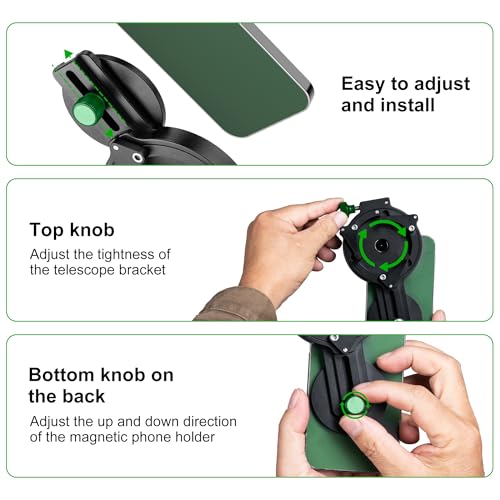


As an Amazon Associate we earn from qualifying purchases. Product prices and availability are accurate as of the date/time indicated.

APEXEL 360° Universal Digiscoping Phone Adapter with Bluetooth Remote | Upgraded Binocular Photo Adapter for Android & iPhone, Smartphone Mount for Telescope, Monocular, Microscope, Spotting Scope
As an Amazon Associate we earn from qualifying purchases. Product prices and availability are accurate as of the date/time indicated.
Ratings are editorial assessments for travel digiscoping, based on the makers’ published compatibility ranges, adjustment designs, and construction, and value at typical prices. Prices are typical retail ranges; custom systems are priced as the case-and-adapter pair the system requires. Compatibility with a specific phone and eyepiece must be confirmed against the makers’ current fit information and, for the traveller, proven in a home bench test before departure, as this guide requires.
The Six Trip Digiscoping Adapters Reviewed
1. Celestron NexYZ – Best for Trips Overall
The NexYZ earns the traveller’s crown on the trip’s own evidence: three axes of adjustment that walk the phone’s lens onto any eyepiece’s pupil, a clamp that swallows the armoured phone as it lives, a grip that fits the eyepiece parish from the lodge’s ancient straight scope to the guide’s modern angled glass, and a price that leaves the trip’s budget its dignity. Its first alignment is a bench’s ten patient minutes — done at home, marked with the paint pen, and thereafter a field minute — and its construction has survived this guide’s imagined decade of daypacks without complaint in the parish’s reports. For the traveller who meets scopes, it is the answer; the review’s only counsel is the guide’s own: mark it, pouch it, bench-test it on arrival, and it will marry your phone to the world’s glass for years of trips.
2. Phone Skope – Best When Your Own Scope Travels
Phone Skope’s custom system is the fastest digiscoping marriage ever sold: the phone in its dedicated case, the case onto the eyepiece’s own adapter, aligned by manufacture rather than by adjustment — deployed in the seconds a sighting allows, repeated perfectly at the hundredth mating. Its travel condition is absolute and this review states it in the first breath: the scope must be yours, its eyepiece the one the adapter was born for. The birding tour where your own scope rides the vehicle with you, the safari where your glass is the group’s — there, the Phone Skope is the trip’s best tool and this table’s speed champion. Everywhere the scope is a stranger, its crown passes to the universals, and the honest traveller owns the distinction rather than discovering it at a hide.
3. Novagrade – Best Build for Hard Travel
Novagrade machines its universal adapter like instrument furniture: a compression ring that grips the eyepiece evenly and kindly — the borrowed scope’s diplomacy designed in — adjustment that holds its settings through the journey’s knocks better than the price class’s, and a phone fit across the broad modern parish. Its price is the machined class’s and its weight a few honest ounces more than the moulded competition. For the expedition traveller — the adapter that must survive the boat, the border bus, and the tenth season — it is the durability answer, and its grip’s kindness to strange eyepieces makes it the guide’s recommended upgrade for the serious borrowed-glass parish.
4. Swarovski VPA 2 – Best for the Swarovski Traveller
The VPA 2 is the optics house’s own answer for its own glass: a variable adapter that mounts to the maker’s scopes with bayonet speed, aligns the phone with the house’s precision, and packs to the small, dense object the premium parish expects. Its condition mirrors the Phone Skope’s — the system’s virtues are the system’s own, exercised on Swarovski eyepieces, at home or wherever the traveller’s own scope has travelled. For the owner of that glass, on the trip where that glass is carried, it is the seamless choice, and its rating grades the experience inside the parish it serves rather than the universality it never claimed.
5. Gosky Universal Mount – Best Spare and Starter
Gosky’s clamp is the category’s doorway and the experienced traveller’s spare: a light, simple universal mount at a price that makes it the second adapter in the bag — the loaner for the companion whose phone wants a turn, the backup when the main mount’s screw is lost to the heather, the starter that teaches a first trip whether digiscoping is their parish at all. Its alignment is the fiddliest here and its grip the least diplomatic, stated plainly. At its price and weight, it earns its pouch; the traveller who graduates from it has spent the smallest tuition the category offers.
6. Kowa TSN-IP – Best for the Kowa Traveller
Kowa’s system serves its own fluorite parish as the Swarovski serves its: a phone-case adapter fitted to the maker’s eyepieces, with the alignment built in and the deployment at the custom school’s speed. The Kowa traveller carrying their own scope — and that glass travels in the best company, on the world’s serious birding circuits — gets a marriage of equals. Its rating, like its Swarovski counterpart’s, grades the fitted experience, and the universal crown remains with the clamps for the borrowed-glass world beyond the parish.
Buying Guide: Choosing and Using a Digiscoping Adapter on Trips
Step One: Name the Trip’s Scopes Before the Adapter
Begin where the guide’s fork begins: with the trip’s glass, listed honestly. Your own scope, carried — the custom and brand systems open, their speed available, the choice between them made by whose name is on the scope. Your own scope, left home, and the trip’s glass borrowed, lodged, or hired — the universals alone survive the audit, and the choice between them is build and budget. Both kinds of trip in your year — the universal travels, and the custom, if bought, stays home with the home scope, a division of labour the serious parish accepts without resentment. Write the trip’s scope list at the worksheet’s head, confirm your phone’s fit against the adapter maker’s current compatibility information, and bench-test the complete marriage — your phone, the adapter, the nearest available eyepiece — before any bag is packed, because the airport is the worst alignment bench in the world and the hide is the second worst.
Step Two: The Travel Routine — Marks, Pouch, and the Arrival Check
Adopt the routine that makes any of these adapters a travel instrument rather than a travel hope. At home: align once, perfectly, on the bench, and mark every axis with the paint pen or the tape flag, so the field starts from a known geometry; set the phone’s digiscoping discipline in the same sitting — the camera app opened to the lens the adapter aligns, the digital zoom’s temptation understood (a modest pinch enlarges the disc’s centre and hides its ragged edge; the heroic zoom only enlarges the blur), the timer or a Bluetooth remote paired and proven as the shutter’s release. In the bag: the adapter in its rigid pouch with the remote and a lens cloth, in the daypack’s protected core. On arrival: the two-minute window check at the lodging, alignment proven against a distant rooftop, before the first dawn’s reputation is staked on it. In the field: the scope tripodded and settled, the adapter mounted and aligned from its marks, the focus made by the scope upon the subject, the phone’s exposure touched upon the bird and locked, the burst fired by remote while the wind’s pauses are minded. That routine, rehearsed twice at home, is the difference between the traveller who digiscopes and the traveller who owns an adapter.
Step Three: Field Manners and the Borrowed Scope
Close with the diplomacy the trip demands, because the borrowed scope is a relationship before it is an instrument. Ask before mounting — the guide’s scope, the lodge’s glass — and show the adapter’s grip, that it takes the eyepiece body kindly and leaves no trace; mount over the owner’s eye, focus by their scope’s own controls without forcing any stop or detent, and return the glass as found, eyecup and covers restored. Offer the photograph — the guide who lent the scope has earned the image of their own bird, sent that evening — and the parish’s reputation, which travels faster than any traveller, is burnished for the next stranger with an adapter. At the hide and the viewpoint, the digiscoper’s manners mirror the scope’s own: no monopolising the glass, no shutter clatter of a hundred bursts where a dozen considered frames serve, and the phone returned to the pocket for the watching itself, which was the trip’s first purpose. The adapter is a few ounces of aluminium and intention; used with the routine and the manners of this guide, it brings home the distant parish in pictures — and leaves every scope it met ready to welcome the next traveller who carries one.
How We Selected These Adapters for Photography Trips
We included only real, named, currently sold digiscoping adapters spanning the universal-clamp, custom-case, and optics-house system schools, graded for travel conditions — fit across unfamiliar eyepieces, alignment that survives transport, manners with cased phones and borrowed glass, and packed size — above home-studio virtues. Compatibility claims follow the makers’ published ranges, and every adapter is directed to be bench-tested with the reader’s own phone before a trip depends on it, as the buying guide requires.
Frequently Asked Questions About Digiscoping Adapters for Trips
Will a universal adapter fit the scope at my lodge or on my tour?
Almost certainly, with the honest margin stated: the universal clamps in this table grip eyepieces across the wide diameter parish that the overwhelming majority of spotting scopes — the lodges’ workhorses, the guides’ glass, the hire fleet — inhabit, and their phone cradles fit the modern phone fleet including most cases. The exceptions are the exotic margins: unusually small or large eyepiece housings, eyepieces whose bodies offer no grippable cylinder, and scopes whose eye relief demands a geometry a given clamp reaches awkwardly — which is why the guide’s bench test, on the nearest available glass before departure, is doctrine rather than decoration, and why the travelling digiscoper emails the lodge or the tour’s scope model ahead when the trip’s photography truly matters. Arrive with the adapter proven on something, its marks set, and its pouch packed: the stranger scope then becomes a two-minute alignment rather than a discovery, and the tour’s glass — chosen by people who watch for a living — is usually fine glass to be married to.
Is digiscoping with a phone actually good enough to justify on a trip?
For the trip’s purposes, genuinely yes — with the quality’s honest address stated. In good light, on a steady scope, with the alignment this guide teaches, the phone-and-scope system produces images of distant subjects — the nest, the skyline ibex, the surfacing whale — that no phone alone and no travel camera at the adapter’s price approaches, at magnifications the watching itself already owns. Its limits are the physics’: the scope’s own optical ceiling, the atmosphere’s shimmer at long range, and low light, where the small sensor’s honesty shows. Against those, weigh what the system costs the traveller: a few ounces, no extra camera body, no long lens’s luggage, and a learning curve of one rehearsed evening. For the traveller whose trip is built around watching — the birding tour, the safari, the seawatch — it is the best photographic value in the bag. For the dedicated wildlife photography expedition, it is the companion to the real rig, not its replacement, and the guide’s parish knows which trip it is packing for.
How do I stop digiscoped photos coming out blurry?
Blur in digiscoping has three authors, and the routine in this guide addresses each in turn. The first is movement: the scope’s magnification multiplies every tremor, so the tripod is a real one with the head locked, the shutter is fired by timer or remote rather than a finger’s jab, and the burst is taken in the wind’s pauses — the single greatest quality lever in the whole technique costs nothing but patience. The second is focus: the phone’s autofocus hunts through the eyepiece, so the discipline is the scope focused by eye upon the subject first, then the phone’s focus and exposure touched on the subject and locked, so the camera stops renegotiating what the scope already decided. The third is alignment: a lens off the pupil’s centre vignettes and softens, which the marked axes and the arrival check exist to prevent. Practise the three at home on a rooftop aerial until the frames come home sharp by routine — the trip’s subjects will not wait while the technique is invented, and they should not have to.
Should I buy the custom case system or a universal clamp?
By the trip’s scopes, as this guide’s fork rules: the custom system — Phone Skope, or the optics houses’ own — is the finest digiscoping experience available, fast and perfectly repeatable, on exactly the phone and eyepiece it was built for; it is the right purchase when your own scope travels with you and the pairing is stable across seasons. The universal clamp is slower to align the first time and travels to every scope on Earth; it is the right purchase when the trip’s glass is borrowed, lodged, hired, or varied — which describes most travelling naturalists most of the time, and is why the NexYZ wears this guide’s trip crown while the Phone Skope wears the speed crown in its own review. The parish’s settled pattern, for the traveller who does both kinds of trip, is the universal for the road bought first, and the custom added when a home scope’s pairing proves permanent. Either way, the bench test before departure is non-negotiable: the adapter is geometry, and geometry is proven, never presumed.
Related guides
- Best Spotting Scope for Travel Concert Viewing in 2026: 7 Spotting Scopes With Clear Optics, Compact Build, and Simple Use for Travel Concerts
- How to Avoid Thermal Resolution Mistakes Beginners in 2026: Choose the Right Thermal Resolution for Your First Thermal Monocular
- Best Spotting Scope for Lighthouse Photography Trips in 2026: ED Glass, Weatherproofing, and Digiscoping Reach for Towers That Stand a Mile Offshore
- Best Affordable Night Vision Scope in 2026: 7 Night Vision Scopes That See in the Dark, Hold Zero, and Stay Under a Beginner Budget
More from Amazon
Programs that pair well with the guide above. Offers and eligibility are set by Amazon and may change.
Free shipping on eligible items, Prime Video and more. Eligible new members can start with a free trial.
Start a Prime free trialAudiobooks and podcasts to listen to on the go. Eligible new members can start with a free trial.
Try Audible freeAd-free music streaming. Eligible new subscribers can start with a free trial.
Try Music Unlimited freeA free business account with business pricing and bulk-buying tools for work, shop or home office.
Create a business accountAs an Amazon Associate we earn from qualifying purchases.

Write Your Review
No reviews yet. Be the first to share your experience!