
What's inside
- Best Spotting Scope for Beginners Hunting Compared: Quick Comparison Table
- Best Spotting Scope for Beginners Hunting in 2026: Detailed Reviews
- Best Spotting Scope for Beginners Hunting Buying Guide: How to Choose the Right Scope
- Best Spotting Scope for Beginners Hunting FAQ: Hunting Spotting Scope Questions Answered
As an Amazon Associate I earn from qualifying purchases. This post may contain affiliate links at no extra cost to you.
A spotting scope is the tool that turns a distant shape into a clear decision. With binoculars you can find an animal, but with a spotting scope you can judge its size, its antlers, its sex, and whether it is worth a stalk. For beginners, the best spotting scope for hunting is not the most powerful scope, and it is not the most expensive one. It is the scope that is easy to set up, easy to focus, bright enough at dawn and dusk, and forgiving enough that you can find and follow game without fighting the optics.
For most beginner hunters, the best overall choice in 2026 is the Vortex Diamondback HD 20-60×85. It typically costs $400 to $500. It is bright, sharp, waterproof, and has a wide zoom range that lets you scan at 20x and zoom to 60x to judge detail. If you want a lighter, more affordable starter scope, the Celestron Ultima 80 is a strong choice, typically $150 to $200, with a 20-60x zoom and a good image for the price. For a step up in optical quality, the Vortex Viper HD 20-60×85 is an excellent alternative, typically $700 to $800.
This guide compares seven real, currently sold spotting scopes for beginner hunters. It explains magnification, objective size, exit pupil, eye relief, and tripod choice in plain language, and it gives you a simple buying guide for your first hunting spotting scope. You do not need to spend a fortune to judge game well. You need a scope that is bright, stable on a tripod, and easy to use in the field.
Our Top Picks
Best Spotting Scope for Beginners Hunting Compared: Quick Comparison Table
Use this table to compare the best spotting scope for beginners hunting at a glance. Prices are typical retail ranges, not fixed prices, and will vary by retailer. Ratings are editorial scores out of five based on brightness, sharpness, ease of use, waterproofing, and value for beginners.
| Model | Key Specs | Best For | Typical Price Range | Rating |
|---|---|---|---|---|
| Vortex Diamondback HD 20-60×85 | 20-60×85, HD glass, 60mm eye relief, waterproof | Best overall for beginners | $400–$500 | 4.9 / 5 |
| Celestron Ultima 80 | 20-60×80, 45-degree eyepiece, waterproof, 33 oz | Best budget starter scope | $150–$200 | 4.7 / 5 |
| Vortex Viper HD 20-60×85 | 20-60×85, HD glass, XR coatings, waterproof | Best step-up optics | $700–$800 | 4.8 / 5 |
| Bushnell Legend T-Series 20-60×80 | 20-60×80, ED glass, waterproof, 36 oz | Best Bushnell for hunting | $300–$400 | 4.7 / 5 |
| Athlon Argos G2 HD 20-60×85 | 20-60×85, HD glass, waterproof, 65 oz | Best value 85mm scope | $300–$400 | 4.7 / 5 |
| Leupold SX-4 Pro Guide HD 20-60×85 | 20-60×85, HD glass, waterproof, 65 oz | Best premium for beginners | $800–$1,000 | 4.8 / 5 |
| Vortex Crossfire HD 20-60×80 | 20-60×80, HD glass, waterproof, 48 oz | Best value Vortex scope | $200–$300 | 4.6 / 5 |
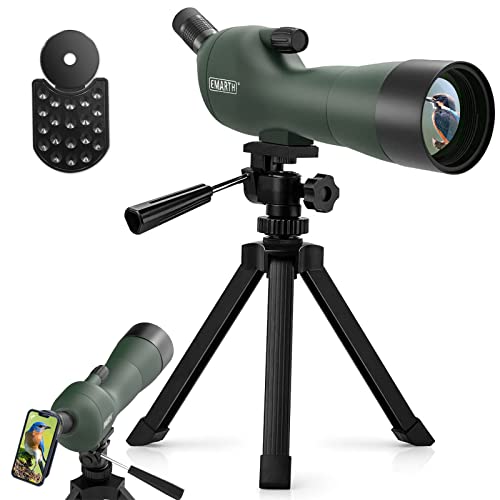
Emarth 20-60x60 Angled Spotting Scopes for Target Shooting/Hunting/Birding | 1.37lb light Spotting scope for Target Shooting w/Tripod 14" tabletop/Carry Bag, spotter scope for Hunting/Birding/Wildlife
As an Amazon Associate we earn from qualifying purchases. Product prices and availability are accurate as of the date/time indicated.

GUANIEE 25-75x60 Spotting Scope for Target Shooting with Tripod Carrying Bag and Phone Adapter Spotter Scope for Bird Watching Wildlife Viewing Hunting Camo
As an Amazon Associate we earn from qualifying purchases. Product prices and availability are accurate as of the date/time indicated.

20-60X60 Compact Spotting Scope with Tripod for Target Shooting | Spotting Scopes with Phone Adapter, BAK4 Prism FMC Coating High Definition Telescope for Bird Watching, Wildlife, Hunting
As an Amazon Associate we earn from qualifying purchases. Product prices and availability are accurate as of the date/time indicated.
Best Spotting Scope for Beginners Hunting in 2026: Detailed Reviews
Each scope below is a 20-60x zoom, because that range is the best starting point for hunting. At 20x you can scan a hillside quickly, and at 60x you can judge antler points, body size, and detail. Read the objective size and exit pupil notes, because those numbers affect brightness more than magnification alone.
1. Vortex Diamondback HD 20-60×85 — Best Spotting Scope for Beginners Hunting Overall
The Vortex Diamondback HD 20-60×85 is the best overall spotting scope for beginner hunters. Its 85mm objective lens gathers a lot of light, which makes the image bright at dawn and dusk when game is most active. The HD optical system gives a sharp, clear image with good colour, and the 20-60x zoom lets you scan wide at low power and zoom in for detail.
Exit pupil is 4.25mm at 20x, calculated as 85 divided by 20, and 1.42mm at 60x, calculated as 85 divided by 60. That means the image is bright and comfortable at low power, and dimmer at high power, which is normal for any zoom scope. For beginners, the lesson is simple: use 20x to 30x for scanning, and only zoom to 60x when you need to judge detail and the light is good. The Diamondback HD is waterproof, fogproof, and has a rugged armour coating that protects it in the field. It also has a strong warranty, which is reassuring for a first scope.
Why we like this scope: bright 85mm objective, HD glass, wide zoom range, and good value. Consider: it is heavier than an 80mm scope, so you need a sturdy tripod, and the image softens a little at 60x in low light.
2. Celestron Ultima 80 — Best Budget Spotting Scope for Beginners Hunting
The Celestron Ultima 80 is the best budget starter scope in this list, typically $150 to $200. It has a 20-60x zoom, an 80mm objective, a 45-degree angled eyepiece, and a waterproof design. The angled eyepiece is comfortable for glassing from a seated position or from a tripod set low, which is common when hunting from a hillside or a blind.
The image is bright and clear in daylight, and the scope is light enough to carry in a pack. It is not as sharp at the edges as the Vortex Diamondback, and the focus can feel less precise, but for a beginner who is learning to glass and judge game, it is an excellent first scope. It comes with a soft case and a tabletop tripod, although you will want a full-size tripod for hunting.
Why we like this scope: affordable, light, and easy to use. Consider: optics are a step below premium scopes, and the included tripod is too short for most hunting.
3. Vortex Viper HD 20-60×85 — Best Step-Up Spotting Scope for Beginners Hunting
The Vortex Viper HD 20-60×85 is a step up from the Diamondback HD, with better HD glass, XR fully multi-coated lenses, and a slightly brighter, sharper image, especially at high magnification. It has the same 20-60×85 format, the same waterproof and fogproof construction, and a similar weight, but the optical quality is noticeably better in low light and at 50x to 60x.
It typically costs $700 to $800, making it a good choice if you know you will use a spotting scope often and want better optics without jumping to a flagship price. For beginners who plan to hunt regularly, the Viper HD is a scope you will not outgrow quickly. It is also a good choice if you wear glasses, because the eye relief is generous and the eyecup adjusts easily.
Why we like this scope: excellent HD optics, bright at high power, and strong build. Consider: higher price than the Diamondback, and heavier than an 80mm scope.
4. Bushnell Legend T-Series 20-60×80 — Best Bushnell Spotting Scope for Beginners Hunting
The Bushnell Legend T-Series 20-60×80 uses ED prime glass to reduce colour fringing and improve sharpness, especially in bright, high-contrast light. It has a 20-60x zoom, an 80mm objective, and a waterproof, fogproof design. The 80mm objective is slightly smaller than an 85mm, so it is a little lighter and easier to carry, while still gathering enough light for most hunting.
It typically costs $300 to $400, making it a mid-range option that offers good optical quality for the price. The focus is smooth, the zoom is easy to adjust, and the scope comes with a hard case. For beginners who want Bushnell optics and a good balance of size and performance, the Legend T-Series is a strong choice.
Why we like this scope: ED glass, good sharpness, and mid-range price. Consider: 80mm objective is slightly dimmer than 85mm at dawn and dusk.
5. Athlon Argos G2 HD 20-60×85 — Best Value 85mm Spotting Scope for Beginners Hunting
The Athlon Argos G2 HD 20-60×85 is the best value 85mm scope in this list, typically $300 to $400. It has HD glass, a 20-60x zoom, an 85mm objective, and a waterproof, fogproof design. The large objective gives it a bright image, and the HD glass keeps the image sharp across most of the zoom range.
It is heavier than some rivals, at about 65 ounces, so you need a sturdy tripod. The Argos G2 is a good choice if you want an 85mm scope at a lower price than the Vortex Diamondback, and you do not mind a slightly heavier build. It is also a good choice for hunting from a fixed position, like a hillside or a blind, where weight matters less.
Why we like this scope: large 85mm objective, HD glass, and good value. Consider: heavier than other 85mm scopes, and the focus can feel stiff when new.
6. Leupold SX-4 Pro Guide HD 20-60×85 — Best Premium Spotting Scope for Beginners Hunting
The Leupold SX-4 Pro Guide HD 20-60×85 is the premium option in this list, typically $800 to $1,000. It uses HD glass, a 20-60x zoom, and an 85mm objective, with a rugged, waterproof design that is built for harsh conditions. The image is bright, sharp, and high-contrast, even at 60x, and the focus is precise and smooth.
For beginners who want the best optics they can get without buying a flagship scope, the SX-4 Pro Guide is an excellent choice. It is heavier than the Diamondback, at about 65 ounces, so you need a good tripod, but the optical quality is worth it if you hunt in low light or need to judge game at long distances. Leupold also offers a strong warranty and a reputation for durability.
Why we like this scope: excellent optics, rugged build, and good low-light performance. Consider: premium price, and heavier than budget scopes.
7. Vortex Crossfire HD 20-60×80 — Best Value Vortex Spotting Scope for Beginners Hunting
The Vortex Crossfire HD 20-60×80 is the value Vortex option, typically $200 to $300. It has HD glass, a 20-60x zoom, an 80mm objective, and a waterproof, fogproof design. It is lighter than the Diamondback HD, at about 48 ounces, and it is easier to carry in a pack.
The image is bright and clear in daylight, and the scope is easy to use. It is not as sharp as the Diamondback at high magnification, but for a beginner, the difference is modest in good light. It is a good choice if you want Vortex quality and warranty at a lower price, or if you need a second scope for a partner or a backup.
Why we like this scope: good value, light, and easy to use. Consider: optics are a step below the Diamondback HD, and the 80mm objective is dimmer than 85mm at dusk.
Best Spotting Scope for Beginners Hunting Buying Guide: How to Choose the Right Scope
Choosing a spotting scope for hunting is simpler than it looks if you focus on the right numbers. Beginners often make the mistake of buying the highest magnification they can afford, thinking more power means a better view. In practice, the opposite is true in low light and in wind. Higher magnification makes the image dimmer, narrower, and harder to hold steady. The three questions below will help you choose correctly.
Magnification, Objective Size, and Exit Pupil: Why 20-60×85 Is Best for Beginners
For hunting, a 20-60x zoom with an 80mm or 85mm objective is the best starting point. At 20x you can scan a large area quickly, and at 60x you can judge detail. The objective size determines how much light the scope gathers. An 85mm objective gathers more light than an 80mm, and both gather much more than a 65mm scope, which is better for backpacking but dimmer at dawn and dusk.
Exit pupil is the objective size divided by magnification. For a 20-60×85 scope, exit pupil is 4.25mm at 20x and 1.42mm at 60x. For a 20-60×80 scope, it is 4.0mm at 20x and 1.33mm at 60x. A larger exit pupil means a brighter, more comfortable image, especially in low light. That is why you should scan at 20x to 30x, where the image is bright, and only zoom to 60x when you need detail and the light is good. Never look at the Sun through a spotting scope, and never use a scope without a front solar filter for solar viewing.
Angled vs Straight Eyepiece, Eye Relief, and Focus: How to Use a Spotting Scope Comfortably
Angled eyepieces, at 45 degrees, are more comfortable for glassing from a seated position or from a tripod set low, because you do not have to crane your neck. They are also easier to share between people of different heights. Straight eyepieces are faster to aim, because you point the scope directly at the target, and they are easier to use from a vehicle window mount. For most beginner hunters, an angled eyepiece is the better choice, because you will spend most of your time glassing from a hillside or a blind.
Eye relief is the distance from the eyepiece to your eye where you see the full image. For glasses wearers, look for at least 14mm, and twist the eyecup down when you wear glasses, up when you do not. Focus is a two-step process: first use the coarse focus to get the image roughly sharp, then use the fine focus to sharpen it. Practice focusing on a distant tree or rock before you hunt, so you can focus quickly when you find game.
Tripod, Head, and Care: Why a Fluid Head Beats a Ball Head for Spotting Scopes
A spotting scope is only as good as its tripod. A cheap, wobbly tripod will make even the best scope unusable at 60x, because every vibration is magnified. Use a fluid head, not a ball head, for a spotting scope, because a fluid head lets you pan smoothly and follow game without jerking. A ball head is good for a camera, but it is too jerky for a spotting scope.
Choose a tripod with a load rating at least 2 pounds more than your scope plus head. For example, if your scope weighs 4 pounds and your head weighs 1 pound, choose a tripod rated for at least 7 pounds. Carbon fibre tripods are lighter and absorb vibration better than aluminium, but they cost more. For beginners, a sturdy aluminium tripod with a fluid head is a good starting point.
Care for your scope by cleaning the lenses correctly. Use a brush or blower first to remove dust, then a clean microfibre cloth with lens cleaner. Never use a household cleaner, ammonia, or a paper towel, because they can scratch the coatings. Store the scope in its case, with lens caps on, in a dry place. If the scope gets wet, dry it with a soft cloth and let it air dry before storing.
Best Spotting Scope for Beginners Hunting FAQ: Hunting Spotting Scope Questions Answered
What is the best spotting scope for beginners hunting?
The best spotting scope for beginners hunting is the Vortex Diamondback HD 20-60×85 for most hunters, because it is bright, sharp, waterproof, and easy to use, with a 20-60x zoom that lets you scan at low power and judge detail at high power. The Celestron Ultima 80 is the best budget alternative, while the Vortex Viper HD 20-60×85 is the best step-up option.
What magnification do I need for hunting with a spotting scope?
For hunting, a 20-60x zoom is the best starting point. Use 20x to 30x to scan a hillside and find game, because the image is bright and the field of view is wide. Use 40x to 60x only when you need to judge antler points, body size, or detail, and when the light is good. Higher magnification makes the image dimmer and narrower, so it is not better for scanning.
Is an 85mm spotting scope better than an 80mm for hunting?
An 85mm spotting scope gathers slightly more light than an 80mm scope, which makes the image a little brighter at dawn and dusk. The difference is modest, but it can matter when you are glassing in low light. An 85mm scope is also heavier, so an 80mm scope is a good choice if you need to carry the scope in a pack for long distances. For most beginners hunting from a fixed position, an 85mm scope is the better choice.
Do I need a special tripod for a spotting scope?
Yes, you need a sturdy tripod with a fluid head for a spotting scope. A fluid head lets you pan smoothly and follow game, while a ball head is too jerky for spotting scope use. Choose a tripod with a load rating at least 2 pounds more than your scope plus head, and use a tripod that is tall enough to glass comfortably from a standing or seated position.
FAQ
What is the best spotting scope for beginners hunting?
What magnification do I need for hunting with a spotting scope?
Is an 85mm spotting scope better than an 80mm for hunting?
Do I need a special tripod for a spotting scope?
Related guides
- Best Value Digiscoping Phone Mount Birding in 2026: 7 Affordable Phone Mounts That Turn Your Spotting Scope Into a Birding Camera
- Best Tripod for Travel Lightweight Packing in 2026: 7 Lightweight Travel Tripods That Pack Small, Hold a Spotting Scope Steady, and Fit in Your Carry-On
- Best Spotting Scope for Beginners Easy Setup in 2026: Forgiving Scopes, Simple Tripods, and a First Session That Ends With a Bird — Not a Manual
- Best Spotting Scope vs Binoculars for Beginners in 2026: 6 Top Spotting Scope vs Binoculars for Beginners Options, Easy Viewing, and Easy Use
More from Amazon
Programs that pair well with the guide above. Offers and eligibility are set by Amazon and may change.
Free shipping on eligible items, Prime Video and more. Eligible new members can start with a free trial.
Start a Prime free trialAudiobooks and podcasts to listen to on the go. Eligible new members can start with a free trial.
Try Audible freeAd-free music streaming. Eligible new subscribers can start with a free trial.
Try Music Unlimited freeA free business account with business pricing and bulk-buying tools for work, shop or home office.
Create a business accountAs an Amazon Associate we earn from qualifying purchases.

Write Your Review
No reviews yet. Be the first to share your experience!