
What's inside
- What Makes the Best Digiscoping Mount for Spotting Scope Different
- Quick Comparison: Best Digiscoping Mount for Spotting Scope Models
- Detailed Reviews: Best Digiscoping Mount for Spotting Scope Picks
- Buying Guide: Choosing the Best Digiscoping Mount for Spotting Scope
- Frequently Asked Questions About Best Digiscoping Mount for Spotting Scope
As an Amazon Associate I earn from qualifying purchases. This post may contain affiliate links at no extra cost to you.
The best digiscoping mount for spotting scope use is the small, unglamorous component on which the whole of digiscoping stands or falls. Digiscoping, photographing and filming through a spotting scope with a phone, promises telephoto reach no phone lens can approach, and delivers it only when the phone’s camera is held in exact alignment with the scope’s eyepiece: centred on the exit pupil, at the right eye relief distance, square to the optical axis, and held there without sag, slip, or a vignette that eats the frame’s edges. A millimetre of misalignment is a black crescent in every photograph. This guide compares real, currently sold digiscoping adapters from Phone Skope, Novagrade, Swarovski, Kowa, Celestron, and Carson, explains the alignment and eye relief principles that decide sharp results, and gives the field routine, remote shutter, manual focus discipline, and settings, that turns an aligned phone into photographs worth keeping.
Two adapter philosophies divide the category. Model-specific systems, Phone Skope being the pattern, build a case for your exact phone and an adapter ring for your exact scope eyepiece, so the alignment is manufactured rather than adjusted, and the phone clicks into position in the same place every time in seconds. Universal adjustable adapters, Novagrade and the clamp designs being the pattern, grip a range of phones and eyepieces with adjustable arms and plates, serving several phones and scopes at the cost of a setup that must be aligned carefully and rechecked. Neither is the correct answer for everyone: a one-phone, one-scope birder is served best by the specific system, a household, a guiding operation, or a scope shared between users is served by the universal. What both must do, and what this guide rates them on, is hold the alignment rigidly on a scope that is itself on a tripod in wind, because an adapter that flexes has defeated the tripod beneath it.
Compatibility is the first check and it is exact: the adapter must state your scope’s eyepiece model or its diameter, and your phone model or its dimensions, in the maker’s fitment terms, because eyepieces differ by millimetres that matter here. Prices are typical retail ranges, and specifications are each maker’s stated details for the current version.
Our Top Picks
What Makes the Best Digiscoping Mount for Spotting Scope Different
Alignment, Eye Relief, and the Exit Pupil
The optical heart of digiscoping is a small bright disc, the scope’s exit pupil, floating just behind the eyepiece at the eye relief distance, and the phone’s lens must sit inside that disc, centred and square, at the distance the eyepiece was designed for. Too close or too far and the image circle shrinks into a porthole; off centre and a black crescent takes a corner; tilted and one edge softens. A good adapter makes that position repeatable rather than findable, which is why the specific systems rate so highly in the field: the alignment is built into the parts. With a universal adapter, the alignment ritual is the skill: fit the phone, centre the camera over the eyepiece using the live preview, adjust until the image circle is complete and centred with the scope at its lowest magnification, lock everything, and only then zoom. Set the phone’s camera to its main 1x lens, because that is the lens the adapter is aligned to, and be aware that phones switch lenses automatically in some modes, which an adapter cannot follow.
Rigidity, Weight, and the Tripod Beneath
A phone and adapter add weight behind the eyepiece, cantilevered off the scope’s balance point, and the system answers in two places. The adapter itself must grip the eyepiece without rotating under the phone’s weight, a failure that shows as a slowly tilting horizon across a session. The scope’s mounting foot and the tripod head must rebalance the shifted load, sliding the scope forward on its plate until the whole rig sits neutrally, because a back-heavy scope creeps in its head and vibrates longer after every touch. This is why digiscoping rewards the tripod discipline of this site’s other guides with compound interest: at effective magnifications of a thousand millimetres and beyond in equivalent terms, every vibration is a photograph’s ruin, and the remote shutter release, Bluetooth or cable in the accessory makers’ systems, or the phone’s timer and voice control, is not an accessory but the second half of the mount.
Speed in the Field: The Bird Does Not Wait
Digiscoping’s subjects move, and the mount’s speed of deployment is a photographic specification. The field sequence is: scope on the bird, focus the scope, attach the phone, confirm the framing, shoot. A specific click-on system performs the middle steps in seconds, which is photographs; a universal adapter being realigned performs them in a minute, which is a description of a bird that was there. Experienced digiscopers therefore pre-align a universal adapter at home and transport it fitted, or choose the specific system for a working scope, and keep the phone in the case half of a specific system permanently, accepting a bulkier everyday case as the price of the instant mount. Judge every adapter in this guide by a stopwatch as honestly as by its materials, because in this category time is image quality.
Quick Comparison: Best Digiscoping Mount for Spotting Scope Models
| Model | Type and Key Specs in Maker’s Terms | Fitment Notes | Typical Price Range | Rating |
|---|---|---|---|---|
| Phone Skope Digiscoping Kit class | Phone-specific case plus eyepiece adapter ring system in maker’s design | Exact phone model and exact scope eyepiece versions, fastest field fit | $90 – $160 by phone and scope | 4.7 / 5 |
| Novagrade Phone Adapter class | Universal adjustable adapter, machined construction in maker’s terms | Adjusts across phones and eyepieces, tablet versions in maker’s line | $120 – $200 by version | 4.6 / 5 |
| Swarovski VPA Variable Phone Adapter class | Adjustable premium adapter in maker’s system for Swarovski eyepieces | Designed for the maker’s scopes, wide phone adjustment range | $180 – $260 | 4.6 / 5 |
| Kowa Smartoscope and phone adapter class | Adapter systems in maker’s line for Kowa eyepieces, by version | Maker-matched to Kowa scopes, phone sizing by version | $100 – $200 by version | 4.5 / 5 |
| Celestron NexYZ class adapter | Three-axis adjustable universal adapter in maker’s design | Broad phone and eyepiece range, good first universal | $55 – $85 | 4.4 / 5 |
| Carson HookUpz and digiscoping adapter class | Clamp-style universal adapters in maker’s line, by version | Budget universals, lighter build, casual digiscoping | $35 – $70 by version | 4.2 / 5 |

tridaptor - Universal Phone Scope Digiscoping Adapter|High-Precision XYZ Metal Telescope Mount 3-Axis Smartphone Holder for Spotting Scope Monocular Binos|Fits All Cell Phone Camera/Max 2.4" Eyepiece
As an Amazon Associate we earn from qualifying purchases. Product prices and availability are accurate as of the date/time indicated.

FANAUE Telescope Phone Adapter, Spotting Scope Smartphone Phone Mount for Binoculars Monocular Microscope, Magnetic Cell Phone Digiscoping Holder for Camera Photography


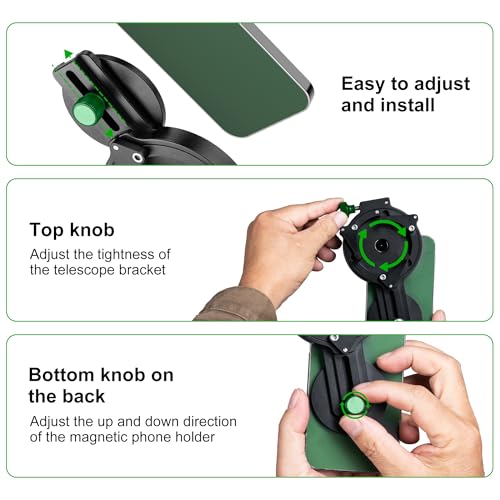


As an Amazon Associate we earn from qualifying purchases. Product prices and availability are accurate as of the date/time indicated.

MAGVIEW Digiscoping S1 Spotting Scope Universal Phone Adapter
As an Amazon Associate we earn from qualifying purchases. Product prices and availability are accurate as of the date/time indicated.
Fitment ranges, phone dimensions, and eyepiece diameters are each maker’s stated specifications for the current version and are decisive in this category, so order against your exact phone, in the case it will wear, and your exact eyepiece. Price ranges are typical retail ranges and vary by version and retailer. Ratings are editorial ratings for digiscoping duty: alignment repeatability, rigidity under the phone’s weight, speed of field deployment, breadth of fitment, and value.
Detailed Reviews: Best Digiscoping Mount for Spotting Scope Picks
1. Phone Skope Kit Class – Best Digiscoping Mount for Spotting Scope Overall
Phone Skope’s system is the field standard because it removes alignment from the list of things that can go wrong: a case built for your phone, a ring built for your eyepiece, and a connection between them that seats in the same position every time, in seconds, with cold or gloved hands. For the birder whose scope and phone are a settled pair, nothing else in this guide is as fast or as repeatable, and in digiscoping those two qualities are most of the photographs. Its costs are its specificity, a new phone means a new case, and a household of phones is not its brief, both accepted knowingly by owners who shoot daily.
2. Novagrade Adapter Class – Best Universal Digiscoping Mount for Spotting Scope
Novagrade builds the universal adapter as an instrument: machined, rigid, and adjustable across a wide range of phones and eyepieces in its maker’s stated dimensions, with the solidity to hold alignment on a scope in wind rather than merely achieve it on a table. It suits the multi-phone household, the guide with clients’ phones, and the scope owner who changes eyepieces, and its price reflects its construction. Set it up carefully at home, mark the positions for your phone, and its field speed approaches the specific systems while its versatility exceeds them entirely.
3. Swarovski VPA Class – Best Digiscoping Mount for Swarovski Spotting Scopes
Swarovski’s variable phone adapter is the maker-matched answer for its own scopes: an adjustable design in the maker’s system, built to the standard of the optics it serves, with a phone range wide enough for a household. For the owner of a premium Swarovski scope it is the natural purchase, supported inside the same ecosystem as the scope itself. Its premium price buys finish and fit rather than a different principle, and against the Novagrade it wins on maker integration and loses on cross-brand versatility, which is the correct way to choose between them.
4. Kowa Adapter Class – Best Digiscoping Mount for Kowa Spotting Scopes
Kowa’s adapter systems follow the same maker-matched logic for Kowa’s eyepieces, in versions the maker specifies for its scope families, and Kowa’s prominence among digiscopers, its scopes are a digiscoping favourite for their eyepieces’ characteristics, makes its adapters a considered part of that ecosystem. Confirm the exact version against your eyepiece and phone dimensions, as Kowa’s range spans generations, and the result is an alignment as repeatable as the Phone Skope pattern inside one maker’s world.
5. Celestron NexYZ Class – Best Value Digiscoping Mount for Spotting Scope
The NexYZ class is the universal adapter most beginners should buy: three-axis adjustment in its maker’s design, which is the feature that makes alignment achievable rather than approximate, at a price that leaves budget for the tripod the system also needs. Its construction is a step below Novagrade’s, felt as a little more care needed in locking and checking, and for a first digiscoping season it teaches every skill the category requires. More digiscoping careers have started through this adapter than any other in the guide, which is a recommendation in itself.
6. Carson HookUpz Class – Best Budget Digiscoping Mount for Spotting Scope
Carson’s clamp adapters are the casual entry: light, inexpensive, and sufficient for occasional digiscoping, a nesting bird at a known stakeout, a moon photograph, a record shot of a rarity, where setup time is available and conditions are kind. Their hold and alignment precision sit below the rows above, as the price predicts, and a user who finds the hobby taking hold will upgrade through this table in order. As a first taste bought knowingly, they are honest value, and as a working tool they are the floor, not the standard.
Buying Guide: Choosing the Best Digiscoping Mount for Spotting Scope
Match the System to Your Phone Habits
Decide specific or universal by your phone’s future. One phone, kept for years, on one scope: the Phone Skope pattern, and accept a new case at the next phone as a known cost. Phones changing, several users, several scopes, or a guiding life: the Novagrade or maker variable pattern, and accept the alignment ritual as the price of the freedom. Either way, confirm fitment against the phone in its everyday configuration, because a phone that must leave its protective case to mount is a phone that will eventually be dropped onto a scope, and check whether your phone’s camera position, the offset lenses of modern multi-camera phones, sits within the adapter’s stated adjustment, which is the fitment detail the current phone generation has made decisive.
Set Up at Home and Build the Field Routine
Align the complete system at home, on a steady scope, at a distant, detailed target: centre the image circle at the scope’s lowest magnification, lock the adapter, zoom the scope slowly and confirm the alignment holds, and practise the phone’s camera settings until they are a routine, exposure and focus locked on the subject where the phone’s controls allow, the main 1x lens confirmed, digital zoom avoided in favour of the scope’s own magnification, and the remote release or timer paired and tested. In the field, work in the digiscoper’s order: find and focus with the scope alone, attach the phone without moving the scope, let the phone’s screen confirm focus, shoot in short bursts because the subject and the air are both moving, and review at full zoom between bursts rather than at the session’s end. Keep the eyepiece and the phone lens scrupulously clean, because at these magnifications a fingerprint is a weather system.
Support the System and Manage Expectations
Budget and set up the support as part of the mount purchase: rebalance the scope on its head with the phone attached, use the steadiest tripod the combined weight deserves, and shoot with the remote or timer as the default, because a hand on the phone is a hand shaking a thousand-millimetre lens. Then hold the expectations that keep digiscoping joyful: its reach is real and its photographs, in good light, at moderate scope magnifications, with a still subject, can be genuinely fine, while its limits, depth of field measured in centimetres, heat shimmer magnified with everything else, and moving subjects at high power, are physics rather than equipment failure. The best digiscoping mount for a spotting scope is the one that makes alignment a non-event, so that all of the photographer’s attention can go where it belongs: on the bird, the light, and the moment the shutter, remotely and vibrationlessly, is pressed.
Frequently Asked Questions About Best Digiscoping Mount for Spotting Scope
What is the best digiscoping mount for a spotting scope?
The Phone Skope kit class is the best overall for a settled phone and scope pair, with manufactured alignment and the fastest field fit. The Novagrade class is the best universal adapter, Swarovski’s VPA and Kowa’s adapters are the best maker-matched options for their scopes, and Celestron’s NexYZ class is the best value start. Confirm the exact fitment for your phone and your eyepiece before choosing, because in this category a millimetre is the difference between a system and a return.
Why do my digiscoped photos have black corners?
Black corners and crescents are vignetting, the signature of misalignment between the phone’s lens and the scope’s exit pupil: the phone is off centre, tilted, or at the wrong distance from the eyepiece. Realign with the scope at its lowest magnification, centre the complete image circle in the phone’s preview, lock the adapter, and confirm your phone is using its main 1x camera rather than an automatically switched lens. A model-specific system, Phone Skope class, removes most of this by construction; a universal adapter removes it by the careful setup in the buying guide.
Can I digiscope with any phone and any spotting scope?
In principle yes, and in practice within the adapters’ stated fitments: the eyepiece’s diameter and design must suit an adapter, the phone’s size and camera position must fall inside the adapter’s adjustment, and the scope should have the eye relief and eyepiece quality that digiscoping rewards, which most current birding scopes from the makers in this guide provide. Very small eyepieces, very large phones, and phones whose main camera sits far from the adapter’s centre are the combinations to verify with particular care before purchase.
What else do I need besides the digiscoping mount?
A remote shutter release, Bluetooth or cable, or disciplined use of the phone’s timer, because touching the phone shakes the system at digiscoping magnifications; a tripod and head steady enough for the combined rig, with the scope rebalanced for the phone’s weight; and the small routine items, lens cleaning cloths for eyepiece and phone, a spare battery or power bank for a screen that runs all session, and storage that protects the footage. The mount aligns the phone, and those items are what let the alignment become photographs.
Related guides
- Best Budget Spotting Scope for First Time Birders in 2026: 7 Affordable Spotting Scopes That Help Beginners See Birds Clearly Without Overspending
- Best Thermal Monocular for First Time Hunters: 6 Beginner Thermal Monoculars in 2026
- How to Set Up Digiscoping Adapter for Phone in 2026: 7 Adapters Compared for Easy Setup, Clear Photos, and Reliable Use
- Best Thermal Monocular Cleaning Kit for Beginners in 2026: 6 Top Thermal Monocular Cleaning Kits for Beginners, Safe Lens Cleaning, and Easy Use
More from Amazon
Programs that pair well with the guide above. Offers and eligibility are set by Amazon and may change.
Free shipping on eligible items, Prime Video and more. Eligible new members can start with a free trial.
Start a Prime free trialAudiobooks and podcasts to listen to on the go. Eligible new members can start with a free trial.
Try Audible freeAd-free music streaming. Eligible new subscribers can start with a free trial.
Try Music Unlimited freeA free business account with business pricing and bulk-buying tools for work, shop or home office.
Create a business accountAs an Amazon Associate we earn from qualifying purchases.



Write Your Review
No reviews yet. Be the first to share your experience!