
What's inside
As an Amazon Associate I earn from qualifying purchases. This post may contain affiliate links at no extra cost to you.
The fluid head tripod vs ball head tripod argument is usually settled by people talking past each other, because the two heads are not better and worse versions of one tool. They are different tools that happen to share a set of legs. A ball head is a positioning device: a ball in a socket, locked and released by a knob or a lever, which can point a camera, a spotting scope, or a binocular in almost any direction, instantly, and hold it there, in the smallest and lightest head package the tripod world makes. A fluid head is a movement device: a video-derived head whose pan and tilt axes move separately, against adjustable resistance, with a counterbalance that holds a scope or camera at the angle you leave it, built for one purpose above all, moving the view smoothly while you are looking through it. That distinction decides everything. If your instrument mostly sits still once it is aimed, portraits, a scope parked on a feeding ground, a camera on a landscape, the ball head’s speed and compactness are a genuine excellence. If your instrument’s work is following, a bird along a shoreline, a deer across a basin, an aircraft, a race, a child’s match through a camera, the fluid head is not a refinement. It is the difference between watching the subject and chasing it in a series of jerks, overshoots, and corrections that high magnification turns into seasickness.
This guide compares real heads and tripod kits across both parishes, explains drag, counterbalance, load rating, and quick-release systems in terms of what they feel like at 40x magnification, and matches each head to the optics this site serves: spotting scopes, digiscoping, birding, wildlife observation, and the camera work that increasingly shares the same legs. Prices are typical ranges only.
How Each Head Works, and What That Feels Like Through a Scope
The ball head: every axis at once, for better and worse
A ball head’s freedom is its virtue and its tax in a single mechanism. Loosen the main control and the instrument can tilt, pan, and cant together, which is wonderful for composing a photograph at an odd angle and demanding for following anything, because the hand must govern all axes at once while the other hand may be focusing, and at spotting scope magnifications the smallest unintended cant turns the horizon into a slope and the pan into a diagonal dive. Good ball heads answer with quality: a smooth, large ball, a separate pan base with its own lock on better models, a tension or friction preset that lets the head be loosened without the instrument flopping, and an Arca-type quick-release parish that has become the nearest thing the parish has to a standard. Even so, a heavy, long spotting scope on a ball head is a lever looking for an opportunity, and its classic failure, the slow creep or sudden flop of an imperfectly locked head, has introduced more scopes to the ground than any other event in field optics. The defences are discipline and specification: a ball sized and rated well above the instrument’s weight, a friction setting used properly, a hand kept on the scope until the lock is proven, and a plate long enough to balance the scope at its centre rather than at its foot.
The fluid head: separate axes, drag and counterbalance
A fluid head separates the world into pan, left and right, and tilt, up and down, each with its own lock and, in the serious parish, its own adjustable drag, the resistance that turns a push into a glide. Add counterbalance, a spring or stepped system that offsets the instrument’s weight so it stays where it is tilted without being locked, and a long scope or camera becomes, in the hand, almost weightless to move and still the moment you stop. Through a scope, that is transformative: a feeding wader can be followed at 60x with the bird held in the centre of the field, a scanning pan across a marsh can be made at a speed the eye can actually read, and a digiscoping camera records video that looks intended rather than apologetic. The taxes are size, weight, and a narrower range of odd angles, because a fluid head is a larger, more mechanical object than a ball, its tilt range is designed for the horizon’s parish rather than for pointing at the zenith or the ground, and its price for a good one exceeds a comparable ball head’s. For an observer whose instrument moves for a living, those taxes are the purchase. For a photographer whose camera composes and rests, they are dead weight, and both verdicts are correct in their parishes.
Fluid Head Tripod vs Ball Head Tripod: Quick Comparison
| Model | Type / Load Parish | Key Specs | Typical Price Range | Rating |
|---|---|---|---|---|
| Manfrotto 502AH / MVH500AH class | Fluid head, mid | Flat-base fluid parish, stated counterbalance and load in maker’s terms, sliding plate, the birding and scope centre of this table | $180-$280 head only | 4.7/5 |
| Benro S4Pro / S6Pro class | Fluid head, value to mid | Fluid parish by model, stated drag and counterbalance steps in maker’s terms, quick-release plate parish, strong value evidence | $130-$260 by model | 4.5/5 |
| Gitzo Fluid Gimbal / Systematic fluid parish | Fluid and gimbal class, premium | Premium movement parish by model, for long lenses and scopes in the professional’s hands | $400-$700 by model | 4.6/5 |
| Really Right Stuff BH-55 class | Ball head, premium | Large ball parish, separate pan base, lever or knob clamp by configuration, load parish well above scope weights in maker’s terms | $450-$600 | 4.8/5 for stills |
| Markins / Kirk BH class | Ball head, premium | Premium ball parish by model, sweet-spot tension behaviour in their markets’ evidence, Arca parish clamps | $350-$550 by model | 4.7/5 for stills |
| Leofoto LH / Manfrotto XPRO ball class | Ball head, value to mid | Ball parish by model, friction control and pan base on stated models, Arca parish on stated versions | $90-$250 by model | 4.4/5 |
| Sirui VA-5 / K ball class | Fluid compact and ball by model | Compact fluid parish in the VA class for travelling scope users, ball parish in the K class for camera-first kits | $100-$200 by model | 4.4/5 |
Load ratings are stated under each maker’s own conditions and should be read as a class, not a promise: buy a head whose rated parish sits comfortably above your instrument’s weight and, for scopes, above its leverage, which a long body applies out of all proportion to its kilograms.
Matching the Head to the Work
Spotting scopes, birding and digiscoping: the fluid parish
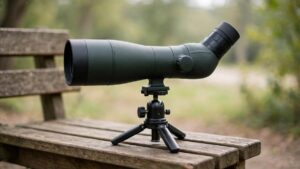
For a spotting scope used to find and follow wildlife, the fluid head is this guide’s default recommendation, and the reason can be tested in any shop: mount the scope, set 40x, and attempt to follow a person walking across the view. On a fluid head with its drag set to your taste, the walker crosses a steady field. On a ball head, the same task is a negotiation. Digiscoping strengthens the verdict, because a camera behind a scope multiplies every movement into the recording, and smooth video, and even sharp stills at long effective focal lengths, begin with a head that does not lurch. Size the fluid head to the scope’s balance as much as its weight: a sliding plate that lets the scope sit at its centre over the head, counterbalance that holds it at a tilt without a lock, and drag with enough range for both a still dawn and a windy estuary. The compact fluid parish, Sirui VA and Benro S classes, serves the travelling birder; the Manfrotto 500 class serves the scope that lives at full size; and the birder who also photographs should read the next parish before concluding that two heads are an extravagance.
Cameras, landscapes and travel: the ball parish, with one hybrid answer
For a camera that composes and rests, landscape, portrait, architecture, astro in its tracked and untracked parishes, the ball head remains the correct tool: fastest to position at any angle including the verticals and the overheads a fluid head cannot reach, smallest on the legs and in the bag, and, in the premium parish of Really Right Stuff, Markins, and Kirk, a piece of engineering whose lock is a certainty rather than a hope. Travel strengthens the case, because a ball head’s weight and bulk parish is a fraction of a fluid head’s. The hybrid answer, for the worker whose legs must serve a scope on Saturday and a camera on Sunday, is a good fluid head for the scope plus either a ball head swapped on the same legs, a five-minute parish with a single centre column screw, or, in the modern parish, a fluid head whose plate and a ball head share the Arca standard so instruments move between them without re-plating. What does not work, and should not be bought, is the cheap pan-and-tilt photo head or the bundled kit head asked to serve a scope: its axes move without drag engineering, its locks flex, and it files, at magnification, as a ball head’s taxes without a ball head’s virtues.
Legs are shared, and they are half of either verdict
Both heads stand on the same truth: legs decide stability, height, and carry, and a fine head on flexing legs is a rumour of quality. For scope work, legs should reach the eyepiece to a standing observer’s eye without extending a centre column into its wobbly parish, because a raised centre column is a monopod balanced on a tripod and the view at 60x will say so. Carbon fibre buys stiffness per gram and a kinder touch in cold weather at a premium; aluminium buys the same parish heavier and cheaper and entirely respectably. Leg locks, section count, and folded length are travel facts to be measured against a bag and a car, and the whole kit, legs, head, scope, should be carried assembled at home across a field’s worth of garden before a trip discovers that its balance point is exactly where no handle is.
Buying Guide: Follow Something at 40x Before You Pay
The purchase tests in order
Test any head with your own instrument, at working magnification, following a moving subject, and let that test outrank every specification in this article. For a fluid head, check in order: counterbalance that holds your scope at a tilt, hands off, without creep; drag with a usable range, from near-free for fast work to a resistance that makes a slow marsh pan read like a dolly shot; a sliding plate long enough to balance the scope; locks that are absolute when you want stillness; and a pan bar positioned for your hand, left or right as models allow. For a ball head, check: a friction preset that lets the instrument be moved without being dropped by its own weight; a separate, smooth pan base if your work pans at all; a clamp in the Arca parish with a plate that suits your instrument’s foot; and a ball large enough that its lock, tested with the scope at its most leveraged angle, does not move by a hair. In both parishes, buy the head one class above your instrument’s weight, because leverage, wind, a camera added for digiscoping, and your next, larger scope are all already in the room.
Care and the long parish
Keep either head as its maker directs: grit is the enemy of every moving parish, so a head used on beaches and estuaries earns a brush, a cover, and a rinse parish exactly as its manual states, and no improvisation with household lubricants, because a fluid head’s drag is a designed system and a ball’s behaviour lives in its tolerances. Store plates on instruments rather than in a drawer of good intentions, keep a spare plate for the second instrument, and check leg locks, head locks, and plate screws in the home parish at the season’s turn, because a tripod’s failures are announced quietly, in a creep, a play, a stiffening, long before they are announced at a cliff edge. The fluid head tripod vs ball head tripod question, resolved, is a question about movement: the fluid head, Manfrotto’s 500 class at the scope’s centre, for the instrument that follows, the ball head, the premium parish entire, for the instrument that composes, and legs beneath either that reach the eye without a column’s apology, and in that company an observer stops fighting the support and starts, at last, simply watching through it, which was the entire point of putting three legs under a lens.
Frequently Asked Questions
Which is better for a spotting scope, a fluid head or a ball head?
A fluid head, for almost every spotting scope use that involves finding, following, or recording a living subject. Its separate pan and tilt axes, adjustable drag, and counterbalance let you follow an animal at high magnification in a smooth, centred field, pan a shoreline at a readable speed, and leave the scope sitting at an angle without locking it, none of which a ball head, whose axes release together, can match without a continuous negotiation. A ball head can hold a scope perfectly well once it is aimed, and a travelling observer who parks on a nest, a feeding ground, or a migration watchpoint and rarely pans may be well served by a strong, friction-controlled ball head’s smaller parish. Test with your own scope at 40x, following a walker, before deciding, because thirty seconds of that experiment contains more information than this entire article, and every honest dealer in the parish knows it.
Can I use a ball head for video or digiscoping?
You can record through a ball head, and many do, but you will be working against the tool in every moving shot. A ball head has no drag system, so a pan begins with the break of static friction, a lurch the recording magnifies, continues at whatever speed your hand improvises, and ends with a lock that shifts the framing as it tightens. For a static camera, a locked ball head is an excellent, rigid support, and for occasional, short, forgiving clips it suffices. For digiscoping a moving bird, filming wildlife behaviour, or any video whose motion is part of its quality, a fluid head is not an upgrade but the correct instrument, and the compact fluid parish in the Sirui and Benro classes exists precisely for the travelling digiscoper who once believed a ball head would do. Buy the fluid head for the moving parish and keep the ball for the stills, and let each do the work it was engineered for.
What load rating do I need for a tripod head?
More than the instrument weighs, by a margin that accounts for leverage, and read as a class rather than a guarantee, because makers test under their own conditions. A spotting scope is a long lever: its weight acts at a distance from the head, a camera added behind it extends the lever further, and wind on a scope body is a load no scale at home will show you. As a working rule, choose a head whose stated parish is comfortably, at least half again and preferably twice, your whole mounted load, scope, plate, camera where fitted, and then test its lock and its counterbalance with your own kit at its most awkward angle. For ball heads, the same margin is what separates a lock that is a fact from a lock that is a hope at a tilt. An under-rated head rarely announces itself by breaking; it creeps, sags, and vibrates, filing its inadequacy across a season of slightly spoiled watching, which is a more expensive failure than its price difference ever was.
Do I need different tripod heads for my scope and my camera?
Ideally, yes, and in practice, one good set of legs can carry both parishes handsomely. The scope wants a fluid head, the camera, for most stills work, wants a ball head, and swapping a head on a set of legs is a matter of minutes at home and a plausible parish in the field for the organised. Standardise your plates on the Arca parish where your heads allow it, so scopes and cameras move between heads without a screwdriver, keep a plate on each instrument permanently, and the two-head system becomes a kit rather than a compromise. The worker who truly uses only one instrument, or whose camera work is all video, or whose scope work is all static, can own one head with a clear conscience. The worker who follows birds by day and composes landscapes by evening will find, as most in that parish do, that the second head costs less than the season of fighting the first one at the wrong job.
Related guides
- Best Film Rangefinder Camera in 2026: 7 Film Rangefinder Cameras That Give You Sharp Photos, Quiet Shutters, and Classic 35mm Film Photography
- Best Thermal Monocular Battery for Night Hunting 2026: 6 Batteries With Long Runtime, Cold Weather Performance, and Reliable Power for Night Hunting
- Best 2000 Yard Rangefinder in 2026: 7 Rangefinders for 2000 Yard Ranging
- Best Rangefinder Under 300 in 2026: 7 Rangefinders Under $300 That Give You Accurate Distance, Fast Readings, and Clear Displays for Hunting and Golf
More from Amazon
Programs that pair well with the guide above. Offers and eligibility are set by Amazon and may change.
Free shipping on eligible items, Prime Video and more. Eligible new members can start with a free trial.
Start a Prime free trialAudiobooks and podcasts to listen to on the go. Eligible new members can start with a free trial.
Try Audible freeAd-free music streaming. Eligible new subscribers can start with a free trial.
Try Music Unlimited freeA free business account with business pricing and bulk-buying tools for work, shop or home office.
Create a business accountAs an Amazon Associate we earn from qualifying purchases.

Write Your Review
No reviews yet. Be the first to share your experience!