
What's inside
- What Makes the Best Budget Spotting Scope for Birding Wetlands Different
- Quick Comparison: Best Budget Spotting Scope for Birding Wetlands Models
- Detailed Reviews: Best Budget Spotting Scope for Birding Wetlands Picks by Birder
- Buying Guide: Choosing the Best Budget Spotting Scope for Birding Wetlands
- Frequently Asked Questions About Best Budget Spotting Scope for Birding Wetlands
As an Amazon Associate I earn from qualifying purchases. This post may contain affiliate links at no extra cost to you.
The best budget spotting scope for birding wetlands is chosen by the marsh’s own conditions, because a wetland is the hardest inexpensive assignment in birding: birds that sit a hundred yards out across open water, in flat grey light, behind heat shimmer off the mud at noon and under a dawn sky that gives a cheap lens almost nothing to work with. A spotting scope earns its place there by resolving the difference between shorebirds that differ by a bill’s length and a leg’s colour, at distances where binoculars have honourably retired, and by surviving the environment that produces those birds, boardwalk damp, hide humidity, sea spray at the coast, and the walk back in weather that was not in the forecast. The six scopes below are the budget field’s honest citizens, from Vortex, Celestron, Athlon, Gosky, and Svbony, dividing into the mid-budget instruments that genuinely resolve a marsh and the entry instruments that introduce it, and they are judged as systems, because a scope is a tripod with a lens on it in every practical sense: the head’s smoothness, the support’s steadiness in a boardwalk’s foot traffic and a marsh wind, and the eyepiece’s comfort across a morning are specifications as real as the glass, and a budget divided wrongly between them is the commonest mistake in this category.
Optics for wetlands obey the marsh’s arithmetic. Magnification in the 20-to-60 class in the makers’ terms covers the work, with the honest secret that most wetland birding lives between 25 and 45 power, where the image is brightest, the shimmer is least amplified, and a flock can be swept rather than stalked bird by bird. Objective size is the dawn’s specification: a larger front lens, in the 80mm class and above in the makers’ figures, gathers the flat light a marsh morning offers and keeps the image usable at the higher powers, while a 60mm class scope travels lighter and cheaper and gives back the day’s first and last twenty minutes. Angled bodies, in the makers’ designs, own this habitat for reasons of pure posture: a group sharing the scope at different heights, a seated hide session, a tall birder’s neck across a long morning, all argue for the angled eyepiece, and every row in this table is angled or offered angled in its maker’s terms. Waterproofing and fogproofing, in the makers’ published constructions, are not features here but citizenship, because a scope that fogs internally in a damp hide is a tube with a view of its own weather.
The ethics and the fieldcraft are this site’s standing text, translated for marsh birds. Wetland birds are watched from the bird’s distance, which a scope exists to provide: the flock that flushes at your approach has spent energy it was saving for migration or for winter, and the scope’s whole purpose is to make that approach unnecessary, so set up on the boardwalk, the hide, or the dike at the distance the birds themselves declare by their calm, and let the glass cross the rest. Nests, colonies, and roosting concentrations get a wider berth in their seasons as the site’s rules and reputable birding codes direct, and a rare bird’s location is shared with the discretion your local birding community’s guidance prescribes, because a crowd is also a disturbance. The scope is never, under any circumstances, pointed at or near the Sun, in this site’s absolute rule for every optic it covers, a rule a wetland morning tests when birds fly east into the light: admire the silhouettes with the naked eye, and swing the scope the other way. With those terms kept, the budget scope on a boardwalk is one of birding’s great democratic instruments, and the table below prices its admission honestly.
Our Top Picks
What Makes the Best Budget Spotting Scope for Birding Wetlands Different
Brightness at Working Magnification, and the Tripod Underneath It
Buy for the powers you will use, which on a marsh are the middle ones. A scope’s exit pupil and its coatings, in its maker’s published terms, decide how bright and contrasty the image is at 30 and 40 power in flat light, and that is where a dowitcher becomes identifiable rather than probable. Read the reviews and the makers’ figures for that working behaviour rather than for the maximum magnification’s brag, because 60 power on a budget scope over sunlit mud is mostly a shimmer amplifier, beautiful and useless, while the same scope at 35 is an identification instrument. Heat shimmer is the wetland’s weather inside the optics, worst over dark mud at midday, least in the first hours and over open water, and the experienced marsh birder schedules around it exactly as they schedule around tides: dawn for the light and the calm air, the scope at moderate power, and the long scans done before the marsh starts to boil in the eyepiece.
The tripod is the scope’s other half and the budget’s most common false economy. A scope at 40 power magnifies the support’s every tremor with the bird, and a marsh adds its own motion, wind off open water, boardwalk planks flexing under other birders’ boots, a hide’s wooden floor drumming with a shifted chair. A tripod and head in their makers’ classes that hold the scope at your eye height, seated or standing as your birding demands, with a smooth panning head in its design that lets a flock be followed without a lurch, is worth a full price class of glass, and this guide’s budget advice is explicit: buy one class down in scope before buying one class down in tripod, because the steady ordinary image identifies more birds than the shaking excellent one. Set the legs on the firmest ground the site offers, hang a bag’s weight from the column hook where the design provides one in a marsh wind, and keep the scope’s height no taller than the session needs, since every unnecessary inch of extension is an inch of sway purchased with your own money.
Reach, Eyepiece Comfort, and Sharing the View
Wetland birding is social in a way woodland birding is not: the bird is far, the scope is the group’s instrument, and an eyepiece with generous eye relief in its maker’s terms, friendly to glasses, with a twist-up cup in its design that sets each viewer’s distance in a second, is the difference between a shared identification and a queue of squints. Zoom eyepieces in the makers’ classes are this category’s standard for a reason, the flock found wide and the bird examined close without an eyepiece change in the damp, and their behaviour at the working middle of their range is, again, the specification that matters. A rotating collar, where the maker’s design offers it, lets an angled scope’s eyepiece be turned for a seated hide window or a child’s height without moving the tripod, a small mechanism that a morning in a hide promotes to a headline feature.
Digiscoping deserves its sentence, because a wetland scope and a phone are the modern pair: an adapter in the accessory makers’ terms that holds a phone to the eyepiece turns the scope into a long lens for the record shot, the rarity documented, the identification argued over at home from evidence. Budget scopes serve it well at moderate powers in good light, which is the marsh’s morning exactly, and the adapter costs less than the tripod’s head. Keep the phone’s own flash and sounds disciplined in the hide as the site’s etiquette directs, shoot from the birds’ distance as always, and let the photograph be the scope’s by-product rather than its purpose, because the birder who watches through a screen all morning has carried a fine instrument to a marsh in order to look at a phone, and the birds deserve the compliment of being watched.
Quick Comparison: Best Budget Spotting Scope for Birding Wetlands Models
| Model | Magnification, Objective, and Key Specs in Maker’s Terms | Best Wetland Birder | Typical Price Range | Rating |
|---|---|---|---|---|
| Vortex Diamondback HD 20-60×85 Classes | Angled classes in maker’s terms, waterproof classes | Serious marsh birding on a mid budget | $400 – $500 by version | 4.7 / 5 |
| Celestron Ultima 80 Classes | 20-60×80 classes in maker’s terms | First real scope, hides and boardwalks | $180 – $230 by version | 4.4 / 5 |
| Athlon Talos 20-60×80 Classes | Angled classes in maker’s terms | Value hunters wanting a rotating collar class | $200 – $260 by version | 4.4 / 5 |
| Svbony SV406P Classes | Angled ED classes in maker’s terms | Glass-led buyers on a strict budget | $230 – $300 by version | 4.5 / 5 |
| Gosky 20-60×80 Classes | Angled classes in maker’s terms, phone adapter classes | Beginners and digiscoping starters | $130 – $180 by kit | 4.2 / 5 |
| Celestron Ultima 65 Classes | 18-55×65 classes in maker’s terms | Walking birders, lighter carry | $130 – $170 by version | 4.2 / 5 |

20-60x85 Spotting Scope with Full Size Tripod for Birding & Wildlife Falcon | With Phone Adapter and Cleaning Kit, 101-48 ft/1,000 yd FOV, BAK4, FMC, Waterproof & Fogproof, Fine Focus Control for Hunting
As an Amazon Associate we earn from qualifying purchases. Product prices and availability are accurate as of the date/time indicated.
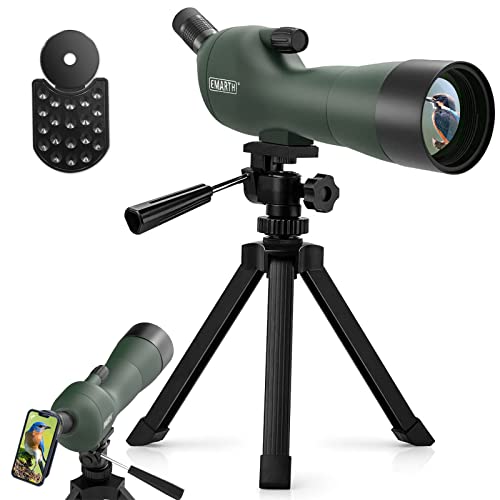
Emarth 20-60x60 Angled Spotting Scopes for Target Shooting/Hunting/Birding | 1.37lb light Spotting scope for Target Shooting w/Tripod 14" tabletop/Carry Bag, spotter scope for Hunting/Birding/Wildlife
As an Amazon Associate we earn from qualifying purchases. Product prices and availability are accurate as of the date/time indicated.

Celestron Ultima 22-66x100 Spotting Scope for Long-Range Viewing | Large Objective Lens, Long-Range Birding & Wildlife Viewing, Fully Multi-Coated, Smooth Focusing, Waterproof Construction
As an Amazon Associate we earn from qualifying purchases. Product prices and availability are accurate as of the date/time indicated.
Magnification range, objective diameter, eye relief, waterproof and fogproof construction, and weight are each maker’s specification for the current version and must be confirmed in the listing, because several names cover angled and straight variants. Prices are typical street ranges for the scope as shown, with a tripod and head additional in every row and essential to the system. Ratings reflect budget wetland suitability: brightness and resolution at working magnifications, weather sealing, eyepiece comfort for glasses and groups, and value as a scope-and-tripod system.
Detailed Reviews: Best Budget Spotting Scope for Birding Wetlands Picks by Birder
1. Vortex Diamondback HD 20-60×85 – Best Budget Spotting Scope for Birding Wetlands Overall
The Diamondback HD leads this table as the budget’s serious marsh instrument: an 85mm objective in Vortex’s terms gathering the dawn properly, HD optical design in the maker’s language for the contrast flat light demands, waterproof and fogproof construction in its published build, and an eyepiece whose comfort across a morning its owners praise in the terms this guide weights most. At the working powers where shorebirds are separated, it resolves what the rows below it gesture at, and that resolution, across a season of tides, is the difference between a list of probables and a list of birds.
For a committed wetland birder, this is the recommendation here, on a tripod bought with the same seriousness, because this scope deserves a support that does not ration it. Its warranty culture in Vortex’s published terms is the budget tier’s deepest insurance, a real consideration for an instrument that lives in damp hides and car boots. It costs the table’s ceiling and returns it in the only currency a marsh pays, identifications, made calmly, at distance, in the day’s first grey hour when the budget rows are still waiting for the light to help them.
2. Svbony SV406P – Best Glass in a Budget Spotting Scope for Birding Wetlands
Svbony’s SV406P is the glass-led insurgent: an angled scope in the maker’s terms with ED glass classes in its design at a price the established names reserve for ordinary glass, giving it a colour honesty and an edge crispness at working powers that embarrass its tier. For the birder whose identifications turn on subtle plumage tones in flat light, a grey shorebird’s exact shade of almost-nothing, that optical ambition at a budget figure is the most interesting proposition in this table.
For a glass-led buyer, this is the recommendation here, bought from a seller whose returns are easy, as this guide advises for every insurgent brand, and inspected on arrival with the sky and a distant sign as the test chart. Its mechanics and finish are its price’s honest neighbourhood, a step behind the Vortex’s, and its owner trades a little polish for a lot of lens. Across a marsh, where the lens is the instrument and the polish is a pleasure, that trade has a great many satisfied signatories.
3. Celestron Ultima 80 – Best First Budget Spotting Scope for Birding Wetlands
The Ultima 80 is the category’s first real scope for a generation of birders: an 80mm angled instrument in Celestron’s terms at the price where the hobby becomes possible, with a zoom eyepiece in its classes, weather-resistant construction in its terms, and an image at the working powers that turns a marsh from a rumour into a field guide with a pulse. Its limits are its price’s, a softness at the top of its zoom and a hunger for light at dawn that the 85mm rows feed better, and they are the correct limits for its station.
For a first scope, this is the recommendation here, with the tripod rule applied in its favour: buy this scope and a genuinely steady support before buying a finer scope and a trembling one, because the Ultima on a good tripod out-birds a premium scope on a bad one every morning of the season. It is also the digiscoping starter’s friend, its eyepiece accepting the common adapters in the accessory makers’ terms. A birder’s first scope should be bought to be outgrown happily, and this one has launched more second scopes than any row here, which is a compliment about the first.
4. Athlon Talos 20-60×80 – Best Value Budget Spotting Scope for Birding Wetlands
Athlon’s Talos competes on completeness at its price: an 80mm angled scope in the maker’s terms with a rotating collar class in its design that hide birders will use daily, waterproof construction in its published build, and optics that sit in the honest middle of this table, which at its street figure is a compliment with money attached. It is the row for the birder who priced the Ultima, wanted a little more instrument, and found the increment here rather than at the Vortex’s altitude.
For a value hunter, this is the recommendation here. Its eyepiece and mechanics serve a morning without complaint, its collar earns its keep the first time the scope is shared across a hide’s bench, and its maker’s warranty terms give the budget buyer a paperwork floor the anonymous tier cannot. In a table of specialists it is the generalist, and a marsh, which asks a little of everything before breakfast, respects a generalist.
5. Gosky 20-60×80 – Best Starter Kit Budget Spotting Scope for Birding Wetlands
Gosky’s kit is the marsh’s front door: an 80mm angled scope in the maker’s terms sold with the accessories a beginner actually needs, a phone adapter in its kit classes for the record shot, a small tripod in its box whose role this guide will describe honestly in a moment, and a price that makes the first season’s experiment nearly free. Its optics at the working powers introduce the marsh properly, bright enough at 25 to 35 power to separate the common shorebirds and teach the eye its trade.
For a beginner, this is the recommendation here, with its one condition printed large: the included tripod is a table tripod in spirit, fit for a hide shelf, and a standing birder should budget a real tripod with the purchase, because the system’s steadiness is the scope’s resolution in every practical sense. Bought with that understood, it is the cheapest honest introduction to wetland scope birding in this guide, and its phone adapter will document the morning a beginner becomes a birder, which is a moment worth the whole price.
6. Celestron Ultima 65 – Best Lightweight Budget Spotting Scope for Birding Wetlands
The Ultima 65 trades aperture for legs: a 65mm scope in Celestron’s terms that walks to the far hide, rides in a day pack, and sets up on the dike where the bigger glass stayed in the car for reasons of weather and will. Its image gives back the dawn’s edges to its larger siblings and keeps the working day entirely, and for the birder whose wetlands are reached on foot, across a reserve’s whole trail system, its lightness is not a compromise. It is the reason the scope is present at all, and a present scope out-birds an absent flagship by an infinite margin.
For a walking birder, this is the recommendation here, paired with a tripod in the travel classes in its makers’ terms whose height still reaches your eye, because a light scope on a short tripod is a system arguing with itself. It is also the second-scope answer for the Diamondback’s owner, the grab-and-go instrument for an hour’s opportunistic marsh. Categories need their travellers, and this row, humble in aperture and heroic in attendance, is this table’s.
Buying Guide: Choosing the Best Budget Spotting Scope for Birding Wetlands
Aperture for the Dawn, Angled for the Morning, and Half the Budget’s Respect to the Tripod
Buy in this order. Aperture first, by your birding’s hours: the 80mm class and above in the makers’ figures if your marsh is a dawn and dusk place, the 65mm class if your birding walks far and lives at midday, because the front lens is the light budget every other specification spends. Body second: angled in the maker’s design for hides, groups, and seated hours, which is most wetland birding, with eye relief in its terms that serves your glasses if you wear them. System third and priced entire: scope, a tripod and panning head in their makers’ classes tall enough for your posture and steady enough for a marsh wind, a phone adapter where digiscoping calls, and a rain cover or case in the accessory makers’ terms for the habitat’s weather, because the system is what arrives at the marsh and the scope alone is a component. Glass last within the budget that remains, ED and HD classes in their makers’ terms where the money reaches, because at the working powers their contrast is the identification, and a birder who has priced the system whole can spend the remainder on lens with a clear conscience.
Watch From the Birds’ Distance, Mind the Shimmer, and Never Toward the Sun
Use the scope as the habitat teaches. Arrive for the light and the tides, set up where the birds’ calm says you may, boardwalk, hide, or dike, and let the glass cross the distance so the flock never has to spend itself on you. Work the middle powers, sweep wide for the flock and close for the bird, and read the shimmer’s schedule like weather, the fine identifications made in the calm early air and the midday hours given to scanning and to lunch. Share the scope as the social instrument it is, eyepiece set for each viewer, identifications talked through the field marks aloud, because a marsh morning’s knowledge compounds in company. Keep the absolute rule without exception: never point the scope at or near the Sun, and be careful swinging it across an eastern dawn, because an optic concentrates light exactly as it concentrates everything else it is pointed at.
Maintain the instrument for its damp parish. Wipe lenses by the optics method this site always prescribes, blower first, brush second, cloth and fluid last and sparingly, because a marsh’s grit is an abrasive with a tide table. Dry the scope before it is cased after a wet session, store it in moving air rather than in a sealed damp bag, keep its caps on in transit, and check the tripod’s leg locks and head for the grit the habitat donates. Review the system each season against the birding it served, and let the evidence, the dawns lost to a small aperture, the identifications lost to a trembling head, name the next purchase in the order it was lost. The best budget spotting scope for birding wetlands, in the end, is the one still resolving a dowitcher at dawn in its third season, and every entry in this table, supported properly and pointed with respect, has made exactly that identification on somebody’s finest marsh morning.
Frequently Asked Questions About Best Budget Spotting Scope for Birding Wetlands
What is the best budget spotting scope for birding wetlands?
The Vortex Diamondback HD 20-60×85 classes are the best budget spotting scope for birding wetlands overall, for dawn brightness, flat-light contrast, weatherproof build, and eyepiece comfort across a long morning. Svbony’s SV406P leads on glass per dollar, Celestron’s Ultima 80 is the first-scope benchmark, Athlon’s Talos is the value generalist, Gosky’s kit starts beginners, and the Ultima 65 serves walking birders. Whichever you choose, buy angled for hides and groups, size the objective to your hours, and price a genuinely steady tripod and panning head into the same purchase, because the support is half the instrument at marsh magnifications.
What magnification do you need for wetland birding?
Less than the box suggests, used in its middle. Most wetland identification happens between about 25 and 45 power, where the image is brightest, the field is wide enough to sweep a flock, and the heat shimmer off mud and water is least amplified; the 20-to-60 zoom classes in this guide cover that band with room on both sides. Maximum power earns its keep on calm, bright mornings for a distant rarity, and disappoints at midday over shimmer, when dialling down produces the clearer, more identifiable image. A larger objective, in the 80mm class and above in the makers’ terms, matters more than top magnification, because it keeps the working powers bright at dawn and dusk, which is when a marsh is most alive.
Angled or straight spotting scope for wetlands?
Angled, for most wetland birding, and every recommendation in this guide follows that rule. An angled eyepiece serves a seated hide session without a crick, lets a group of different heights share the scope with only the tripod’s height adjusted, and is kinder across a long morning of looking slightly down at birds on water and mud. Straight scopes keep a small following for following flight and for standing-only, eye-level work, and a rotating collar on an angled scope answers most of their cases anyway. Glasses wearers should confirm eye relief in the maker’s terms for the exact model, and everyone should rehearse the angled scope’s one learning curve, finding the bird by sighting along the body, at home before the marsh examines them on it.
How much should you spend on a tripod for a budget spotting scope?
Enough that the scope’s image is steady at 40 power in a marsh wind, which usually means a real tripod and panning head in their makers’ classes rather than the table tripod in a starter kit’s box, and this guide’s rule is to step down a class in scope before stepping down in support. The support must reach your eye at your working posture, seated in a hide or standing on a dike, without extending its thinnest leg sections or its centre column to their trembling limits, and its head should pan smoothly enough to follow a flock without a lurch. Hang a bag from its hook where the design provides one on windy days, set it on the firmest ground available, and count it as half the optical system in the budget, because at these magnifications it functionally is.
Related guides
- Best Spotting Scope Under 100 Dollars for Whale Watching in 2026: 6 Top Spotting Scopes Under 100 Dollars for Whale Watching, Clear Whales, and Easy Use
- How to Choose Night Vision Infrared for Beginners: 6 Beginner Night Vision Devices in 2026
- Best Spotting Scope for Glacier Viewing Trips in 2026: 7 Bright Spotting Scopes That See Ice, Crevasses, and Wildlife Across Cold Valleys
- Best Mid Range Spotting Scope in 2026: 7 Scopes That Offer Clear Glass, Strong Zoom, and Reliable Use for Hunting and Birding
More from Amazon
Programs that pair well with the guide above. Offers and eligibility are set by Amazon and may change.
Free shipping on eligible items, Prime Video and more. Eligible new members can start with a free trial.
Start a Prime free trialAudiobooks and podcasts to listen to on the go. Eligible new members can start with a free trial.
Try Audible freeAd-free music streaming. Eligible new subscribers can start with a free trial.
Try Music Unlimited freeA free business account with business pricing and bulk-buying tools for work, shop or home office.
Create a business accountAs an Amazon Associate we earn from qualifying purchases.

Write Your Review
No reviews yet. Be the first to share your experience!