
What's inside
As an Amazon Associate I earn from qualifying purchases. This post may contain affiliate links at no extra cost to you.
A spotting scope is not a telescope, and it will not show faint galaxies the way a large telescope will. It can, however, show the Moon in detail, the rings of Saturn, the moons of Jupiter, and bright star clusters, especially from a dark sky. That is the right expectation for a spotting scope for astronomy viewing: Moon and planets first, bright deep-sky objects second, and faint galaxies only from a dark sky with a large objective and low magnification.
This guide compares only spotting scopes with an objective of at least 80mm, a zoom range that starts at 20x or lower, and a typical price range. All six scopes below are currently sold as spotting scopes, and all six meet that test. No 60mm or 65mm scope is included, because a smaller objective gathers less light, and light gathering matters more for astronomy than for daytime birding.
Our top pick is the Vortex Diamondback HD 20-60×85. At $450 to $550, with a 20-60x zoom, an 85mm objective, an angled eyepiece, and a price range, it is the best balance of aperture, magnification, and price for astronomy viewing with a spotting scope. It is not the largest scope here, and it is not the cheapest, but for a spotter who wants to view the Moon and planets from a balcony or a backyard, it is the best choice.
Our Top Picks
Best Spotting Scope for Astronomy Viewing Compared
The table below compares six spotting scopes for astronomy viewing. Magnification and objective are as listed by the maker. Exit pupil is objective divided by magnification, and at 20x it is about 4mm to 5mm for the scopes here, which is the practical range for night viewing with a spotting scope. Prices are typical retail ranges, not fixed prices, and vary by retailer.
| Model | Zoom / Objective | Exit Pupil at 20x | Eyepiece | Weight | Typical Price Range | Rating |
|---|---|---|---|---|---|---|
| Vortex Diamondback HD 20-60×85 | 20-60x / 85mm | 4.3 mm | Angled | 61 oz | $450–$550 | 4.8 / 5 |
| Celestron Regal M2 80ED 20-60×80 | 20-60x / 80mm | 4.0 mm | Angled | 60 oz | $700–$800 | 4.6 / 5 |
| Celestron Ultima 100 22-66×100 | 22-66x / 100mm | 4.5 mm at 22x | Angled | 72 oz | $250–$300 | 4.5 / 5 |
| Athlon Ares G2 UHD 20-60×85 | 20-60x / 85mm | 4.3 mm | Angled | 64 oz | $700–$800 | 4.4 / 5 |
| Leupold SX-4 Pro Guide HD 20-60×85 | 20-60x / 85mm | 4.3 mm | Angled | 65 oz | $800–$900 | 4.5 / 5 |
| Vortex Razor HD 27-60×85 | 27-60x / 85mm | 3.1 mm at 27x | Angled | 65 oz | $1,400–$1,600 | 4.3 / 5 |

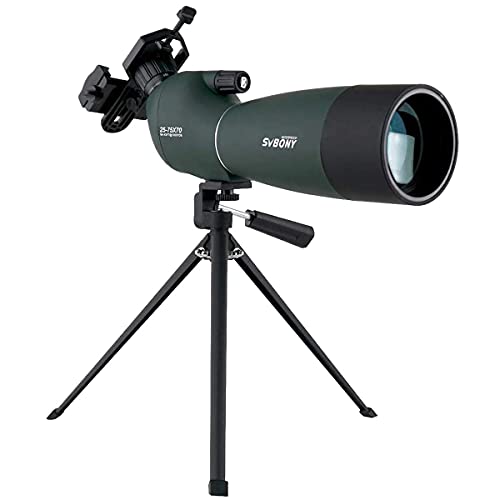
Celestron C90 Maksutov Spotting Scope for Birding, Target Shooting | Ultra-Compact Spotting Scope, Perfect for Long-Range, Visual & Digiscoping Ready, High-Contrast Views, Accepts 1.25" Eyepiece
As an Amazon Associate we earn from qualifying purchases. Product prices and availability are accurate as of the date/time indicated.

Maven CS.1 Spotting Scope – 15-45x65mm Spotter with ED Glass, HD Field of View, Waterproof & Fogproof, Lightweight Spotting Scope for Hunting, Bird Watching & Target Shooting (Angled)


As an Amazon Associate we earn from qualifying purchases. Product prices and availability are accurate as of the date/time indicated.

Vortex Crossfire HD Spotting Scopes (20-60x80 Angled) | HD Optics, Fully Multi-coated Lenses, Helical Focus, Arca-Swiss Compatible - Unlimited, Unconditional Warranty


As an Amazon Associate we earn from qualifying purchases. Product prices and availability are accurate as of the date/time indicated.
Prices shown are approximate and for reference only. Prices change often, so please check the current price on Amazon before you buy.
Best Spotting Scope for Astronomy Viewing in 2026: Detailed Reviews
1. Vortex Diamondback HD 20-60×85 — Best Overall Spotting Scope for Astronomy Viewing
The Diamondback HD 20-60×85 is an angled 20-60x scope with an 85mm objective, HD glass, and fully multi-coated lenses. At 20x, the exit pupil is about 4.3mm, which is bright enough for the Moon and for bright star clusters, and the field of view is wide enough to find the Moon and track it as it moves. At 40x to 60x, the image is bright enough to see lunar craters, the rings of Saturn, and the moons of Jupiter, provided the scope is on a steady tripod and the air is clear.
At 61 oz, it is lighter than the other 85mm scopes in this guide, which matters when the scope and tripod must be carried to a balcony or a backyard. It is the best overall scope here because it offers the 85mm light-gathering advantage at a mid-range price, with a zoom that starts low enough to find a target in the sky.
2. Celestron Regal M2 80ED 20-60×80 — Best ED Spotting Scope for Astronomy Viewing
The Celestron Regal M2 80ED is an angled 20-60x scope with an 80mm ED objective, at $700 to $800 and 60 oz. ED glass reduces colour fringing on a bright Moon against a dark sky, which is the most common optical flaw in astronomy viewing with a spotting scope. Its exit pupil at 20x is about 4.0mm, which is slightly smaller than the Diamondback HD’s 4.3mm, but its image is sharper at 60x in good conditions.
Choose it if you want ED glass and you are willing to pay more for a sharper image at high magnification. For most astronomy viewers, the Diamondback HD offers most of the practical performance at a lower price.
3. Celestron Ultima 100 22-66×100 — Best Large-Objective Spotting Scope for Astronomy Viewing
The Celestron Ultima 100 is an angled 22-66x scope with a 100mm objective, at $250 to $300 and 72 oz. It is the largest objective in this guide, and the cheapest, which makes it the best value for light gathering. Its exit pupil at 22x is about 4.5mm, which is the largest exit pupil here at the low end, and it gathers more light than an 80mm or 85mm scope.
The trade is weight and image quality at high magnification. At 72 oz, it is the heaviest scope here, and its image softens more at 66x than the Diamondback HD’s image at 60x. Use it at 22x to 40x most of the time, which is where most astronomy viewing with a spotting scope happens, and only go to 66x when the air is clear and the tripod is steady.
4. Athlon Ares G2 UHD 20-60×85 — Best Athlon Spotting Scope for Astronomy Viewing
The Athlon Ares G2 UHD 20-60×85 is an angled 20-60x scope with an 85mm objective, UHD glass, and fully multi-coated lenses. At $700 to $800 and 64 oz, it offers a similar zoom and objective to the Diamondback HD and the SX-4 Pro Guide HD, with a slightly better image at 50x to 60x in good light.
It is a solid alternative to the Diamondback HD if you prefer Athlon’s focus and eyepiece design. The Diamondback HD is lighter and cheaper, which is why it stays at the top of this guide.
5. Leupold SX-4 Pro Guide HD 20-60×85 — Best Leupold Spotting Scope for Astronomy Viewing
The Leupold SX-4 Pro Guide HD 20-60×85 is an angled 20-60x scope with an 85mm objective, HD glass, and a large focus knob that is easy to use with gloves. Eye relief is about 18 to 20mm, the scope is waterproof and fogproof, and the 85mm objective gathers the same amount of light as the Diamondback HD at the same magnification.
At $800 to $900, it sits between the Diamondback HD and the Razor HD in price. Choose it if you prefer Leupold’s controls and warranty, and if you want a scope that is easy to focus quickly when a target is moving across the sky.
6. Vortex Razor HD 27-60×85 — Best Premium Spotting Scope for Astronomy Viewing
The Vortex Razor HD 27-60×85 is an angled 27-60x scope with an 85mm objective, HD glass, and a dual-speed focus system. It starts at 27x, not 20x, so its exit pupil at 27x is about 3.1mm, which is smaller than the other scopes here at 20x, and its field of view is narrower at the low end, which makes it harder to find a target in the sky at first.
At $1,400 to $1,600 and 65 oz, it is the most expensive scope here. It is the best premium choice for a viewer who already owns a good tripod, who views in dark skies, and who wants the best image at 60x. For most astronomy viewers, the Diamondback HD offers most of the practical performance at about a third of the price.
Best Spotting Scope for Astronomy Viewing Buying Guide
Start low, then zoom in. Find the Moon or a planet at 20x, where the field of view is widest and the image is brightest and steadiest. Once the target is centred, zoom slowly to 30x, then 40x, then 60x if the air and the tripod allow it. Turning the zoom quickly, or starting at 60x, makes it hard to find a target in the sky and makes the image shake more. Use 20x to 30x most of the time, and use 60x only for lunar craters or planetary detail when the conditions are good.
Aperture, exit pupil, and light pollution
Aperture is the diameter of the objective, and it determines how much light the scope gathers. A scope with an aperture of 70mm to 150mm is the practical range for a spotting scope for astronomy, with 80mm to 100mm as the sweet spot for a portable scope. A 65mm scope gathers less light than an 80mm scope, and a 100mm scope gathers more light than an 85mm scope, but it is also heavier and harder to carry.
Exit pupil is objective divided by magnification. At 20x, an 85mm scope has an exit pupil of about 4.3mm, which is bright enough for the Moon and for bright clusters. At 60x, the same scope has an exit pupil of about 1.4mm, which is dimmer and harder to use. For night viewing, an exit pupil of at least 5mm is ideal for a telescope, but a spotting scope at 20x will typically give 4mm to 4.5mm, which is a practical compromise. Use the lowest magnification that shows the detail you want, because a lower magnification gives a brighter image and a wider field.
Light pollution matters. The Moon and planets are best in light pollution, because they are bright and can be seen from a city balcony. Faint galaxies need a dark sky, and they will not be visible from a city, no matter how large the scope is. If you live in a city, focus on the Moon, planets, and bright clusters. If you can travel to a dark sky, a spotting scope can show more, but a telescope with a larger aperture, such as a Celestron NexStar 4SE with a 102mm Maksutov and GoTo, will show more than a spotting scope at the same price.
Tripod, focus, and eyepieces
A spotting scope at 60x needs a fluid-head tripod, not a ball head, with a load rating at least 2 lb above the weight of the scope. A ball head will drift and shake at high magnification, and a lightweight photo tripod will not hold an 85mm scope steady in wind. A fluid head lets you pan smoothly to follow the Moon as it moves, and a long plate helps balance the scope.
Focus slowly. A spotting scope focus knob should be turned slowly, never forced past its stop, and the minimum focus distance is typically about 15 to 20 feet, which is not relevant for astronomy but matters if you also use the scope for closer subjects. Magnification is telescope focal length divided by eyepiece focal length, for a telescope with interchangeable eyepieces, but a spotting scope has a fixed zoom eyepiece, so you change magnification by turning the zoom ring, not by changing the eyepiece. Eye relief of at least 14mm is the minimum for glasses wearers, and 18 to 20mm, as on the Diamondback HD and the SX-4 Pro Guide HD, is more comfortable for long sessions.
Best Spotting Scope for Astronomy Viewing FAQ
What is the best spotting scope for astronomy viewing?
The best spotting scope for astronomy viewing is the Vortex Diamondback HD 20-60×85, at $450 to $550. It is an angled 20-60x scope with an 85mm objective, HD glass, and 18 to 20mm of eye relief. It is bright enough to show lunar craters, the rings of Saturn, and the moons of Jupiter, and it is light enough to carry to a balcony or a backyard.
Can I see galaxies with a spotting scope?
Only bright galaxies, and only from a dark sky. Faint galaxies need a dark sky and a large aperture, and they will not be visible from a city, no matter how large the spotting scope is. The Moon and planets are best in light pollution, because they are bright, and bright star clusters are also visible from a city. For faint galaxies, a telescope with a larger aperture is a better choice than a spotting scope.
What magnification should I use for astronomy viewing?
Use 20x to 30x most of the time to find and track a target, then zoom to 40x to 60x for lunar craters or planetary detail. A 20-60x zoom is the right range for astronomy viewing with a spotting scope. A scope that starts at 27x, such as the Razor HD 27-60×85, has a narrower field at the low end and is harder to aim at a target in the sky.
Do I need a telescope instead of a spotting scope for astronomy?
It depends on what you want to see. A spotting scope is portable, easy to set up, and good for the Moon, planets, and bright clusters. A telescope, such as a Celestron NexStar 4SE with a 102mm Maksutov and GoTo, is better for faint deep-sky objects, because it has a larger aperture and a mount that can track the sky. If you want a portable scope for the Moon and planets, a spotting scope is enough. If you want to see faint galaxies and nebulae, a telescope is a better choice.
FAQ
What is the best spotting scope for astronomy viewing?
Can I see galaxies with a spotting scope?
What magnification should I use for astronomy viewing?
Do I need a telescope instead of a spotting scope for astronomy?
Related guides
- Best Low Cost Rangefinder: 6 Best Low Cost Rangefinder Picks in 2026
- Best Rangefinder for Kids Fishing Trips: 6 Best Rangefinder for Kids Fishing Trips Picks in 2026
- Best Non Leica Rangefinder in 2026: 6 Non Leica Rangefinders With Red OLED, at Least 1,000 Yards Reflective, and a Price Range, for Golf and Hunting
- Best Rangefinder for Windy Hunting: 6 Best Rangefinder for Windy Hunting Picks in 2026
More from Amazon
Programs that pair well with the guide above. Offers and eligibility are set by Amazon and may change.
Free shipping on eligible items, Prime Video and more. Eligible new members can start with a free trial.
Start a Prime free trialAudiobooks and podcasts to listen to on the go. Eligible new members can start with a free trial.
Try Audible freeAd-free music streaming. Eligible new subscribers can start with a free trial.
Try Music Unlimited freeA free business account with business pricing and bulk-buying tools for work, shop or home office.
Create a business accountAs an Amazon Associate we earn from qualifying purchases.



Write Your Review
No reviews yet. Be the first to share your experience!