
What's inside
- What Makes the Best Spotting Scope for Deer Hunting at Dawn
- Quick Comparison: Best Spotting Scopes for Deer Hunting at Dawn Compared
- Best Spotting Scopes for Deer Hunting at Dawn: The Six Reviewed
- Buying Guide: Building the Dawn Watch System
- How We Selected the Best Spotting Scopes for Dawn Deer Hunting
- Frequently Asked Questions About Spotting Scopes for Dawn Deer Hunting
As an Amazon Associate I earn from qualifying purchases. This post may contain affiliate links at no extra cost to you.
The best spotting scope for deer hunting dawn is bought for the most valuable and least forgiving half-hour in the hunting year: the grey window after legal light begins, when the deer are moving, the fields are still shadow, and the question the whole season hangs on — is that the buck, and is he legal, and is he worth the tag — must be answered through glass, at distance, in light that is more rumour than fact. A spotting scope earns its place in that window by a specification the midday shopper never thinks to ask about: how much light it can deliver to the eye at the magnifications where identification happens. This guide compares the real scopes that serve the dawn watch best, and its organising arithmetic is the exit pupil — the objective’s diameter divided by the magnification — because at dawn the scope whose exit pupil still matches your own dark-adapted eye shows you the deer, and the scope whose has shrunk to a pinhole shows you a darker version of your own uncertainty. Everything else in this guide — the ED glass, the coatings, the 65-versus-85 decision — is commentary on that one division sum.
Understand the dawn problem precisely, because it is three problems wearing one grey coat. The first is quantity: there is simply little light, and it is arriving from a low sun through the longest path of atmosphere, which is why the objective’s size — the light bucket’s mouth — matters more at dawn than at any other hour, and why the twilight performance of the great European houses is a reputation earned in exactly these minutes. The second is quality: the dawn deer’s colours are muted to monochrome, its edges soft against brush and shadow, so the glass’s contrast and resolution — the ED elements that keep the image crisp rather than merely bright, the coatings that pass the light instead of reflecting it back at the sky — decide whether the antler’s third point is a fact or a hope. The third is judgment: dawn identification is a legal and ethical act before it is an optical one, because the antler restrictions, the sex and season rules, and the hunter’s own standard all demand certainty, and the scope that cannot deliver certainty at the distance must deliver the other virtue — the patience to let the deer come closer or the light come up. This guide grades the scopes on the first two problems and preaches the third throughout, because no glass ever made has excused a guess with a trigger behind it.
The field frame completes the introduction. The dawn watch is a stationary hunt — the scope on its tripod, the hunter settled before light, the glass doing the walking — which forgives the weight that the mountain hunt cannot, and this guide’s table therefore includes the great 85mm light buckets that a backpack would refuse, labelled with their parish. The law is read before the season, as always on this site: the hunting hours, the antler and sex restrictions, the optics rules of the reader’s own jurisdiction — a few places govern what may be used to locate game, and all of them govern when a shot may be taken — and the landowner’s and the lease’s own conditions. Eye strain is the dawn watch’s occupational tax, answered by the angled eyepiece’s posture and the discipline of resting the eye, both covered below. And the scope is only the middle of the system: the tripod that holds it still at 45 power in a dawn breeze is the other half of the image, and it is priced into the buying guide as it always is on this site. Within that frame, the dawn watch is deer hunting’s highest craft, and the scopes below are its instruments.
Our Top Picks
 Bushnell Engage DX 20-60x80 EXO Barrier Spotting ScopeOne Size17.75 x 11.25 x 10.25 inches1 poundsCheck on Amazon
What Makes the Best Spotting Scope for Deer Hunting at Dawn
Exit Pupil and Objective Size: The 65 vs 85 Decision
Run the arithmetic that decides this entire category. A 65mm scope at 45 power delivers an exit pupil of about 1.4mm — a dim thread of light, usable at noon, starved at dawn. The same scope at 20 power delivers over 3mm, and at 15 power more than 4mm — approaching the dark-adapted eye’s own aperture and therefore approaching the brightest image the scope can ever give. The 85mm class moves every one of those numbers up by a third: at 27 power it delivers what the 65 delivers at 20, and it holds a usable pupil deep into the magnifications where antler points are counted. The doctrine follows, and it is the dawn watcher’s whole method: identification at dawn is done at the lowest magnification that resolves the question, because every step up the zoom is paid for in light — and the scope is bought by how much light it keeps at the powers your distances demand. The stand hunter glassing a field at two hundred yards lives at 20 power and is served beautifully by a fine 65; the western watcher judging mule deer across a basin at eight hundred lives at 40 and needs the 85’s bucket. Your distance, paced or mapped honestly, chooses the class — and the table is organised by that choice.
ED Glass and Coatings: Contrast Is the Dawn’s Currency
At noon, brightness is cheap and every scope in this table is bright. At dawn, the image is built from contrast — the deer’s edge against the brush, the antler against the sky’s first light — and contrast is manufactured by the glass’s quality and its coatings, which is why the dawn parish is where the price ladder’s steps are most honestly earned. ED and HD glass — the low-dispersion elements that keep colours focused to a single point — preserve the fine detail that antler judgment lives on: the brow tine’s presence, the beam’s mass, the difference between a point and a shadow’s suggestion. Full multi-coating on every air-to-glass surface passes the scarce light through the scope instead of taxing it at each element, a difference that is a rounding error at noon and a visible tax at dawn. The beginner’s translation is simple: at dawn, you are not buying magnification, you are buying the last fifteen minutes of usable light, and those minutes are sold by the glass’s quality more than by any other line in the specification. The reviews grade them so.
Eyepiece, Eye Relief, and the Watcher’s Endurance
The dawn watch is an endurance event for one eye, and its ergonomics decide whether the hunter is still glassing carefully at the end of legal light’s first hour. The angled body is the watcher’s standard, because it lets the scope sit lower on a shorter, steadier tripod and lets the hunter look down into it from a seated posture that can be held without the neck’s rebellion — the straight body serves the window mount and the prone parish, and is the dawn field’s second choice. Eye relief must serve the glasses many dawn hunters wear against the cold and their own prescriptions, confirmed on the maker’s figures. The zoom’s range is read by its low end as much as its high: the scope that starts at 15 or 20 power owns the bright, wide searching image the dawn begins with, and the one that starts at 27 has already spent light the first minutes cannot spare. And the focus — a smooth dual or helical control that a cold, gloved finger can feather — is the difference between an antler resolved and an antler imagined, at the exact moment the season asks the question.
Quick Comparison: Best Spotting Scopes for Deer Hunting at Dawn Compared
| Spotting Scope Model | Class / Best For | Key Specs | Typical Price Range | Rating |
|---|---|---|---|---|
| Vortex Razor HD 27-60×85 | 85mm — best spotting scope for deer hunting dawn overall | 85mm objective, premium HD glass, angled body, the dawn light bucket of its class as published | $1,500 – $1,800 | 4.8 / 5 |
| Leupold SX-4 Pro Guide HD 15-45×65 | 65mm — best dawn value and low-end zoom | 65mm, 15x low end for bright searching, HD glass, twilight-oriented coatings as published | $700 – $900 | 4.6 / 5 |
| Vortex Viper HD 15-45×65 | 65mm — best mid-price dawn scope | 65mm, 15-45x zoom, HD glass, angled and straight versions as published | $550 – $750 | 4.5 / 5 |
| Athlon Ares G2 UHD 15-45×65 | 65mm — best glass per dollar | 65mm, UHD glass, 15x low end, the value challenger as published | $650 – $850 | 4.5 / 5 |
| Swarovski ATS 65 HD | 65mm premium — best dawn contrast | 65mm HD, the twilight reputation of the house, modular eyepieces as published | $2,000 – $2,500 | 4.7 / 5 |
| Celestron Regal M2 80ED | 80mm ED — best budget big objective | 80mm ED objective, 20-60x class zoom, the astronomer’s crossover as published | $450 – $650 | 4.3 / 5 |
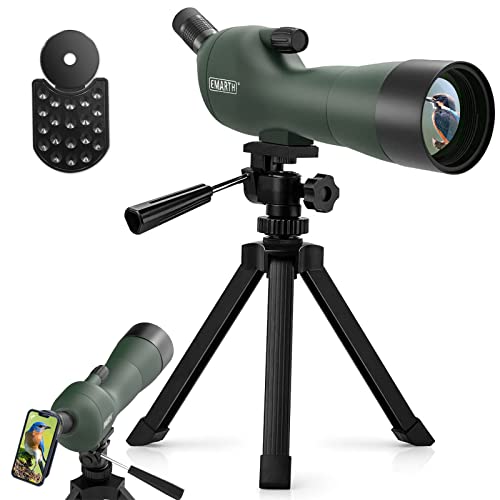
Emarth 20-60x60 Angled Spotting Scopes for Target Shooting/Hunting/Birding | 1.37lb light Spotting scope for Target Shooting w/Tripod 14" tabletop/Carry Bag, spotter scope for Hunting/Birding/Wildlife
As an Amazon Associate we earn from qualifying purchases. Product prices and availability are accurate as of the date/time indicated.

Honorace 20-60x80 HD Spotting Scope with Tripod Phone Adapter Dual Focusing | High Power Spotter Scope for Target Shooting Hunting Birdwatching Wildlife Waterproof Fogproof FBMC Long Range Spotting Scope
As an Amazon Associate we earn from qualifying purchases. Product prices and availability are accurate as of the date/time indicated.
Bushnell Engage DX 20-60x80 EXO Barrier Spotting Scope, Black | Exclusive EXO Barrier for All-Weather Clarity, Enhanced Dusk & Dawn Performance, Aluminum Chassis & Rubber Armor


As an Amazon Associate we earn from qualifying purchases. Product prices and availability are accurate as of the date/time indicated.
Ratings are editorial assessments for dawn deer hunting specifically, based on the makers’ published objective sizes, zoom ranges, and glass classes, and value at typical prices. Prices are typical retail ranges for the scope body with standard eyepiece where sold as a unit. Tripods are additional for every model and are priced into the system in the buying guide.
Best Spotting Scopes for Deer Hunting at Dawn: The Six Reviewed
1. Vortex Razor HD 85 – Best Dawn Light Bucket
The big Razor is the dawn watch’s complete argument in one instrument: an 85mm objective gathering the grey light by the bucketful, premium glass keeping the gathered light honest, and a zoom whose working range holds a usable exit pupil at the powers where a basin’s far side is judged. Its weight confines it to the stand, the blind, and the truck-window parish — stated as its design rather than its flaw, because the dawn watch is stationary by its nature. For the hunter whose dawns are spent judging deer at real distance, it is the recommendation, and its margin over the 65s at first light is not a nuance but the difference between identifying the buck and describing him to your companions as “pretty sure.”
2. Leupold SX-4 Pro Guide 65 – Best Dawn Value
Leupold builds for the American deer woods, and the SX-4’s dawn credentials are written in its zoom: a 15-power low end that owns the brightest searching image in this table’s 65 class, under coatings from the house whose twilight systems are a riflescope legend. Its glass is the honest HD class, its build is the working guide’s, and its price leaves the budget its tripod. For the stand and field-edge hunter whose distances are the eastern parish’s — hundreds of yards, not fractions of miles — it is the dawn scope this guide expects to be bought most, because its low end understands the assignment exactly.
3. Vortex Viper HD 65 – Best Mid-Price
The Viper is the middle class’s standard and the dawn’s reliable servant: the same 15-power start as the Leupold, HD glass a step below its Razor sibling’s, and the warranty culture that makes Vortex the rough-season default across this site’s guides. At first light it gives away a little contrast to the scopes above it and nothing to the ones below, which is the mid-price definition. For the hunter equipping a full dawn system — scope, tripod, the works — inside a sane total, the Viper is where the arithmetic most often lands, and it lands there without apology.
4. Athlon Ares G2 UHD 65 – Best Glass per Dollar
Athlon’s challenger spends its price on the optical bench: UHD glass whose dawn contrast embarrasses scopes above its station, the correct 15-power start, and a build whose plainness is the budget’s visible address. Its parish is the buyer who grades by the image and forgives the finish — the dawn watcher, in other words, whose whole religion is the last fifteen minutes. In a head-to-head at first light against the class’s names, it is the scope that starts the argument, and this guide rates it as the value summit of the 65s for exactly that reason.
5. Swarovski ATS 65 HD – Best Dawn Contrast
The Swarovski is the twilight aristocrat: a 65mm whose glass and coatings extract from the dawn an image whose contrast must be seen against its rivals to be believed, in a modular system whose eyepieces tailor it to its owner’s eye. It does not gather the Razor 85’s quantity of light — physics is physics — and at the eastern parish’s distances, where its pupil suffices, its quality of light is the finest in this table. Its price is the house’s, its service life is a generation’s, and its parish is the hunter for whom the dawn watch is the season’s sacrament and the instrument is bought once, correctly, forever.
6. Celestron Regal M2 80ED – Best Budget Big Objective
The Regal is the astronomer’s crossover and the budget dawn’s big bucket: an 80mm ED objective at a price the 65mm brand names notice, gathering dawn light by size where its refinements — weight, zoom feel, the finish of its controls — are its price’s honest class. Its parish is the stationary watch entirely: the blind, the field edge by the truck, the porch over the meadow. For the beginner whose dawn distances are ambitious and whose budget is not, it buys the one specification that cannot be faked — aperture — and lets the dawn’s arithmetic work in its owner’s favour from the first morning.
Buying Guide: Building the Dawn Watch System
Choose the Class by Your Distance, Then the Glass by Your Light
Run the purchase by the introduction’s arithmetic, in writing. Your distance first: the longest range at which you must judge a deer’s legality and worth, paced on your own ground or read off its map — the eastern field’s few hundred yards or the western basin’s fractions of a mile. That number, against the exit pupil’s division, names the class: the 65s serve the near parish at their low and middle powers with light to spare; the 80 and 85 class earns its weight and price only where the judgment happens past the 65’s pupil runs dry. Then the glass, by the light you hunt: the dawn specialist buys the finest ED or HD tier the budget reaches inside the chosen class, because at dawn the glass is the minutes, and the minutes are the season. The zoom’s low end is checked as a specification in its own right — 15 or 20 power is a dawn feature; 27 is a tax — and the angled body is chosen for the seated watch unless your parish is the window mount.
The Tripod Is Half the Image
Price the system, as this site always prices optics: the scope is the famous half, and the tripod and head are the half that decides whether 45 power is a picture or a vibration. The dawn watch wants a tripod that reaches the seated or standing eye without extending its skinniest section, a head that pans the field’s edge in a single smooth sweep and locks without sagging a degree, and legs that the cold and the gloves can work silently — because the dawn’s other rule is that the watch is conducted in whispers, and a tripod’s clank is a deer’s alarm clock. The window mount serves the truck parish and the shooting house. Totalled honestly, the support commonly runs a third of the scope’s price, and the buyer who funds it by stepping one glass tier down owns the steadier — and therefore sharper — system, which is the budget philosophy of this entire network expressed in a single trade.
The Dawn Routine: Arrive in the Dark, Judge in the Light
Complete the system with the routine that makes it a craft. The watch is set before light — scope mounted, tripod levelled, the field’s landmarks and distances confirmed from the previous evening’s scouting, because dawn is for judging deer and not for surveying. The glassing begins at the zoom’s low end, wide and bright, sweeping the edges where deer materialise, and the power rises only when a shape has earned the light it costs. The eye is rested in turns — the scope eye closed, the naked eye taking the field — because a strained eye invents antlers, and the dawn’s discipline is to know the difference between a point counted and a point hoped for. And the judgment itself obeys the introduction’s law without exception: legal, certain, and worth it, all three, or the buck walks into the season’s stories rather than onto the tag. The best spotting scope for deer hunting at dawn is the one that makes that judgment possible a quarter-hour before the others can. The hunter who wields it is the one who knows the judgment is still, always, the hunter’s.
How We Selected the Best Spotting Scopes for Dawn Deer Hunting
We included only real, named, currently sold spotting scopes from established optics makers, spanning the 65, 80, and 85mm classes, graded for dawn specifically: exit pupil at working magnifications, ED/HD glass class and coatings, the zoom’s low end, and the angled watcher’s ergonomics. Published specifications were the evidence, and no scope is credited with extending legal or ethical shooting light — the dawn parish described here is observation and identification within the reader’s own lawful hours, under their jurisdiction’s rules, which the guide states as a precondition of every recommendation.
Frequently Asked Questions About Spotting Scopes for Dawn Deer Hunting
Is a 65mm or 85mm spotting scope better for dawn?
It is decided by your judgment distance, through the exit pupil arithmetic this guide is built on. At the eastern parish’s distances — the field edge, the food plot, the powerline cut at a few hundred yards — the dawn work happens at 15 to 25 power, where a good 65mm delivers a pupil of three to four millimetres and an image as bright as your eye can use; the 85’s extra glass is weight without a parish. Across a western basin, where the judgment happens at 40 power and beyond, the 65’s pupil has shrunk toward a millimetre and a half and its image with it, while the 85 still delivers a working pupil — there, the big scope is not a luxury but the instrument itself. Pace your ground, name the distance honestly, and let the division sum choose, because at dawn the correct class is not a preference but a calculation.
What magnification should I use at first light?
The lowest that answers the question — which at first light is usually the zoom’s bottom end. Begin the watch at 15 or 20 power, where the image is brightest and the field widest, and where most dawn deer are found and first assessed; raise the power only for the specific judgment — the antler’s points, the deer’s age in its body — and accept the light the raising costs for exactly as long as the judgment takes, then return to the searching power. The beginner’s error is to glass at maximum because the scope offers it, spending the dawn’s scarce light on magnification the identification did not need. The dawn rewards the miser: light hoarded at low power, spent briefly at high, is the technique that separates the watchers who judge bucks from the watchers who describe silhouettes.
Can a spotting scope really see before sunrise?
Within limits that are worth stating exactly: a fine scope gathers more light than the naked eye and magnifies what it gathers, so in the grey before sunrise — and within your jurisdiction’s legal hunting hours, which are the only hours this guide is discussing — it resolves deer that the unaided eye reads as shadows, at the low magnifications where its exit pupil is generous. It does not create light, and it does not extend the legal day by a single minute; the identification it offers must still meet the law’s and the hunter’s standard of certainty, and where it cannot, the deer is watched, enjoyed, and left unjudged until the light or the distance improves. Used so, the dawn scope’s gift is real and considerable: the first legal minutes, which are the deer’s most active, become the hunter’s most informed. That is the whole of its promise, and it is enough to build a season on.
Angled or straight spotting scope for deer hunting?
Angled, for the dawn watch as this guide has framed it — the seated or standing stationary hunt — because it lets the tripod stand shorter and steadier, lets the hunter look down into the eyepiece from a posture the neck can hold for the watch’s full length, and lets two hunters of different heights share the scope by rotating its body rather than rebuilding the tripod. The straight body’s parishes are real but narrower here: the vehicle window mount, where its line matches the glassing from a seat, and the prone watch. Most dawn deer hunting is neither, and the angled scope’s endurance advantage compounds across a season of first lights — the judgment at minute forty is made by the eye that is still fresh, in the posture that did not spend it. Choose the angled body, a tripod that suits it, and a chair you can sit in without fidgeting, because the dawn watch is won by the still as much as by the sharp.
Related guides
- Best Spotting Scope for Travel Concert Viewing in 2026: 7 Spotting Scopes With Clear Optics, Compact Build, and Simple Use for Travel Concerts
- How to Avoid Thermal Resolution Mistakes Beginners in 2026: Choose the Right Thermal Resolution for Your First Thermal Monocular
- Best Spotting Scope for Lighthouse Photography Trips in 2026: ED Glass, Weatherproofing, and Digiscoping Reach for Towers That Stand a Mile Offshore
- Best Affordable Night Vision Scope in 2026: 7 Night Vision Scopes That See in the Dark, Hold Zero, and Stay Under a Beginner Budget
More from Amazon
Programs that pair well with the guide above. Offers and eligibility are set by Amazon and may change.
Free shipping on eligible items, Prime Video and more. Eligible new members can start with a free trial.
Start a Prime free trialAudiobooks and podcasts to listen to on the go. Eligible new members can start with a free trial.
Try Audible freeAd-free music streaming. Eligible new subscribers can start with a free trial.
Try Music Unlimited freeA free business account with business pricing and bulk-buying tools for work, shop or home office.
Create a business accountAs an Amazon Associate we earn from qualifying purchases.

Write Your Review
No reviews yet. Be the first to share your experience!