
What's inside
- What Makes the Best Tripod for Spotting Scope Beach Viewing
- Quick Comparison: Best Tripods for Spotting Scope Beach Viewing Compared
- Best Tripods for Spotting Scope Beach Viewing: The Six Reviewed
- Buying Guide: How to Choose the Best Tripod for Spotting Scope Beach Viewing
- How We Selected the Best Tripods for Spotting Scope Beach Viewing
- Frequently Asked Questions About Tripods for Beach Spotting Scope Viewing
As an Amazon Associate I earn from qualifying purchases. This post may contain affiliate links at no extra cost to you.
The best tripod for spotting scope beach viewing must survive the most hostile environment a tripod ever works in, while doing the most demanding job a tripod ever does. The hostility is total: sand invades every lock and joint and grinds there; salt spray corrodes what the sand misses; the ground itself is a fluid that swallows feet and settles unevenly; and the sea breeze — the gentle, constant, scope-shaking sea breeze — blows across the whole performance. The job is equally unforgiving, because a spotting scope at forty or sixty power magnifies every tremor the tripod allows into a seasick swim, and beach viewing aims that magnification at the finest subjects in optics: waders and terns at two hundred metres, seals and surfers, ships on the horizon line, the moon rising out of the sea. This guide compares the real tripods worth taking to the shoreline, judged by the beach’s own criteria — how their legs plant in sand, how their locks tolerate grit, how their materials forgive salt, and how the whole system rinses clean in the evening — because a tripod that dies of the beach in its second season was not a bargain at any price, and the shoreline is littered with their aluminium ghosts.
Understand the beach’s three attacks, because each one selects for different defences. Sand attacks the mechanisms: it enters leg locks and head bearings and turns smooth adjustments into grinding ones, which argues for locks that can be flushed and serviced, for fewer and simpler sections at the waterline, and for a working habit — legs extended from the top sections first, the lowest section kept out of the wet sand where possible — that this guide teaches as doctrine. Salt attacks the materials: it pits cheap aluminium, creeps into threads, and punishes any steel it finds, which argues for carbon fibre’s indifference and anodised, sealed construction, and for the evening rinse in fresh water that is the beach tripod’s sacrament. Softness attacks the stance: round feet sink and creep in sand, which argues for spiked or wide accessory feet, for legs spread and settled before the scope is mounted, and for the hanging weight trick — a bag of sand itself, hung from the centre hook, being the beach’s own ballast provided free of charge. A tripod chosen against all three attacks, and maintained by the rinse, will serve the shoreline for a decade. The table below is graded on exactly that service.
The viewing itself sets the remaining specifications. Beach work is standing work more often than the mountain’s seated glassing — the watcher stands above the dune grass and the other beachgoers’ heads — so full standing height for the owner’s own eye level, with the scope’s angled body taken into account, is a headline requirement rather than a luxury. The head is the scope’s partner in the wind: a smooth pan or small fluid head lets the eye follow a bird along the tideline without the stick-slip judder of a cheap ball head at high power, and its handle gives cold, sandy hands a lever that does not require a precision grip. Weight argues its usual corner — the beach watcher walks from the car park, not up a fell — so a mid-weight tripod that a mountain guide would scorn is entirely rational here, and its mass is ballast the breeze respects. Buy for the shoreline you actually watch, from the stance you actually take, and let the rinse decide the rest.
Our Top Picks
What Makes the Best Tripod for Spotting Scope Beach Viewing
Legs in Sand: Feet, Sections, and the Settling Ritual
A tripod stands on a beach the way a table stands on a beach — by negotiation. Wide feet or spikes, offered as standard or as accessories on the models in this table, spread the load and bite through the loose surface to the firm sand beneath, and the difference is not marginal: a footed tripod on dry sand creeps visibly at 60x, while a spiked and settled one simply stands. Fewer leg sections serve the shoreline twice over — each section joint is a door for sand and a point of flex — so the beach favours two- and three-section legs over the four- and five-section travellers, accepting a longer packed length as the price of a cleaner, stiffer leg. The settling ritual completes the stance: legs spread to their working angle, each foot pressed or screwed into the sand until the settlement stops, the scope mounted only after the tripod has taken its own weight’s measure of the ground, and the centre hook loaded with the day’s bag — or a stuff sack filled with the beach itself — when the breeze freshens. Practised once, it takes a minute; skipped, it costs the afternoon’s viewing in small, constant corrections.
Locks and Materials: Built to Be Rinsed
The beach chooses its lock the way it chooses everything: by what survives the rinse. Twist locks seal their threads inside the leg and shed sand well in use, and the better makers’ designs can be disassembled, flushed, and reassembled by the owner — a serviceability specification this guide treats as a headline for shoreline duty. Lever locks flush more openly and show their grit honestly, at the price of more exposed mechanism. Either school serves if the maker supports it with seals, spares, and instructions; the anonymous tripod with neither is the one the beach retires early. Materials follow the same law. Carbon fibre ignores salt entirely and damps the breeze’s vibration better than metal — the flagship beach choice, priced as flagships are. Anodised aluminium of honest quality serves for seasons with the rinse kept faithfully, and its scratches are memoirs rather than wounds. What neither forgives is neglect: the unrinsed tripod, left in the car boot in its salt, is being consumed between trips, and the finest warranty in the table does not cover a sacrament unperformed.
Height and Head: The Standing Watcher’s Specification
Measure the height by your own eye, standing, with the scope’s angled eyepiece adding its geometry: the tripod’s maximum, minus the head, plus the angled scope’s drop, must arrive at your eye without the centre column raised — because a raised centre column is a mast, and the sea breeze plays masts like instruments. A column used for the last few inches of fine adjustment is a convenience; a column carrying the whole stance is a vibration with a scope on top. The head’s specification is smoothness under load at high power: a pan or fluid head rated honestly above the scope’s weight, with a quick-release plate that locks with a certainty sandy fingers can verify, and a handle long enough to steer the horizon’s slow traffic. Ball heads serve the seated and the still; the shoreline’s moving subjects — birds working the tide line, boats crossing the field — belong to the pan, and the beach watcher’s head should be bought for the motion of its subjects, not the stillness of its portraits.
Quick Comparison: Best Tripods for Spotting Scope Beach Viewing Compared
| Tripod Model | Best For | Key Specs | Typical Price Range | Rating |
|---|---|---|---|---|
| Vortex Summit Carbon II | Best tripod for spotting scope beach viewing overall | Carbon fibre legs, compact standing height class, pan head included, rubber feet with spike options in the line as published | $250 – $330 | 4.7 / 5 |
| Manfrotto Befree Advanced | Best aluminium value with serviceable design | Aluminium legs with lever locks, established maker support and spares, ball head versions as published | $180 – $250 | 4.5 / 5 |
| Vanguard VEO 3+ 263CB | Best tall standing stance | Carbon legs, full standing height, multi-angle centre column, convertible features as published | $280 – $360 | 4.5 / 5 |
| Leupold Alpine Carbon Tripod Kit | Best optics-maker kit for scope owners | Carbon legs with pan head, designed for spotting scopes, Arca-compatible plate as published | $300 – $400 | 4.6 / 5 |
| Sirui AM-324 Carbon Tripod | Best heavy-duty sand stance | Large-diameter carbon legs, few sections for stiffness, spiked feet included as published | $220 – $300 | 4.6 / 5 |
| Benro Tortoise TTOR35C | Best compact carbon for travelling watchers | Carbon legs without centre column for low vibration, compact pack size as published | $300 – $380 | 4.4 / 5 |

Binocular Tripod, 72” Spotting Scope Tripod Stand with Binocular Adapter and 2 QR Plates, Travel Camera Stand with Phone Holder/Carry Bag, Compatible with Binoculars/Spotting Scope/Camera/Phone
As an Amazon Associate we earn from qualifying purchases. Product prices and availability are accurate as of the date/time indicated.

69” Tripod for Spotting Scopes, Binocular & Camera, Includes Binocular Adapter, 2 QR Plates, Phone Holder & Carry Bag, Ideal for Bird Watching, Hunting, Wildlife Viewing & Target Shooting

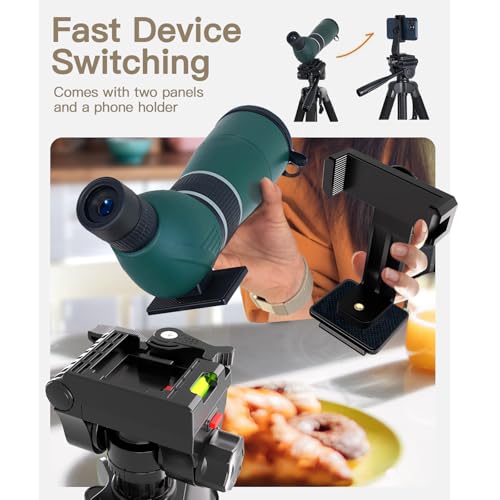


As an Amazon Associate we earn from qualifying purchases. Product prices and availability are accurate as of the date/time indicated.
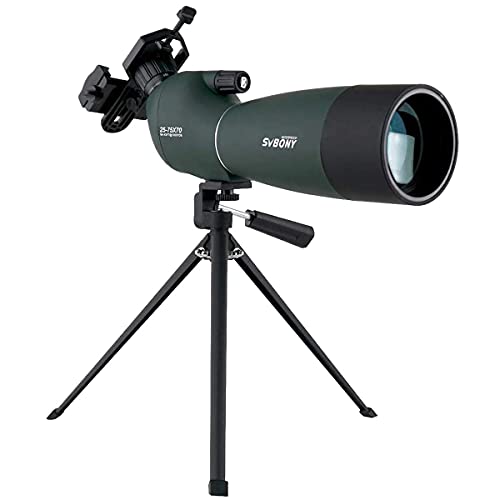
SVBONY SV28 Spotting Scope, Angled 25-75x70 with Tripod for Target Shooting | Spotter Scope, Beginner for Bird Watching, Wildlife, Clearly at 200 Yards, with Phone Adapter, Light Waterproof Fogproof
As an Amazon Associate we earn from qualifying purchases. Product prices and availability are accurate as of the date/time indicated.
Ratings are editorial assessments for beach and shoreline spotting scope use, based on the makers’ published heights, materials, load ratings, and head types, and value at typical prices. Prices are typical retail ranges, with heads included where the model is sold as a kit. Load ratings and heights are the makers’ figures; real stability at high magnification depends on the stance and settling practice this guide teaches, on any tripod at any price.
Best Tripods for Spotting Scope Beach Viewing: The Six Reviewed
1. Vortex Summit Carbon II – Best Overall
Vortex’s carbon kit is the beach watcher’s balanced answer: legs that ignore salt, a pan head matched to a scope’s motion, a stance that settles properly with its feet worked into the sand, and a warranty culture that suits equipment used where equipment suffers. It packs small enough for the walk from the car and stands tall enough for the standing watch, and its locks have the sealed, flushable manners the shoreline demands. For the scope owner buying one tripod for the coast, it is the recommendation — rinsed nightly, it will outlast the car that carries it.
2. Manfrotto Befree Advanced – Best Aluminium Value
The Befree brings the photographic giant’s support network to the shoreline at an aluminium price: lever locks that flush openly, spares and service that actually exist, and a folded size the travel bag approves. Its ball head versions ask the moving-subject watcher to upgrade the head in time, and its metal asks for the rinse with a faithfulness carbon does not — both stated plainly, both manageable. For the watcher whose beach is a holiday’s week rather than a life’s parish, it is the rational purchase, and its afterlife as the household’s general tripod is the longest in the table.
3. Vanguard VEO 3+ – Best Standing Height
The VEO 3+ stands tallest in this table with its legs rather than its column doing the work, which is the sea breeze’s preferred arrangement, and its carbon build keeps the salt’s counsel. Its multi-angle column and convertible tricks serve the watcher who also photographs the shore at ground level — the waders’ own perspective — making it the dual-purpose choice for the beach naturalist with a camera beside the scope. It is the most versatile stance here, priced like it, and worth it to the watcher whose beach work is varied.
4. Leupold Alpine Kit – Best Optics-Maker Match
Leupold’s kit is designed from the scope outward: a pan head that tracks the tideline smoothly, a plate system that speaks the optics world’s language, and carbon legs under a name the glassing community already trusts at dawn. Its stance settles well and its locks behave under the rinse. For the Leupold scope owner — and the watcher who values a kit designed as a unit over a tripod adapted from photography — it is the tailored choice, and its price is the tailoring’s honest fee.
5. Sirui AM-324 – Best Heavy-Duty Stance
The big Sirui is the fortress of the table: fat carbon legs in few sections, spiked feet in the box, and a stiffness at full height that the breeze argues with and loses. It is more tripod than a small scope needs and exactly what a big 85mm glass on an exposed headland demands, and its build shrugs at sand with a heavyweight’s indifference. The watcher whose parish is the storm beach and the winter seawatch should start here; the holiday watcher should admire it and buy up-table, where the weight suits a gentler shore.
6. Benro Tortoise – Best Compact Carbon
The Tortoise deletes the centre column entirely — the mast the breeze plays — and builds its stance on legs alone, packing to a size the travelling watcher’s luggage forgives. Its low, stiff geometry suits the seated seawatch and the dune-top prone session as much as the standing one, and its carbon manners under salt are its maker’s standard. For the watcher who travels light to other people’s coastlines, it is the connoisseur’s compact, and its missing column is a feature this guide praises in the wind’s own language.
Buying Guide: How to Choose the Best Tripod for Spotting Scope Beach Viewing
Match the Tripod to the Scope’s Weight and Your Eye’s Height
Two numbers before the order: the scope’s weight with its case off and its eyepiece on, against the tripod-and-head’s honest load rating — with margin, because ratings are ceilings and the breeze loads a scope like a sail — and your standing eye height, against the tripod’s maximum with the head fitted and the column down. Then choose the head for your subjects: pan or fluid for the moving shoreline, and confirm the plate system matches or adapts to your scope’s foot, because a plate that cannot be trusted with sandy fingers is a scope waiting to fall. Shortlist from the table by those numbers, and let the beach’s remaining questions — locks, materials, feet — be answered by the reviews’ shoreline evidence rather than by the photography shelf’s general virtues.
Rehearse the Beach Ritual at Home
The shoreline’s techniques are learnable on a lawn: extend the top sections first, settle each foot with weight, hang the bag, and track a slow target at your scope’s highest power until the pan is a reflex. Then rehearse the evening sacrament until it is equally automatic — the full rinse in fresh water, legs extended and locks worked under the tap or the shower, the whole tripod dried standing with its legs open, and a drop of the maker’s approved care on the joints the manual names. The first beach trip should find both rituals boring. A tripod maintained so will still be boring — smooth, tight, uncorroded — in its tenth season, which is the whole of the law for equipment that works where the land dissolves into the sea.
Watch the Shore Like a Guest of It
Close with the beach watcher’s etiquette, because the tripod stands in a shared and fragile place. Set up off the dune vegetation and the nesting birds’ peace — the shore’s residents have their own claim on the tideline, and in season their closures and distances are law as well as courtesy, checked before the trip like the tide table. Pack out everything the stance used, including the sandbag’s contents returned to the beach they came from, and leave the pitch as sand, which forgets footprints by the next tide in any case. The best tripod for the beach is, in the end, the one still standing steady in its tenth season of dawns — rinsed, settled, and welcome back. Buy it once, by this guide’s numbers, and let it become exactly that.
How We Selected the Best Tripods for Spotting Scope Beach Viewing
We included only real, named, currently sold tripods and kits from established makers, with published load ratings, heights, and materials suited to spotting scopes. Sand and salt defences — flushable locks, corrosion-indifferent materials, spiked or wide feet, and maker serviceability — were weighted as headline criteria alongside stability at high magnification, because the beach is a service environment before it is a viewing one. No tripod is rated for the shoreline on specifications alone; the settling and rinsing practices in this guide are part of every recommendation.
Frequently Asked Questions About Tripods for Beach Spotting Scope Viewing
Carbon fibre or aluminium for the beach?
Carbon is the shoreline’s ideal and aluminium its honest value, and the difference is maintenance more than performance. Carbon ignores salt, damps vibration kindly, and asks only for the rinse that removes the sand; aluminium of good anodised quality serves for seasons if the rinse is kept faithfully, and corrodes in the joints and threads if it is not. The budget’s verdict follows the watcher’s calendar: the weekly seawatcher amortises carbon quickly, while the holiday watcher in a rinsed aluminium tripod loses nothing but a little weight. What neither material survives is the unrinsed boot-storage after a salt trip — that habit, and not the metal, is what the beach’s aluminium ghosts died of.
How do I stop the tripod sinking and shifting in sand?
By the settling ritual this guide teaches: choose the firmest sand available — the wet band above the waterline stands like a floor compared to the dry dune sand — spread the legs to their working angle, and press or twist each foot down until the settlement stops, with spiked or wide feet fitted where the tripod offers them. Mount the scope after the stance has settled, hang your bag from the centre hook for ballast, and re-check the level after the first minutes, because sand finishes its settling under load on its own schedule. A stance so built holds 60x steady in the working breeze; a stance merely placed on the surface creeps all afternoon, and the difference is two minutes at the start.
Twist locks or lever locks in sand?
Both serve, maintained — the schools divide by temperament rather than by verdict. Twist locks keep their mechanism inside the leg, shedding sand during the session and flushing clean under the evening rinse, and the better makers let the owner strip and clean them fully. Lever locks expose their working faces, which grit reaches sooner, but they also flush the most openly and show their condition honestly. The decisive question is the maker’s support: seals, spare parts, and cleaning instructions in the manual are the shoreline features, whichever lock wears them. Buy the supported lock, rinse it like you mean it, and the argument dissolves into the evening routine.
How should I clean the tripod after a beach session?
The same evening, in fresh water, completely: rinse the whole tripod with the legs extended, work every lock and the head’s movements under the water so the grit flushes rather than settles, and pay the feet and the lowest sections — the sand’s home counties — a second pass. Stand it to dry with legs open and locks loose, in moving air, and only then close it for storage; a tripod stored damp and salty is corroding in the dark at its leisure. Periodically, by the maker’s manual, strip the locks for a deep clean and renew their lubrication with the approved product. Ten minutes an evening is the whole cost, and it is the difference between the tripod in this guide’s tenth season and the ghost in its introduction.
Related guides
- Best Value Digiscoping Phone Mount Birding in 2026: 7 Affordable Phone Mounts That Turn Your Spotting Scope Into a Birding Camera
- Best Tripod for Travel Lightweight Packing in 2026: 7 Lightweight Travel Tripods That Pack Small, Hold a Spotting Scope Steady, and Fit in Your Carry-On
- Best Spotting Scope for Beginners Easy Setup in 2026: Forgiving Scopes, Simple Tripods, and a First Session That Ends With a Bird — Not a Manual
- Best Spotting Scope vs Binoculars for Beginners in 2026: 6 Top Spotting Scope vs Binoculars for Beginners Options, Easy Viewing, and Easy Use
More from Amazon
Programs that pair well with the guide above. Offers and eligibility are set by Amazon and may change.
Free shipping on eligible items, Prime Video and more. Eligible new members can start with a free trial.
Start a Prime free trialAudiobooks and podcasts to listen to on the go. Eligible new members can start with a free trial.
Try Audible freeAd-free music streaming. Eligible new subscribers can start with a free trial.
Try Music Unlimited freeA free business account with business pricing and bulk-buying tools for work, shop or home office.
Create a business accountAs an Amazon Associate we earn from qualifying purchases.

Write Your Review
No reviews yet. Be the first to share your experience!