
What's inside
- Best Value Digiscoping Phone Mount Birding: Alignment Is the Whole Product
- Best Value Digiscoping Phone Mount Birding: Quick Comparison
- The Six Digiscoping Phone Mounts Reviewed
- Buying Guide: How to Choose the Best Value Digiscoping Phone Mount for Birding
- Frequently Asked Questions About Digiscoping Phone Mounts for Birding
As an Amazon Associate I earn from qualifying purchases. This post may contain affiliate links at no extra cost to you.
The best value digiscoping phone mount birding is a small purchase with an outsized effect, because digiscoping, photographing through a spotting scope with a phone, turns the scope you already own into a telephoto system of a focal length no camera budget at this level can touch, and the mount is the entire difference between that promise and a vignetted blur. A phone held by hand against an eyepiece produces, in order, a black circle, a crescent, a photograph of the inside of the eyecup, and a birder reconsidering their choices, because the phone’s lens must sit at the eyepiece’s exact eye relief point, centered to a fraction of a millimeter, held parallel, while a bird does what birds do, which is leave. A proper mount solves the geometry once, repeatably: it clamps the scope’s eyepiece, holds the phone in an adjustable cradle, and lets you align the camera to the optical axis at home, so that in the field the phone clicks into the same alignment in seconds. This guide compares six real, currently sold mounts across the value range, from a universal three-axis adapter under fifty dollars to the custom case systems the serious digiscopers swear by, and teaches the compatibility checks, eyepiece diameter, phone size, camera position, that decide whether a given mount fits your scope and your phone at all.
Value, in this category, deserves a definition before the table. A cheap universal mount that fits everything approximately can cost more in missed birds than a fitted system costs in money, because digiscoping opportunities are measured in seconds and a mount that must be re-aligned at every use consumes them all. Conversely, the premium fitted systems earn their price only for the birder who digiscopes weekly. The value summit, for most readers, is the mount that aligns accurately, repeats that alignment, and fits the scope and phone they actually own, bought once and understood completely. That is the standard the ratings below apply.
Our Top Picks
 ORLNK Universal Digiscoping Adapter Phone to Telescope Metal3.2 x 3.8 x 6.9 inches0.43 poundsCheck on Amazon
Best Value Digiscoping Phone Mount Birding: Alignment Is the Whole Product
The Three Axes and Why Two-Axis Mounts Frustrate
Your phone’s camera must be centered on the eyepiece’s exit pupil in two directions, up and down, left and right, and positioned at the correct distance from the lens, which together make three adjustments. Simple mounts clamp the eyepiece and offer a cradle that slides in one or two of them, leaving the third to luck, to the phone’s size, or to a shimmed improvisation that works until the phone is changed or the case is swapped. Three-axis mounts, led in this table by Celestron’s NexYZ, adjust in all three, which is why they fit the widest range of phone and scope combinations genuinely rather than nominally. Custom case systems take the opposite road to the same destination: a case molded for your exact phone fixes its camera position permanently, and a ring sized to your exact eyepiece fixes the scope side, so alignment is manufactured rather than adjusted. Both philosophies work. The first serves households with several phones and scopes. The second serves one birder, one phone, one scope, and a season of identical, instant setups, until the phone is upgraded, at which point a new case joins the bill, a cost this guide counts openly in its review.
Eyepiece Diameter, Eye Relief, and the Phones With Three Cameras
Before any mount is ordered, measure or look up two numbers: the outside diameter of your scope’s eyepiece at the point the mount will grip, commonly in the range of about 30 to 60 millimeters across scopes, and whether your scope’s eyepiece has a twist-up or rubber eyecup that the clamp must grip over, under, or instead of. A mount whose clamp range excludes your eyepiece is not a bargain at any discount, and the makers in this table publish their ranges, which the buying guide turns into a checklist. Then consider the phone. Modern phones carry two to four rear cameras and choose between them by zoom level and light, sometimes mid-photograph, so the mount must align the specific camera your phone uses at the zoom you will shoot, usually the main 1x camera, with digital zoom applied by you rather than a lens switch decided by the phone. Learn, at home, which lens your phone digiscopes through, lock the settings your camera app allows, and the field behavior becomes predictable. Add a Bluetooth remote shutter or your earbuds’ volume button as the trigger, because tapping the screen of a phone mounted on a scope at 40x is a vibration delivery system, and digiscoping’s sharpest enemy is not optics but touch.
What Digiscoping Can and Cannot Do for a Birder
Set the expectation honestly and the mount will delight you. Digiscoping excels at documenting: the rarity that needs a record, the shorebird whose identification turns on a leg color and a bill shape, the seabird raft, the nest at a respectful distance, the warbler that sat, miraculously, for four seconds. It produces images of genuine quality in good light at moderate scope magnifications, typically with the scope at its lower zoom settings and the phone adding a modest digital crop. It does not replace a dedicated camera for birds in flight, for dawn forests at high ISO, or for publication-grade action, and it asks for technique, a steady tripod, a remote shutter, burst mode, and the discipline to photograph the bird you have rather than chase the one in the next bush. For the birder whose first goal is identification and whose second is the record shot, which describes most of us, a fifty-dollar mount on a good scope is the highest-value photographic purchase in the hobby.
Best Value Digiscoping Phone Mount Birding: Quick Comparison
| Phone Mount Model | Key Specs | Best For | Typical Price Range | Rating |
|---|---|---|---|---|
| Celestron NexYZ 3-Axis Universal Adapter | Adjusts in X, Y, and Z axes, fits eyepieces about 30-60 mm class per maker, fits most phones, metal and polymer construction | Best value overall, most scopes and phones | $45 – $65 | 4.6 / 5 |
| Phone Skope Complete Kit (case plus eyepiece adapter) | Custom case for exact phone model, adapter ring sized to exact scope eyepiece, repeatable instant alignment | Best repeatable system for one phone and scope | $110 – $160 by configuration | 4.7 / 5 |
| Carson HookUpz 2.0 | Universal adapter, self-centering clamp in this line class, fits a wide range of eyepieces and phones, no case removal on many phones | Best fast on-and-off universal mount | $50 – $75 | 4.3 / 5 |
| Novagrade Phone Adapter (standard and tablet versions) | Machined adapter, compression ring grip on eyepiece, phone-specific trays in this line class, made in USA line | Best build quality in universal class | $85 – $120 | 4.5 / 5 |
| GOSKY Universal Phone Adapter Mount | Metal universal mount, rotating phone holder, fits eyepieces about 28-47 mm class in common versions, very low price | Cheapest way to try digiscoping | $15 – $25 | 3.9 / 5 |
| Swarovski VPA 2 Variable Phone Adapter | Premium adjustable adapter in this line class, precise alignment, designed for Swarovski and other scopes with suitable rings | Best premium adjustable mount | $230 – $280 | 4.5 / 5 |

tridaptor - Universal Phone Scope Digiscoping Adapter|High-Precision XYZ Metal Telescope Mount 3-Axis Smartphone Holder for Spotting Scope Monocular Binos|Fits All Cell Phone Camera/Max 2.4" Eyepiece
As an Amazon Associate we earn from qualifying purchases. Product prices and availability are accurate as of the date/time indicated.

FANAUE Telescope Phone Adapter, Spotting Scope Smartphone Phone Mount for Binoculars Monocular Microscope, Magnetic Cell Phone Digiscoping Holder for Camera Photography


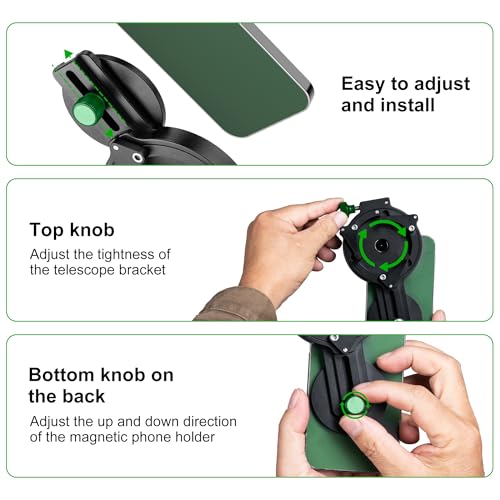


As an Amazon Associate we earn from qualifying purchases. Product prices and availability are accurate as of the date/time indicated.
ORLNK Universal Digiscoping Adapter Phone to Telescope Metal Holder Mount | More robust, lighter, and easier to align for Spotting Scope Monocular Microscope


As an Amazon Associate we earn from qualifying purchases. Product prices and availability are accurate as of the date/time indicated.
Prices shown are approximate and for reference only. Prices change often, so please check the current price on Amazon before you buy.
Compatibility ranges summarize manufacturers’ published information for current models and common versions; measure your eyepiece and confirm your phone’s fit before ordering, as this guide directs. Ratings are editorial, weighing alignment accuracy and repeatability, compatibility, build, field speed, and value at typical prices.
The Six Digiscoping Phone Mounts Reviewed
1. Phone Skope Complete Kit: Best System for the Committed Digiscoper
Phone Skope’s idea is to remove adjustment from the field entirely: you order a case molded for your phone and an adapter matched to your scope’s eyepiece, and from then on the phone clicks into alignment the same way, in seconds, every time, which over a season of dawn outings is worth more than any optical specification in this article. The image quality ceiling becomes your scope and your technique, not your mount’s mood. Its costs are the system’s honesty: the highest price among the value contenders, and a new case when the phone changes, which on a two-year phone cycle is a subscription by another name. For the birder who digiscopes weekly, it remains the value answer, because value is cost per successful photograph, and no mount here succeeds faster.
2. Celestron NexYZ: Best Value Overall
The NexYZ is the mount this guide recommends to the largest number of readers, because its three-axis adjustment genuinely fits the combinations the universal label usually only promises: large and small eyepieces, large and small phones, phones in their everyday cases in many instances, and binoculars and microscopes as a bonus the birding household will find uses for. Alignment takes a few patient minutes the first time and under a minute thereafter if you mark or remember the settings. It is not as instant as the Phone Skope nor as machined as the Novagrade, and at its price it should not be. It is the complete, honest, adjustable answer, and the value summit of the table for anyone whose phone or scope may change.
3. Novagrade Phone Adapter: Best Built Universal
Novagrade machines its adapters like instruments, with a compression ring that grips the eyepiece evenly and trays that hold the phone without the flex that creeps into plastic cradles at full scope magnification. For the birder whose universal mount must survive a decade of field use, or whose scope’s eyepiece defeats lesser clamps, the Novagrade’s price buys a permanence the category seldom offers. Its adjustment is less theatrical than the NexYZ’s three-axis dance and its fit should be confirmed against your exact eyepiece and phone tray, as its line is more specific. Judged as a tool to buy once, it is the connoisseur’s universal.
4. Carson HookUpz 2.0: Best for Speed On and Off
The HookUpz 2.0 centers itself on the eyepiece with a clamp designed for quick attachment, serving the birder whose digiscoping is opportunistic, the scope used naked for an hour of watching, the phone mounted for the one bird that must be documented, and off again before the flock moves. That rhythm, watch first, photograph second, is how most real birding works, and a mount that respects it earns its place even with a fraction less alignment precision than the leaders. Families sharing one scope and several phones will find its universality forgiving, and its price forgiving of the learning curve’s early drops and knocks.
5. Swarovski VPA 2: Best Premium Adjustable
Swarovski’s variable adapter brings the maker’s machining and optical seriousness to the phone mount, with precise, repeatable adjustment for owners of premium scopes who found universal mounts a indignity their eyepiece did not deserve. It is included in a value guide as the ceiling that defines the class: if your scope is a flagship and your digiscoping is a practice rather than an experiment, its cost is proportionate. For everyone else, its review is the useful kind, the demonstration that the NexYZ and Novagrade deliver most of this performance at a third of the price, which is what value means and why this guide can recommend them without a blush.
6. GOSKY Universal Adapter: The Fifteen-Dollar Experiment
Every birder should be able to try digiscoping for the price of a field guide, and the GOSKY is that trial: a metal universal mount that fits a modest range of eyepieces, holds a phone adequately, and will produce, on a steady tripod in good light, a record photograph good enough to decide whether the hobby has claimed you. Its clamping range is narrower, its adjustments coarser, and its repeatability a matter of patience, all stated here so its rating is understood as praise within its class. Buy it to learn. If the first rarity photograph comes out, and it will, upgrade with the knowledge of exactly which limitation you are paying to remove, which is the most valuable thing a cheap mount can teach.
Buying Guide: How to Choose the Best Value Digiscoping Phone Mount for Birding
Step One: Measure the Eyepiece, Identify the Phone’s Working Camera
Measure your scope eyepiece’s outside diameter where a mount will grip, with the eyecup in the position you actually use, and write down your phone’s exact model and whether it wears a case you are unwilling to remove in the field. Check those two facts against the maker’s compatibility range for each finalist, in the maker’s own documentation, and reject any mount that fits by optimism. Then, at home with the scope on its tripod, hold the phone to the eyepiece by hand once, not to take a photograph but to learn which rear camera your phone uses at the settings you will shoot, and where that camera sits, because a mount aligned to the wrong lens is aligned to nothing, and this five-minute lesson prevents the commonest beginner failure in digiscoping.
Step Two: Align at Home, Mark the Settings, Add a Remote
Perform the full alignment at a table, on a distant, detailed target, in daylight, adjusting until the circular image is centered, maximal, and free of crescent shadows, then note or mark every setting the mount allows you to record. Set the phone’s camera as this guide directs, the main lens, exposure and focus locked on the subject where the app permits, burst mode ready, and pair a Bluetooth remote shutter or confirm the earbud button method works with your phone and app. Compose the kit’s whole price as you do: mount, remote, a small case that holds mount and remote together in the scope bag, and, for fitted systems, the honest future cost of a case at your next phone. A mount aligned at home and triggered remotely will out-photograph a premium mount tapped by hand in the field, every day of the season.
Step Three: Field Technique That Makes the Mount Worth Buying
Use the scope at its lower magnifications for digiscoping, where the image is brightest and the phone’s exposure stays fast, and crop with the phone’s modest digital zoom rather than the scope’s maximum power, which dims and shakes the image past usefulness. Work in the best light of the morning, brace the tripod against wind with your body as a shield rather than a hand on the scope, and take bursts, because among ten frames of a living bird, one will be sharp, still, and blinking at the right moment, and that arithmetic is the professional’s secret stated plainly. Review the day’s photographs at home at full size, note which settings and magnifications produced the keepers, and write it on the same card as your alignment marks. Digiscoping rewards the systematic birder out of all proportion to budget, which is why a value mount, systematically used, beats a premium mount improvised, and why this guide’s last word is a notebook rather than a product.
Frequently Asked Questions About Digiscoping Phone Mounts for Birding
Will a phone mount fit my spotting scope and my phone?
It will if two compatibilities are verified, and only then. The mount’s clamp range must include your eyepiece’s outside diameter at its gripping point, over or in place of its eyecup as the mount is designed to work, and the mount’s cradle or case must fit your phone’s exact size and camera position, ideally with the case you use daily. Universal three-axis mounts cover the widest territory and are the safe choice for unusual combinations and households with several devices. Fitted case systems cover exactly one phone and one eyepiece, perfectly, and nothing else. Measure the eyepiece, name the phone, read the maker’s own compatibility documentation, and treat any listing that promises a universal fit without publishing a diameter range as a question rather than an answer, because in this category the millimeters are the product.
Can I digiscope through binoculars instead of a spotting scope?
Yes, and several mounts in this guide fit binocular eyepieces as readily as scope eyepieces, producing a lower-magnification, wider, brighter image that suits close birds, feeders, and documentation at modest distances. The limits are the binocular’s: less reach for distant shorebirds and raptors, and the practical question of holding or mounting the binocular itself steadily, since a handheld binocular plus phone multiplies every tremor the scope’s tripod exists to remove. A binocular on a tripod adapter, with a phone mount on one eyepiece, is a genuinely capable and inexpensive digiscoping rig for garden and local patch birding. For the estuary, the hawk watch, and the rarity two fields away, the spotting scope remains the instrument, and the same mount, if its clamp range spans both eyepieces, serves you on each.
Why are my digiscoped photos blurry or dark on one side?
Blur and the dark crescent, called vignetting when it circles the whole image and shading when it eats one side, have different cures, and diagnosing them separately saves a season. A one-sided shadow means misalignment: the phone’s lens is off the eyepiece’s axis or at the wrong distance, so return to the home alignment of this guide, adjust in small increments, and confirm the full circle is centered before blaming anything else. General blur is usually motion, from tapping the screen, from wind, from a tripod asked to hold a scope at too high a magnification for the day, answered by the remote shutter, burst mode, lower scope power, and a faster exposure in better light. A uniformly dim image is the scope at high zoom or a dull day asking more of the phone’s small sensor than it has, and the cure is light and moderation rather than equipment. Work through the three in that order, alignment, motion, light, and nearly every digiscoping failure a beginner meets will resolve at one of those doors.
Is digiscoping with a phone worth it compared with buying a camera?
For the birder whose goals are identification, documentation, and sharing, yes, decisively, because the mount leverages the scope you already own into focal lengths that a dedicated camera system matches only at many times the price, size, and weight, and the phone you already carry supplies the screen, the processing, and the instant sharing that make a record shot useful in the field, where an identification can be confirmed by a group or an expert before the bird is a memory. A dedicated camera wins, clearly, for flight, for action, for low light, and for the photographer whose goal is the image itself rather than the bird. The two are not rivals so much as successive chapters, and a season of digiscoping is the cheapest possible education in which chapter you belong to, taught by a mount that costs less than a single camera battery and leaves you, at worst, with a shelf of documented sightings and the knowledge of exactly what to buy next, if anything.
Related guides
- Best Thermal Monocular for Spring Hunting: 6 Best Thermal Monocular for Spring Hunting Picks in 2026
- Best Thermal Monocular for Desert Farms: 6 Best Thermal Monocular for Desert Farms Picks in 2026
- Stay on Case Pros and Cons in 2026: Stay on Case Pros and Cons
- Best Night Vision Monocular Under 200 in 2026: Best Night Vision Monocular Under 200
More from Amazon
Programs that pair well with the guide above. Offers and eligibility are set by Amazon and may change.
Free shipping on eligible items, Prime Video and more. Eligible new members can start with a free trial.
Start a Prime free trialAudiobooks and podcasts to listen to on the go. Eligible new members can start with a free trial.
Try Audible freeAd-free music streaming. Eligible new subscribers can start with a free trial.
Try Music Unlimited freeA free business account with business pricing and bulk-buying tools for work, shop or home office.
Create a business accountAs an Amazon Associate we earn from qualifying purchases.

Write Your Review
No reviews yet. Be the first to share your experience!