
What's inside
- Best Spotting Scope Cleaning Kit for Birding: The Dry-First Doctrine and Its Instruments
- Best Spotting Scope Cleaning Kit for Birding: Quick Comparison
- The Six Cleaning Kits and Tools Reviewed
- Buying Guide: How to Build and Use a Spotting Scope Cleaning Kit for Birding
- Frequently Asked Questions About Spotting Scope Cleaning Kits
As an Amazon Associate I earn from qualifying purchases. This post may contain affiliate links at no extra cost to you.
The best spotting scope cleaning kit for birding is bought against a frightening asymmetry: the scope it serves costs somewhere between a car payment and a car, its objective lens wears coatings applied in vacuum chambers and priced accordingly, and the kit that cleans it costs less than the tripod’s quick-release plate, yet a single act of ignorance, the dry wipe of a gritty lens with a shirt tail, can write a permanent signature across that coating in one second. Birding adds its own contaminants to the indictment: sea spray and salt at the coast, the dust of the gravel refuge road, pollen in the spring woods, the fingerprint at the dawn setup, and the condensation that fogs the objective when the scope leaves a warm car for a cold marsh. This guide grades six real, currently sold cleaning kits and tools for the birding scope specifically, on the only doctrine the subject allows: dry before wet, air before contact, the blower first and the cloth last, with every product judged by whether it removes the contaminant or merely rearranges it across the coating. It closes with a buying guide that assembles the field kit and the home kit as two citizens of one system, and teaches the cleaning sequence itself, since in this category the method is the product and the merchandise is merely its instruments.
Learn what is actually on the lens, because each contaminant has its own removal and its own danger. Loose dust and grit are the assassins: hard particles that, dragged under a cloth, become the stylus that engraves the coating, and they are removed by air, the blower’s blast, never by contact first. Salt spray dries into crystals with the same abrasive character and adds a chemical appetite for coatings, answered by the damp, not dry, wipe after the blower has cleared the loose fraction. Oils, the fingerprint and the sunscreen’s migration, smear rather than scratch, and they are the fluid and microfiber’s legitimate parish. Pollen sits between, a soft grain that binds to a damp lens and must be blown before it is wiped lest it paste. The sequence that governs all of it, and that the steps will formalize, is the conservator’s: blow, then brush, then, only if the contamination persists, breathe or apply fluid and wipe with a clean microfiber in a single-direction motion with the lightest pressure that moves, inspecting between passes, since every contact is a wager and the professional makes as few as the dirt allows. A scope cleaned by that doctrine will outlive its owner with its coatings intact; a scope wiped by enthusiasm will show its biography in the first season’s light.
Our Top Picks
Best Spotting Scope Cleaning Kit for Birding: The Dry-First Doctrine and Its Instruments
The Blower and the Brush: Contactless First, Always
The rocket blower is the kit’s first citizen and its most used: a hand-squeezed blast of air, filtered in the better designs so the tool does not contribute its own dust, sized to the field bag, with a nozzle that reaches the objective’s recess and the eyepiece’s cup without touching either. Its technique is part of its grade: the lens held face-down where the scope’s position allows, so the blast’s loosened grit falls away rather than settling, the blower worked in short bursts from a few inches, never with its tip against the glass. The lens brush, camel hair or its modern equivalents in the retractable housings, is the second citizen, sweeping what the air loosened, used with a flick rather than a scrub, and retired or cleaned when its own bristles have become a contaminant’s vehicle. Between them, these two contactless and near-contactless tools perform ninety percent of a birding scope’s lifetime cleaning, which is why this table grades kits by their blower and brush before their fluids, and why the birder whose kit is a blower, a brush, and a clean microfiber in a sealed bag owns a more professional system than the owner of a twelve-piece box whose first move is a wet wipe.
Fluids, Microfiber, and the Wet Stage’s Rules
When the wet stage is earned, by the fingerprint that air cannot move or the salt film that blowing leaves behind, its instruments are a proper optical fluid and a clean microfiber, and both words carry weight. The fluid should be an optics-formulated cleaner from a house that makes or serves lenses, applied to the cloth and never flooded onto the lens, in drops rather than in sprays against the objective, since fluid that migrates past a seal becomes the scope’s internal weather, a fog no external wipe can reach. The microfiber must be clean in the absolute sense: a cloth that has lived loose in a pocket is a grit carrier with a soft voice, so the field doctrine keeps the working cloth in its own sealed pouch, washes or replaces it on a schedule the steps will set, and uses a fresh section for each pass, folding the contamination away rather than spreading it. Technique completes the stage: a single-direction wipe or the gentle spiral from center to edge that the makers teach, the lightest pressure, the lens inspected against the light between passes, and the work stopped the moment the lens is clean, since the pass after clean is pure risk taken for no prize, the conservator’s definition of vandalism.
What Never Touches the Lens: The Prohibited List
The kit’s negative space deserves its section, since the birding world’s lens injuries are overwhelmingly committed with household citizens: the shirt tail and the bandana, whose fibers carry the day’s grit; the paper tissue and the paper towel, whose wood fibers are a documented abrasive at the coating’s scale; the canned air of the office, whose propellant can spit and freeze a coating and whose blast is a gale that drives grit rather than lifting it; the household glass cleaner, whose ammonia and additives argue with optical coatings in a chemistry the makers warn against by name; and the breath-and-sleeve of the impatient, which fogs the lens with a moisture full of the morning’s coffee and then engraves the mixture. The eyepiece and the objective deserve equal doctrine, the eyepiece being, if anything, the more abused, living at the eye’s oils and the lashes’ contact, cleaned on the same sequence with the smaller tools the kits provide. A cleaning kit, properly understood, is as much a fence against these improvisations as a set of tools, its presence in the bag being what the hand reaches for instead, at the marsh, in the wind, with a warbler waiting, which is the exact moment the doctrine is for.
Best Spotting Scope Cleaning Kit for Birding: Quick Comparison
| Spotting Scope Cleaning Kit / Tool | Key Specs | Best For | Typical Price Range | Rating |
|---|---|---|---|---|
| Zeiss Lens Cleaning Kit class | Fluid, microfiber, brush, and blower components in line, optics-house formulation | Best spotting scope cleaning kit for birding overall | $25 – $45 by configuration | 4.7 / 5 |
| Swarovski CS Cleaning Set class | Brush, fluid, cloths, and case in line, premium house kit | Best premium house kit | $50 – $80 | 4.6 / 5 |
| LensPen Original / Optics class | Dry carbon-compound tip in class, retractable brush in line | Best field touch-up tool | $10 – $15 | 4.6 / 5 |
| Giottos Rocket Air Blaster class | Hand blower in class, filtered intake positioning in line, sizes | Best blower | $10 – $18 by size | 4.7 / 5 |
| Vortex Optical Cleaning Kit class | Kit with fluid, cloth, pen-style tools in line, scope-maker’s own | Best scope-maker value kit | $15 – $30 | 4.4 / 5 |
| Celestron Lens Cleaning Kit / Nikon class | Fluid, cloth, brush, wipes in line, established optical houses | Best budget house kit | $12 – $25 by brand | 4.3 / 5 |

20-60x85 Spotting Scope with Full Size Tripod for Birding & Wildlife Falcon | With Phone Adapter and Cleaning Kit, 101-48 ft/1,000 yd FOV, BAK4, FMC, Waterproof & Fogproof, Fine Focus Control for Hunting
As an Amazon Associate we earn from qualifying purchases. Product prices and availability are accurate as of the date/time indicated.
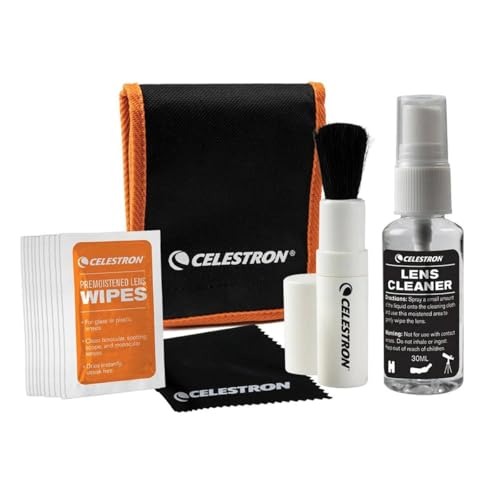
Celestron Lens Cleaning Kit for Telescopes, Binoculars & Cameras | Cleaning Solution, Cloth & Accessories Included, Complete Cleaning Kit, Safe for Optical Coatings, Removes Dust & Smudges
As an Amazon Associate we earn from qualifying purchases. Product prices and availability are accurate as of the date/time indicated.

SVBONY SV28 Spotting Scope, Angled 25-75x70 with Tripod for Target Shooting | Spotter Scope, Beginner for Bird Watching, Wildlife, Clearly at 200 Yards, with Phone Adapter, Light Waterproof Fogproof
As an Amazon Associate we earn from qualifying purchases. Product prices and availability are accurate as of the date/time indicated.
Prices shown are approximate and for reference only. Prices change often, so please check the current price on Amazon before you buy.
Kit contents vary by configuration; confirm components before purchase. Ratings are editorial, weighing doctrine completeness, blower and brush quality, fluid formulation, cloth quality, field practicality, and value.
The Six Cleaning Kits and Tools Reviewed
1. Zeiss Cleaning Kit Class: Best Overall
Zeiss’s kit leads because it assembles the doctrine’s whole sequence from an optics house’s own shelf: a fluid formulated for the coatings its maker applies, microfiber of the grade the task deserves, and the brush and cloth citizens in a case that keeps them clean between uses, which is the kit’s least visible and most important feature. Its components are replaceable as they age, its instructions teach the sequence this guide teaches, and its price is the premium of a house whose lenses are the patient’s relatives. For the birder whose scope is a flagship, it is the recommendation defended first, on the principle that the company that coated the lens should be the first consulted on what touches it.
2. Giottos Rocket Blaster: Best Blower
The Rocket Blaster earns its own row because the blower is the system’s workhorse and this is its reference form: a generous bulb whose blast actually moves grit, a one-way intake that keeps the tool from recycling the dust it just expelled, and sizes from the field bag’s to the home bench’s. It cleans nothing by contact and therefore can do no harm in untrained hands, the only tool in the table of which that is entirely true, and its price makes the two-location doctrine, one in the bag, one at home, a triviality. Every birder should own it before any fluid is bought, a priority its rating, level with the leader’s, is designed to announce: in scope cleaning, the air is the professional and the liquids are the specialists it calls.
3. Swarovski Cleaning Set: Best Premium House Kit
Swarovski’s set serves its own fleet’s owners with the house’s completeness: brush, fluid, cloths, and a case in the brand’s finish, formulated and assembled for the coatings of the scopes it will most often meet. Its price is the flagship’s accessory tariff and its value is the confidence of provenance, the same argument as the leader’s row in the other great house’s accent. For the Swarovski owner it is the natural first purchase, and for the rest of the fleet it is the standard of what a house kit should contain, graded at the summit it occupies without apology for its accent.
4. LensPen: Best Field Touch-Up
The LensPen is the field’s favorite instrument for the fingerprint at dawn: a retractable brush at one end and a dry cleaning tip at the other, whose carbon compound lifts oils and smudges without fluid, in a pen that lives in the vest pocket and deploys in seconds while the bird, unusually, waits. Its doctrine must be stated with its praise: the brush and the blast precede it, since its tip pressed onto grit becomes the stylus of this article’s warning, and its tip is a consumable whose freshness the cap’s recharge maintains and whose age the owner must respect. Used third in the sequence, as designed, it is the fastest clean in birding, and its rating reflects a tool whose misuse is common enough that this guide prints its instructions on its row.
5. Vortex Cleaning Kit: Best Scope-Maker Value
Vortex’s kit brings the doctrine to the value shelf from a scope maker’s own hand: the fluid, cloth, and pen-class tools assembled for the fleet its maker sells by the container, at a price that makes the two-kit system, field and home, painless. Its components are a step less fine than the flagship houses’, its completeness is the doctrine’s, and for the Vortex scope’s owner, and the birder whose budget is allocated by the trip rather than by the glass, it is the considered row, proof that the sequence matters more than the crest on the bottle, a sentence this guide is pleased to print in a value row’s review.
6. Celestron and Nikon Kit Class: Best Budget House Kits
The established optical houses’ budget kits close the table with the essentials honestly assembled: fluid, cloth, brush, and wipes in configurations that cover the doctrine at the floor’s price, from makers whose names are a guarantee against the category’s true floor, the unbranded boxes whose fluids are a rumor and whose cloths arrive pre-loaded with the warehouse’s grit. Their cloths should be washed before their first service, a sentence that applies, in truth, to every row and is printed here where the savings argue loudest. For the beginner’s first kit and the loaner scope’s kit, they are the proportionate purchase, and their presence completes the table’s argument: at every price in this category, the doctrine is available, and the birder’s coatings are therefore without excuse.
Buying Guide: How to Build and Use a Spotting Scope Cleaning Kit for Birding
Step One: Assemble Two Kits, Field and Home
Build the system as two citizens with different duties. The field kit, which lives in the scope’s bag or the vest, is the contactless pair and the emergency citizen: the rocket blower in its field size, the retractable brush, the LensPen for the fingerprint, and one clean microfiber in its own sealed pouch, the whole in a small case that keeps it clean, since a dirty cleaning kit is a contradiction that scratches. The home kit is the wet stage’s laboratory: the house fluid, the stock of fresh microfibers and pre-moistened optical wipes for the deep clean, the large blower, and the inspection light, the headlamp or the desk lamp against which a lens’s cleanliness is actually judged. Buy the field kit first if the budget sequences them, since the marsh is where the injuries happen, and let both kits be replenished as a calendar item, cloths washed or replaced, the pen’s tip renewed, the fluid’s bottle dated, in the off-season’s kit audit that the steps’ third act formalizes.
Step Two: The Cleaning Sequence, Performed in Order
Perform the sequence as a liturgy whose order is its meaning. Set the scope stable, caps off, the lens shaded from the direct sun that would dry a fluid mid-wipe. Blow first, the blower’s bursts across the face-down-tilted objective and the eyepiece, until the loose fraction is gone. Brush second, the retractable brush’s light flicks, if the air left witnesses. Inspect against the light, and only now judge whether the wet stage is earned: the fingerprint, the salt film, the pollen paste, each a named cause. If it is, the fluid goes to the cloth, never flooded to the glass, the cloth’s clean section makes its single-direction passes with the lightest pressure, the lens is inspected between passes, and the work stops at clean, the extra pass being the vandalism this guide has defined. The eyepiece receives the same sequence at its smaller scale. Finish with the exterior, the armor wiped, the focus wheels’ grit blown from their roots, the caps replaced only when the glass is dry, since a capped wet lens is a terrarium whose crop is fungus, the one contaminant no kit in this table can cure.
Step Three: Prevent, Store, and Audit on the Season’s Round
Let prevention carry the load the cleaning should never have to: the objective cap and the eyepiece cover on whenever the scope is not at an eye, the stay-on case or the neoprene armor for the transport between spots, the rain cover deployed at the coast and in the drizzle rather than after them, and the scope acclimatized gradually, bagged in plastic before it enters the warm house from the cold field where the condensation’s worst hour lives, a trick borrowed from the photographers that has saved more coatings than any fluid. Store the scope dry, capped, in its case with a desiccant citizen where the climate argues, and audit the whole system on the season’s turn: cloths washed or replaced, the pen renewed, the blower’s nozzle inspected, the scope’s own glass read against the light for the season’s accumulation, cleaned once at home by the full sequence if the field’s touch-ups have left their sum. Kept so, the scope’s view in its tenth season is the view it had in its first, the warbler at two hundred meters resolved to the feather, through coatings that a decade of marshes could not mark, because their owner learned, early and completely, that in optics the cleaning is not the maintenance of the instrument, it is the instrument’s survival, performed one blast of clean air at a time.
Frequently Asked Questions About Spotting Scope Cleaning Kits
Can I clean my spotting scope lens with my shirt or a tissue?
No, and the prohibition is the article in miniature: the shirt carries the day’s dust and grit in its weave, and a single dry wipe drags those particles across the coating under pressure, which is the precise mechanism of the fine scratches that accumulate into the haze owners blame on age; the paper tissue is worse, its wood fibers being an abrasive at the coating’s scale by manufacture. The emergency hierarchy, when a lens must be cleared in the field and the kit is somehow absent, is air first, your own breath’s fog and gravity doing what they can, the softest clean natural fabric as the last resort with the lightest imaginable touch, and the honest answer, which is to carry the kit, the blower and pen weighing less than the notebook every birder already carries. The coating you save is worth more than the scope’s resale premium entire, since a flagship with a marked objective is a mid-tier scope with a story, and the story is always the same shirt.
How often should I clean my spotting scope?
As rarely as the contamination allows and as promptly as it demands, the doctrine being event-driven rather than calendar-driven: blow the loose dust after the dusty day and the coastal session as a matter of course, since that contactless act carries no risk and prevents the accumulation that later forces contact; reserve the brush and the wet stage for the contamination that is actually present and actually costing view, the fingerprint, the salt film, the water spots dried into their rings. The scope that is cleaned by the full sequence weekly is being worn by its maintenance, every contact a wager, while the scope that is never cleaned loses its view to the film and eventually takes a desperate, gritty cleaning that does the damage of a year in a minute. The professional’s rhythm is therefore a light touch often and a deep touch seldom, the season’s home audit being the deep touch’s usual occasion, and the lens’s own testimony, read against the light, being the only schedule that has never lied to this guide.
What is the safest way to remove salt spray and water spots?
Salt is the two-stage contaminant and must be met in its order: blow first, since the dried crystals are grit in every way that matters and a dry cloth on salt is the engraving tool of this article’s warnings; then the damp stage, a microfiber moistened with the optical fluid or, for heavy salt, with clean water first in the makers’ common teaching, dissolving the crystals into a solution the cloth lifts rather than drags, with fresh sections of cloth for each pass so the dissolved salt leaves instead of relocating. Water spots, the mineral rings of dried droplets, yield to the same damp patience, sometimes two passes, never to pressure. The scope then dries fully before its caps return, and the coastal birder’s kit adds the prevention that makes the cure rare: the rain cover or the stay-on case at the shore, the scope wiped of its spray at the car rather than at the weekend’s end, since salt’s appetite for coatings is a matter of hours and days, and the birder who treats the coast as a cleaning climate rather than as a viewing one will keep a flagship’s face in a gale’s parish for decades.
Are pre-moistened lens wipes safe for spotting scopes?
The optics-formulated ones from the established houses, yes, as the wet stage’s convenient citizens, with the doctrine unchanged around them: they are single-use, which abolishes the microfiber’s contamination question at a stroke, their fluid is measured by their maker, and they serve the field’s deep clean and the traveler’s kit admirably. Their conditions are the sequence’s: never as the first contact on a gritty lens, since a wipe dragged over dust is a tissue with better marketing; never the household glass wipes, whose chemistry is the prohibited list’s; and never scrubbed, the wipe’s pass being the same single-direction, lightest-pressure motion as the cloth’s. Bought from the houses in this table and used third in the order, after the air and the brush, they are a legitimate professional tool, and the birder who prefers them to the cloth-and-bottle for their certainty is making a defensible choice, the doctrine caring about the order and the cleanliness, and being, in its wisdom, entirely indifferent to the packaging in which those virtues arrive.
Related guides
- Best Low Cost Rangefinder: 6 Best Low Cost Rangefinder Picks in 2026
- Best Rangefinder for Kids Fishing Trips: 6 Best Rangefinder for Kids Fishing Trips Picks in 2026
- Best Non Leica Rangefinder in 2026: 6 Non Leica Rangefinders With Red OLED, at Least 1,000 Yards Reflective, and a Price Range, for Golf and Hunting
- Best Rangefinder for Windy Hunting: 6 Best Rangefinder for Windy Hunting Picks in 2026
More from Amazon
Programs that pair well with the guide above. Offers and eligibility are set by Amazon and may change.
Free shipping on eligible items, Prime Video and more. Eligible new members can start with a free trial.
Start a Prime free trialAudiobooks and podcasts to listen to on the go. Eligible new members can start with a free trial.
Try Audible freeAd-free music streaming. Eligible new subscribers can start with a free trial.
Try Music Unlimited freeA free business account with business pricing and bulk-buying tools for work, shop or home office.
Create a business accountAs an Amazon Associate we earn from qualifying purchases.



Write Your Review
No reviews yet. Be the first to share your experience!