
What's inside
As an Amazon Associate I earn from qualifying purchases. This post may contain affiliate links at no extra cost to you.
The 20-60x spotting scope vs 15-45x spotting scope question looks like a question about power, and it is actually a question about light, width, and steadiness, because the two zoom ranges spend the same objective lens very differently. A spotting scope’s eyepiece divides the front lens’s light among the magnification you choose: at 20x, an 80-millimeter scope delivers a four-millimeter beam of light to your eye, bright and wide and easy; at 60x, the same scope delivers one and a third millimeters, a dimmer, narrower, shakier picture of a smaller piece of the world. The 15-45x scope simply refuses the extremes where that trade turns cruel. It starts lower, where the field is widest and finding the subject is easiest, and it stops at 45x, near the limit of what the atmosphere, the tripod, and a 65-millimeter class objective can serve on an ordinary day. This guide compares the two ranges head to head, with six real, currently sold scopes, three of each persuasion, and it reaches the conclusion experienced scope owners reach by ownership: the 20-60x is the right range for the long-distance specialist whose conditions and support justify its top end, and the 15-45x is the better instrument for the majority of birding, travel, and range work, whose owners will live between 20x and 40x and be grateful the scope was optimized for exactly that country.
One piece of physics governs everything below and is worth learning before the table. The atmosphere is the real magnification limit on most days: heat shimmer, haze, and moving air smear fine detail at 60x into a swimming picture that contains less information than the same view at 40x, however expensive the glass. Add the tripod’s tremor, multiplied by the power, and the wind’s opinion, and the field’s verdict is consistent across decades of use: maximum magnification is a fair-weather, early-morning, heavy-tripod capability, and the rest of the time the professional is working in the middle of the range, which is why the middle’s quality, not the top’s number, should drive the purchase.
Our Top Picks
20-60x Spotting Scope vs 15-45x Spotting Scope: The Numbers Compared
Exit Pupil and Brightness Across the Ranges
Run the arithmetic on the common pairings and the personalities emerge. A 20-60×80 gives four millimeters of exit pupil at 20x, two at 40x, and 1.3 at 60x. A 15-45×65 gives about 4.3 millimeters at 15x, a generous 2.2 at 30x, and 1.4 at its 45x ceiling. Two lessons hide in those figures. First, at their ceilings the two are equally dim, because the 45x scope’s smaller objective spends its light as fast as the larger scope’s higher power does; the 20-60x does not own the twilight either. Second, across the middle where work happens, the 15-45x is the brighter instrument at the same magnification in the overlap’s lower half, and its wider exit pupils make eye placement more forgiving, the picture easier to hold, and long sessions less tiring. Brightness in a scope is not a luxury for dawn alone; it is comfort at noon, contrast in shade, and the difference between a view you study and a view you endure.
Field of View: Finding It vs Inspecting It
The 15-45x’s lower starting power buys the widest field in this comparison, and field is the finding instrument: the warbler located in the bush, the shorebird picked out of the flock, the target found after the walk downrange, all enter the scope through its low end, and every second of hunting at 20x that a 15x would have made instant is a small tax paid all day. The 20-60x’s answer is its top end’s inspection: at 50x and 60x, in the still of a good morning on a serious tripod, it resolves what 45x cannot, the distant raptor’s facial pattern, the ring on a far gull, the bullet holes at the range’s far line, the moon’s terminator in geological detail. The question the buyer must answer is therefore autobiographical: is your scope’s life spent finding and following, or inspecting the found at the greatest distance your ground allows? The first life belongs to the 15-45x. The second, with its conditions honestly met, belongs to the 20-60x, and this guide’s table grades each scope inside its own life rather than pretending one life is everyone’s.
Size, Weight, and the Tripod Each Range Demands
The 15-45x scopes in this table are built on 60 to 65-millimeter bodies that travel: they ride in a pack’s side, set up on a lighter tripod, and serve the walker, the traveler, and the birder whose scope goes to the birds. The 20-60x class commonly pairs its range with 80 to 85-millimeter objectives, larger, heavier bodies whose extra light funds the higher powers, and the whole system, scope and the tripod worthy of 60x, becomes a vehicle-and-viewpoint instrument rather than a companion. That tripod deserves its sentence in a comparison of eyepieces, because 60x on a light tripod is a fiction: the image swims with every touch and breeze, and the owner concludes the scope is poor when the support is. Budget the 20-60x with a tripod and head a class above the 15-45x’s, in the total, before declaring the bigger scope the better value, because its sticker is only the first of its two prices.
20-60x Spotting Scope vs 15-45x Spotting Scope: Models Compared
| Spotting Scope Model | Key Specs | Range Class | Typical Price Range | Rating |
|---|---|---|---|---|
| Vanguard Endeavor HD 65A | 15-45×65, angled, ED glass in this line class, waterproof, dual focus | 15-45x | $330 – $430 | 4.6 / 5 |
| Leupold SX-4 Pro Guide HD 15-45×65 | 15-45×65, angled in this line class, HD glass system, waterproof and fogproof, rugged build | 15-45x | $550 – $700 | 4.6 / 5 |
| Celestron TrailSeeker 65 | 16-48×65, angled, fully multi-coated in this line class, waterproof, dual focus | 15-45x class | $230 – $300 | 4.4 / 5 |
| Vortex Diamondback HD 20-60×85 | 20-60×85, angled or straight, HD optical system in this line class, waterproof, large objective | 20-60x | $430 – $550 | 4.5 / 5 |
| Celestron Ultima 80 | 20-60×80, angled, fully multi-coated class optics, waterproof in this line class, value price | 20-60x | $180 – $240 | 4.2 / 5 |
| Bushnell Trophy Xtreme 20-60×65 | 20-60×65, angled in common versions, waterproof, compact for its range class | 20-60x | $200 – $280 | 4.1 / 5 |

SVBONY SV28 Spotting Scope, Angled 25-75x70 with Tripod for Target Shooting | Spotter Scope, Beginner for Bird Watching, Wildlife, Clearly at 200 Yards, with Phone Adapter, Light Waterproof Fogproof
As an Amazon Associate we earn from qualifying purchases. Product prices and availability are accurate as of the date/time indicated.

20-60x80 HD Spotting Scope with Dual Focusing Phone Adapter & Tripod | BAK4,FMC,Shockproof Waterproof Fogproof for Bird Watching Hiking Safari
As an Amazon Associate we earn from qualifying purchases. Product prices and availability are accurate as of the date/time indicated.
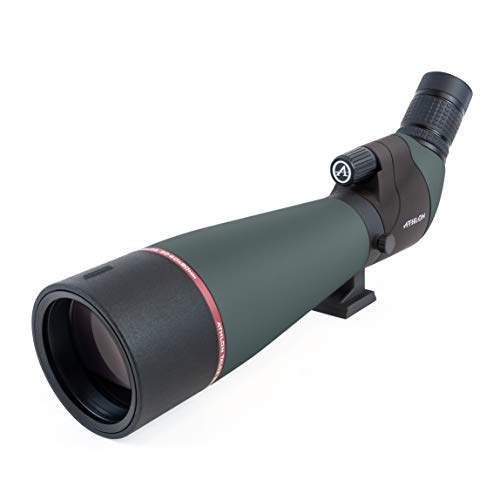
Athlon Optics Talos 20-60x80 Spotting Scope with Tripod and Carrying Case - Angled, Charcoal Grey - 315001G
As an Amazon Associate we earn from qualifying purchases. Product prices and availability are accurate as of the date/time indicated.
Prices shown are approximate and for reference only. Prices change often, so please check the current price on Amazon before you buy.
Specifications summarize manufacturers’ published information for current models. Ratings are editorial and are given within each scope’s intended use, weighing image quality across its working range, build, support demands, and value.
The Six Scopes Reviewed
1. Vanguard Endeavor HD 65A: Best 15-45x Overall
The Endeavor HD is the 15-45x philosophy at its most complete: ED glass that keeps the middle magnifications clean and contrasty, a dual focus that finds precision at the powers where precision lives, and a build that travels without anxiety. At 30x, where a birder’s day is spent, it produces the kind of view that makes owners evangelists, bright, wide, and calm, and its ceiling of 45x, reached on a good tripod, is an honest ceiling rather than a marketing one. For the walking birder and the traveling watcher, it is this comparison’s most persuasive single product, because it never asks its owner to apologize for the range it chose.
2. Leupold SX-4 Pro Guide HD 15-45×65: Best Premium 15-45x
Leupold’s SX-4 brings a hunting house’s virtues to the lower range: a rugged, weather-sealed body, an HD optical system tuned for the low light at the day’s edges where its exit pupils shine, and a lifetime guarantee behind a scope built to be used hard in real country. Its price reaches toward the bigger scopes’, and its defense is the same as theirs, that it will be the only 65-millimeter scope its owner buys. For the western hunter glassing basins at dawn and the birder whose weather is a rumor of rain, it is the 15-45x bought once.
3. Vortex Diamondback HD 20-60×85: Best 20-60x Value in Serious Glass
The Diamondback HD is the 20-60x case made responsibly: an 85-millimeter objective that genuinely funds the higher powers, HD glass that keeps 40x and 50x respectable in kind conditions, and Vortex’s unconditional warranty removing the purchase’s risk. On a tripod of its own class it will do the long work this range promises, reading the far shore and the far target, and at its low end it is a bright, pleasant 20x for the rest of the day. It is a system that asks for a vehicle, a viewpoint, and a support budget, and for the watcher whose life is those things, it is the comparison’s other champion, in the other weight class.
4. Celestron TrailSeeker 65: Best Value in the 15-45x Class
The TrailSeeker’s 16-48x range is the 15-45x philosophy with a small bonus at the top, in a waterproof, dual-focus body at a price that leaves the tripod its proper share of the budget, which this guide has argued is where the system’s quality is actually decided. Its glass is the class’s honest middle, bright and clean through the working powers, and its size travels like the Vanguard’s. For the beginner whose budget must buy scope and support together, it is the most intelligent allocation in this table, and its rating reflects a system judgment rather than a scope’s vanity.
5. Celestron Ultima 80: Best Budget 20-60x
The Ultima 80 has introduced more watchers to 60x than any scope alive, at a price that competes with the eyepiece alone in premium lines, and within its honest limits it serves: a bright 20x to 40x for targets, moon, and shoreline, and a top end that performs on the still, bright mornings its owner learns to wait for. Its glass and build are its price’s, and its included accessories are starters. As the specialist’s first long scope, bought to learn whether the long game is theirs, it remains the class’s tuition bargain, provided its owner reads this guide’s atmosphere sermon before judging it at noon in August.
6. Bushnell Trophy Xtreme 20-60×65: Best Compact 20-60x
Bushnell’s entry puts the 20-60x range on a 65-millimeter body for the watcher who wants the higher ceiling without the 85’s bulk, accepting the arithmetic this guide opened with: at 60x its exit pupil is near one millimeter and the picture is a fair-weather instrument’s. Through the middle powers it is a competent, packable scope from a maker with a long budget record. It earns its place as the compromise candidate, and its rating is the compromise’s: neither the low range’s grace nor the big glass’s authority, and a size that will suit the traveler who insists on the option of 60x and packs accordingly.
Buying Guide: How to Choose Between a 20-60x and a 15-45x Spotting Scope
Step One: Name Your Commonest Subject and Distance
Write down the three subjects you will actually watch and the distances at which you will watch them: songbirds and shorebirds inside two hundred yards, raptors and sea watches beyond it, targets at one hundred or at three hundred, the moon above everything. Subjects that move, hide, and must be found argue for the wide, bright, low range. Subjects that sit at the edge of visibility and reward inspection argue for the 20-60x, provided the next step’s conditions are met. Let the list, not the showroom’s longest wall, choose the range, because a scope’s life is spent on its owner’s subjects, and a range bought for a subject you watch twice a year is a tax on the two hundred sessions you actually have.
Step Two: Audit Your Support and Your Conditions
Be honest about the tripod you own or will buy, the vehicle or the backpack that carries the system, and the hours and weather of your watching. A light travel tripod, a walking life, dawn and dusk sessions, and windy coasts all vote for the 15-45x, whose virtues compound under exactly those conditions. A vehicle-based life, a serious tripod already owned, still mornings, and subjects at extreme distance cast the only responsible votes for 60x. Price the 20-60x as a system, scope plus the support its top end requires, before comparing it with the 15-45x’s total, because the comparison that omits the tripod is the one that produces the disappointed big-scope owner, a figure every optics forum knows by name.
Step Three: Test in the Middle, Buy for the Middle
Wherever a shop or a fellow watcher allows, compare finalists at 30x, the working power, on a detailed target at a real distance, and judge brightness, contrast, eye comfort, and focus feel there, because that is the view you are buying by the hundred hours. Check the ceiling once, for honesty, on the steadiest support available, and check the floor for the finding width your subjects demand. Then buy the scope whose middle you preferred, in the range your first two steps chose, and spend the season learning its atmosphere, the mornings when 45x or 60x sings and the afternoons when 25x is wisdom, because that literacy, more than the range itself, is what separates the scope’s owner from its purchaser, and it is available, free, with either choice honestly made.
Frequently Asked Questions About 20-60x vs 15-45x Spotting Scopes
Is 60x magnification actually usable in a spotting scope?
Yes, under conditions that occur less often than the box implies: a still, cool morning or a calm evening, a subject at long range over water or open ground without heat shimmer, a tripod and head of real substance, and glass whose quality survives the magnification. Under those conditions 60x resolves detail no 45x can reach, and specialists, sea watchers, long-range target shooters, lunar observers, organize their watching around them. Under the ordinary conditions of a breezy afternoon, warm ground, and a travel tripod, 60x commonly shows less than 40x does, because the atmosphere and the shake are magnified with the subject. The honest summary is that 60x is a capability to be used occasionally by an owner equipped for it, not a working power, and a buyer whose life is the ordinary conditions should weight the decision toward the range optimized for them.
Which is better for birding, 20-60x or 15-45x?
For most birding, the 15-45x, and the reasons are the day’s own: birds are found before they are inspected, and the lower range’s wider field finds them; most birding happens at distances where 25x to 40x does the identification, squarely in the lower range’s brightest, easiest country; birders walk, and the 65-millimeter systems travel on a shoulder for miles in a way the big 80s do not; and the day’s best birds so often arrive in poor light, dawn choruses and dusk roosts, where exit pupil is the whole argument. The exceptions name themselves: the sea watcher working distant shearwaters, the hawk watcher at extreme range, the shorebird specialist reading legs and bills across a reservoir, each a stationary, tripod-heavy discipline where the 20-60x’s ceiling earns its keep on the good mornings. Match the range to your birding’s center of gravity, and let the exceptions visit the other range as a second scope in a later year if they truly persist.
Does a bigger objective make up for higher magnification?
Partly, and the arithmetic is worth doing rather than assuming. Brightness at a given power is set by the exit pupil, objective divided by magnification, so an 85-millimeter scope at 60x delivers about 1.4 millimeters, the same as a 65 at 45x, and a dimmer picture than either scope at 30x. The big objective’s true gifts are elsewhere: at the same magnification it out-resolves and out-brightens the smaller scope, its 20x is a four-millimeter flood of light, and it funds the higher powers to the standard the smaller scope reaches at its ceiling. What it cannot do is repeal the atmosphere or the tripod’s physics, which is why the big 20-60x is a system purchase, glass and support together, and why the buyer comparing stickers alone will misjudge both scopes in this comparison.
Can I change the eyepiece later to get the other range?
On some scopes, yes, and it is a buying consideration worth one question at the point of sale. Premium and mid-range systems with interchangeable eyepieces, several makers’ flagship and enthusiast lines, allow a second eyepiece, a wide fixed-power or a different zoom, to transform the same body’s personality, and an owner whose life changes can follow it without replacing the scope. Most fixed-eyepiece scopes, including the majority of this table, are what they are for life, their zoom range chosen at purchase, which returns the decision to this guide’s buying steps with its full weight. Where the option exists and the budget allows, it is the elegant answer to this entire comparison: one fine body, the 15-45x’s grace for the walking years, a higher-power eyepiece for the viewpoint years, and no loser in the argument at all.
Related guides
- Best Tripod for Beginners Winter Hunting in 2026: 6 Best Tripod for Beginners Winter Hunting Picks for Stable Optics, Easy Setup, and Reliable Winter Use
- Best Spotting Scope for Nature Photography Spotting in 2026: How to Pick a Spotting Scope That Helps You Spot Wildlife and Take Better Nature Photos
- Best ED Glass Spotting Scope for Hunting: 6 Best ED Glass Spotting Scope for Hunting Picks in 2026
- Best Professional Thermal Monocular for Hunting in 2026: Best Professional Thermal Monocular for Hunting
More from Amazon
Programs that pair well with the guide above. Offers and eligibility are set by Amazon and may change.
Free shipping on eligible items, Prime Video and more. Eligible new members can start with a free trial.
Start a Prime free trialAudiobooks and podcasts to listen to on the go. Eligible new members can start with a free trial.
Try Audible freeAd-free music streaming. Eligible new subscribers can start with a free trial.
Try Music Unlimited freeA free business account with business pricing and bulk-buying tools for work, shop or home office.
Create a business accountAs an Amazon Associate we earn from qualifying purchases.

Write Your Review
No reviews yet. Be the first to share your experience!