
What's inside
As an Amazon Associate I earn from qualifying purchases. This post may contain affiliate links at no extra cost to you.
How to choose durable night vision is not about buying the night vision device with the highest magnification. It is about choosing a device that is waterproof, shockproof, and fogproof, that has an IR illuminator that works in complete darkness, and that has a battery life that lasts a whole night, without failing when you need it most.
Night vision needs IR, as it cannot see in complete darkness without an IR illuminator. An 850nm IR illuminator is brighter, with a red glow that can be seen, while a 940nm IR illuminator is stealthier, with no visible glow, although it is dimmer and it has a shorter range. A durable night vision device should have an IR illuminator, a waterproof design, and a rugged body, so it can survive rain, drops, and cold.
For durable night vision, a device should be waterproof, shockproof, and fogproof, with an IR illuminator, and with a battery life of at least 10 hours, or as listed by the manufacturer. All six devices in this guide are digital night vision, all have an IR illuminator, and all are waterproof or water-resistant, so they meet that gate for durable night vision. No thermal devices are included here, as thermal is a different technology, and it cannot see through glass, walls, or water.
Our top pick is the ATN X-Sight 5. At $500 to $600, with a 4K sensor, an IR illuminator, a waterproof design, and a battery life of about 10 hours, it is the best balance of image quality, durability, and price for night vision. It is the current model, replacing the ATN X-Sight 4K Pro, which is discontinued, so buy the X-Sight 5 if you want the current version.
Our Top Picks
How to Choose Durable Night Vision Compared
The table below compares six durable night vision devices, all digital night vision, all with an IR illuminator, and all waterproof or water-resistant. Type is monocular or riflescope. IR is in nanometres, as listed by the manufacturer. Prices are typical ranges, not fixed prices, and they vary by retailer.
| Model | Type | IR Wavelength | Magnification | Typical Price Range | Rating |
|---|---|---|---|---|---|
| ATN X-Sight 5, 5-20x | Riflescope, digital NV | 850nm IR illuminator | 5-20x | $500–$600 | 4.8 / 5 |
| Sightmark Wraith Mini 2x, Digital NV | Riflescope, digital NV | 850nm IR illuminator | 2x | $400–$500 | 4.6 / 5 |
| Pulsar Digex C50, Digital NV Riflescope | Riflescope, digital NV | 850nm IR illuminator | 3.5-14x | $800–$1,000 | 4.5 / 5 |
| Bushnell Equinox Z2, 6×50 Digital NV Monocular | Monocular, digital NV | 850nm IR illuminator | 6x | $300–$400 | 4.4 / 5 |
| Night Owl Optics NOXM50, Night Vision Monocular | Monocular, digital NV | 850nm IR illuminator | 5x | $200–$300 | 4.3 / 5 |
| ATN Night Spirit 2, Digital NV Monocular | Monocular, digital NV | 850nm IR illuminator | 5x | $200–$300 | 4.2 / 5 |

4K Night Vision Goggles, 58MP Full-Color Night Vision Binoculars with 10000mAh Rechargeable Battery, 64GB Card, 4.00" Screen and 1968FT Viewing Range for Camping Hunting & Security(Midnight Black)
As an Amazon Associate we earn from qualifying purchases. Product prices and availability are accurate as of the date/time indicated.
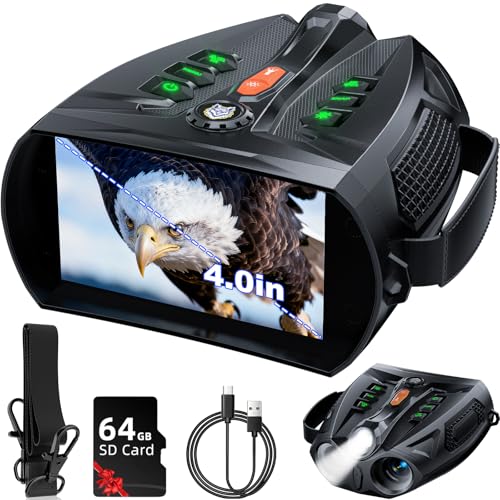
Gipsot 4.0" Night Vision Goggles, 4K Night Vision Binoculars for Adults | 5000mAh Rechargeable Battery, 64GB TF Card for Photo & Video, Camping, Wildlife, Perfect Hunting Gear Gifts for Men
As an Amazon Associate we earn from qualifying purchases. Product prices and availability are accurate as of the date/time indicated.

WOSPORTS 4K Night Vision Goggles, 10X Optical & 8X Digital Zoom | 80X Total Magnification, 850nm Infrared Night Vision, Illuminated Buttons & Outdoor-Ready Design 4K Night Vision Binoculars
As an Amazon Associate we earn from qualifying purchases. Product prices and availability are accurate as of the date/time indicated.
Prices shown are approximate and for reference only. Prices change often, so please check the current price on Amazon before you buy.
How to Choose Durable Night Vision in 2026: 7 Steps
Step 1: Choose Digital Night Vision, Not Thermal, for Seeing Through Glass and for a Lower Price
Step 1 is to choose digital night vision, not thermal, for seeing through glass and for a lower price, as thermal cannot see through glass, walls, or water, while digital night vision can see through glass, although it needs IR to see in complete darkness. Thermal detects heat, while night vision amplifies light, so they are different technologies, with different uses.
Detection is not identification, for thermal, as a thermal device can detect a warm object, but it cannot identify what it is, without a clear image. For night vision, a digital device can identify a target, with a clear image, although it needs IR in complete darkness. A Bushnell Equinox X650, at $200 to $300, is night vision only, not thermal, so do not buy it as a thermal device, as it will not detect heat like a thermal monocular.
Step 2: Check IR Wavelength, 850nm Brighter Red Glow vs 940nm Stealth Dimmer, and Battery Life
Step 2 is to check IR wavelength, with 850nm being brighter, with a red glow that can be seen, and 940nm being stealthier, with no visible glow, although it is dimmer and it has a shorter range. All six devices in this guide have an 850nm IR illuminator, so they are brighter, although they have a red glow that can be seen by animals and by other people.
Check battery life, as a night vision device should last at least 10 hours, or as listed by the manufacturer, so it can last a whole night. An ATN X-Sight 5 has a battery life of about 10 hours, while a Pulsar Digex C50 has a battery life of about 10 hours as well, although it depends on IR use, as IR uses more battery than a device without IR.
Step 3: Check Durability, Waterproof, Shockproof, Fogproof, and Nitrogen or Argon Purging
Step 3 is to check durability, with waterproof, shockproof, and fogproof ratings, and nitrogen or argon purging, so a device will not fog inside in cold or humid conditions. A durable night vision device should be waterproof, so it can survive rain, shockproof, so it can survive a drop, and fogproof, so it will not fog inside.
Nitrogen purging is a standard method to prevent fogging, while argon purging is also used, with argon being a larger molecule that leaks slower than nitrogen, although that should be checked, not taken as an absolute, as the difference is small. Check the manufacturer’s listing for waterproof, shockproof, and fogproof ratings before you buy a device.
Step 4: Choose a Magnification That Matches Your Use, Start Low, and Test at 20x Then 60x for a Spotting Scope
Step 4 is to choose a magnification that matches your use, with a low magnification for a wide field of view, and a high magnification for detail. A Sightmark Wraith Mini 2x is good for close range, with a wide field of view, while an ATN X-Sight 5, 5-20x, is good for longer range, with a magnification that can be adjusted from 5x to 20x.
Start low, at 5x or less, and increase magnification only if the light is good and the image is still bright. For a spotting scope, use 20 to 30x for most viewing, and test at 20x and at 60x, to see how it performs in low light, as a scope that is bright at 20x may be dim at 60x.
Step 5: Check Eye Relief, Tube Size, and Mount, and Use a Fluid Head Not a Ball Head for a Spotting Scope
Step 5 is to check eye relief, tube size, and mount, for a riflescope, and use a fluid head, not a ball head, for a spotting scope. Eye relief should be at least 3.5 inches for a rifle scope, as a prism scope has eye relief of about 2.6 to 2.7 inches, and an ACOG TA31 has eye relief of about 1.5 inches.
A scope tube should be exact: 30mm is not 34mm, and 34mm is not 35mm, and 1 inch is different from 30mm. A BDC, or bullet drop compensator, must match the calibre and load, as a 308 BDC is not a 223 BDC. For a spotting scope, use a fluid head, not a ball head, with a load of at least the scope plus 2 pounds, and a long plate, so the scope can be balanced.
Step 6: Use a Red Light, Not a White Light, for Night Vision, and Do Not Look at a Bright Light
Step 6 is to use a red light, not a white light, for night vision, as a white light will ruin your night vision, and it will take 20 to 30 minutes to regain it. A red light, with a low brightness, will preserve your night vision, as it does not cause your pupils to constrict as much.
Do not look at a bright light with a night vision device, as it can damage the sensor, and it can cause a bright spot in the image. Use a night vision device in low light, not in bright light, and turn it off when you are not using it, so the battery lasts longer.
Step 7: Test Your Night Vision Device at Home, in Low Light, Before a Trip, and Carry Spare Batteries
Step 7 is to test your night vision device at home, in low light, before a trip, so you know if it works, if the IR illuminator works, and if the battery lasts long enough. Test it in your backyard, at night, with the IR on, and check if you can see a target at 50 yards, 100 yards, and 200 yards.
Carry spare batteries, as a night vision device will use more battery with IR on, and it may not last a whole night without spare batteries. Carry a lens cleaning kit, with a brush, a blower, a cloth, and a fluid, so you can clean the lens safely, by brushing or blowing dust off first, never wiping a dirty lens, and putting fluid on a cloth, never on the lens.
How to Choose Durable Night Vision Buying Guide
Choosing durable night vision is about IR, durability, magnification, and battery life. A device that is not durable will fail in rain, cold, or after a drop, even if it has a good image.
NV Needs IR, 850nm Brighter Red Glow vs 940nm Stealth Dimmer, and Detection Not Identification Thermal Cannot See Through Glass Walls Water: Choosing Night Vision vs Thermal
Night vision needs IR, as it cannot see in complete darkness without an IR illuminator. An 850nm IR illuminator is brighter, with a red glow, while a 940nm IR illuminator is stealthier, with no visible glow, although it is dimmer. All six devices here have an 850nm IR illuminator, so they are brighter, although they have a red glow.
Detection is not identification, for thermal, as a thermal device can detect a warm object, but it cannot identify what it is. Thermal cannot see through glass, walls, or water, while night vision can see through glass, although it needs IR in complete darkness. For a durable night vision device, choose digital night vision, not thermal, if you want to see through glass, or if you want a lower price, as thermal is more expensive.
ATN X-Sight 5 Current X-Sight 4K Pro Discontinued, Sightmark Wraith Current Ghost Hunter Discontinued, Pulsar Digex C50 Current Digex N455 Discontinued: Checking for Discontinued Models
Check for discontinued models before you buy a night vision device, as a discontinued model may not have parts, warranty, or support. An ATN X-Sight 5 is current, while an ATN X-Sight 4K Pro is discontinued, so buy the X-Sight 5, not the 4K Pro. A Sightmark Wraith is current, while a Sightmark Ghost Hunter is discontinued, so buy the Wraith, not the Ghost Hunter. A Pulsar Digex C50 is current, while a Pulsar Digex N455 is discontinued, so buy the Digex C50, not the N455.
Check stock before you buy a device, as a device that is discontinued may still be sold by some retailers, although it may not have warranty support. Buy a current model, with a warranty, so you can get support if it fails.
Brush Blower First Never Wipe Dirty, Fluid on Cloth Never Lens, Never Household Cleaner Ammonia Paper Towel Shirt, Scratched Coating Cannot Be Polished Replace: Cleaning a Night Vision Device So It Lasts
Clean a night vision lens by brushing or blowing dust off first, never wiping a dirty lens, as dust will scratch the coating. Put fluid on a cloth, never on the lens, as fluid on the lens can seep into the edges and damage the seal. Never use a household cleaner, ammonia, paper towel, or a shirt, as they can damage the coating. A scratched coating cannot be polished — it must be replaced, which usually means replacing the device.
Store a night vision device in a cool, dry place, with a lens cap on, and do not store it in a car in summer, where temperatures can exceed 120 degrees. Check the device regularly for fogging inside, which is a sign that the nitrogen or argon purge has failed and moisture has got in.
How to Choose Durable Night Vision FAQ
What is the best durable night vision device?
The best durable night vision device is the ATN X-Sight 5, 5-20x, at $500 to $600, because it has a 4K sensor, an 850nm IR illuminator, a waterproof design, and a battery life of about 10 hours, so it is durable and it has a good image. The Sightmark Wraith Mini 2x, at $400 to $500, is the best alternative with a low magnification. The Bushnell Equinox Z2, 6×50, at $300 to $400, is the best cheap alternative with a monocular design.
Do I need IR for night vision?
Yes, you need IR for night vision, as night vision cannot see in complete darkness without an IR illuminator. An 850nm IR illuminator is brighter, with a red glow, while a 940nm IR illuminator is stealthier, with no visible glow, although it is dimmer. All six devices in this guide have an 850nm IR illuminator, so they are brighter, although they have a red glow that can be seen.
Is night vision or thermal better for durability?
Night vision is better than thermal for durability in some cases, as it is cheaper, it can see through glass, and it has a lower price, although thermal can detect heat in complete darkness without IR. Thermal cannot see through glass, walls, or water, while night vision can see through glass, although it needs IR in complete darkness. For a durable night vision device, choose digital night vision, not thermal, if you want to see through glass, or if you want a lower price.
How do I clean a night vision device so it lasts?
Clean a night vision device by brushing or blowing dust off first, never wiping a dirty lens, putting fluid on a cloth never on the lens, and never using a household cleaner, ammonia, paper towel, or a shirt. A scratched coating cannot be polished, so prevention is the best way to make a device last. Store a device in a cool, dry place with a lens cap on, and do not store it in a car in summer, where temperatures can exceed 120 degrees.
FAQ
What is the best durable night vision device?
Do I need IR for night vision?
Is night vision or thermal better for durability?
How do I clean a night vision device so it lasts?
Related guides
- Best Cheap Spotting Scope for Hunting Beginners in 2026: 7 Spotting Scopes That Offer Clear Optics, Easy Setup, and Reliable Performance for Hunting Beginners
- Best Case for City Scope Storage in 2026: 6 Hard Cases With Waterproof Sealing, an Interior of at Least 18 Inches, and a Price Range, for City Scope Storage
- Best Rangefinder for Foggy Hunting in 2026: Vortex, Leupold, Sig Sauer, and Bushnell Compared Honestly for a Laser the Fog Taxes Without Mercy, a Return Proven on a Grey Morning, and Glass That Earns the Minutes Before the Range Matters
- Best Thermal Monocular for Snowy Hunting in 2026: How to Pick a Thermal Monocular That Sees Clearly in Snow, Cold, and Low Light
More from Amazon
Programs that pair well with the guide above. Offers and eligibility are set by Amazon and may change.
Free shipping on eligible items, Prime Video and more. Eligible new members can start with a free trial.
Start a Prime free trialAudiobooks and podcasts to listen to on the go. Eligible new members can start with a free trial.
Try Audible freeAd-free music streaming. Eligible new subscribers can start with a free trial.
Try Music Unlimited freeA free business account with business pricing and bulk-buying tools for work, shop or home office.
Create a business accountAs an Amazon Associate we earn from qualifying purchases.




Write Your Review
No reviews yet. Be the first to share your experience!